5 Layers of the Atmosphere
By Krishna Arya | NetworkBharat.com
5 Layers of the Atmosphere : Earth’s atmosphere is like a giant protective blanket wrapped around our planet. It keeps us warm, shields us from harmful rays, burns incoming meteors before they hit the surface, and makes life possible. But this blanket is not just one uniform layer — it is divided into five major layers, each with its own features, temperature pattern, and role.
In this simple and student-friendly guide, we break down all five layers of the atmosphere, their height ranges, and why each one matters. Whether you are preparing for a competitive exam, creating notes for school, or simply curious, this article gives you everything in a clear and visual way.
5 Layers of the Atmosphere
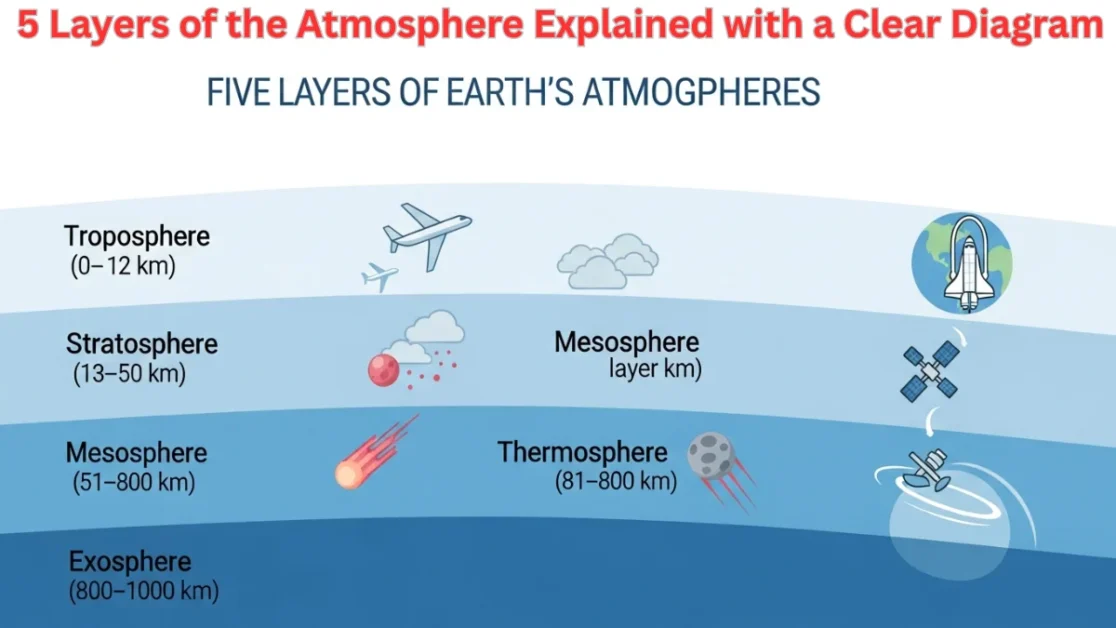
✅ 1. Troposphere (0 to 12 km)
The troposphere is the lowest and most important layer because all weather happens here — clouds, rain, storms, wind, everything. This is also where we live, breathe, and fly in airplanes.
Key features:
- Starts at Earth’s surface and goes up to 12 km
- Contains 75 percent of total atmospheric mass
- Temperature decreases with altitude
- Weather phenomena occur here
- Commercial aircraft fly in this layer
Why it matters:
It controls climate, weather cycles, and supports all forms of life.
✅ 2. Stratosphere (13 to 50 km)
Just above the troposphere sits the calm and stable stratosphere, most famously home to the ozone layer that protects us from harmful ultraviolet (UV) radiation.
Key features:
- Temperature increases with altitude
- Contains the ozone layer
- Very low turbulence
- Ideal for long-distance aircraft flights
Why it matters:
Without the ozone shield, life on Earth would not be possible.
✅ 3. Mesosphere (51 to 80 km)
The mesosphere is the coldest layer of the atmosphere and is known for one dramatic event: meteors burn up here, creating the bright streaks we call “shooting stars.”
Key features:
- Extremely low temperatures
- Meteors burn due to friction
- Protects Earth from space debris
- Thin air and low pressure
Why it matters:
It acts as a natural firewall against incoming space rocks.
✅ 4. Thermosphere (81 to 800 km)
In the thermosphere, temperatures rise sharply. This is where auroras, space shuttles, and many satellites are found.
Key features:
- Very high temperatures (up to 2000°C or more)
- Home to aurora borealis and australis
- The International Space Station (ISS) orbits here
- Extremely thin air
Why it matters:
It supports satellite communication, GPS systems, and space missions.
✅ 5. Exosphere (800 to 1000 km and beyond)
The exosphere is the outermost layer where the atmosphere slowly merges with space. Gas molecules are extremely sparse here and can drift away into space.
Key features:
- Almost vacuum-like
- Very low gravity and pressure
- Satellites orbit in this region
- Starts around 800 km and extends thousands of kilometers
Why it matters:
It forms the gateway between Earth’s atmosphere and outer space.
5 Layers of the Atmosphere
✅ Why Understanding These Layers Matters
From weather prediction to satellite communication, from climate research to space exploration — every scientific field relies on understanding the structure of the atmosphere. These five layers work together like a finely tuned system to make Earth safe and habitable.
5 Layers of the Atmosphere
✅ Final Thoughts
Earth’s atmosphere is more than just air. It is a multi-layered, dynamic shield that protects life, supports weather, enables communication, and connects us to space. Learning these layers builds a strong base for students, competitive exam aspirants, and anyone curious about how our planet works.
For more educational explainers, news, and updates, keep reading NetworkBharat.com.
5 Layers of the Atmosphere
AtmosphereLayers #EarthScience #GeographyNotes #ScienceFacts #StudyMaterial #ExamPrep #EnvironmentEducation #SchoolLearning
5 Layers of the Atmosphere
✅ FAQ Section
Frequently Asked Questions (FAQ)
1. What are the five layers of the atmosphere?
The Earth’s atmosphere is divided into five layers: Troposphere, Stratosphere, Mesosphere, Thermosphere, and Exosphere. Each layer has unique features and temperature patterns.
2. Which layer contains the ozone layer?
The ozone layer is found in the Stratosphere. It protects us from harmful UV rays coming from the Sun.
3. In which layer do airplanes fly?
Most commercial airplanes fly in the lower Stratosphere because it has stable air and very little turbulence.
4. Why do meteors burn up in the mesosphere?
Meteors burn in the mesosphere due to friction with air molecules, even though the air is very thin.
5. Which atmospheric layer is the hottest?
The thermosphere is the hottest layer, where temperatures can reach more than 2000°C due to solar radiation.
6. Where do satellites orbit the Earth?
Most satellites orbit in the thermosphere and exosphere, depending on their purpose and altitude.
7. Which layer is responsible for weather changes?
All weather phenomena like clouds, rain, storms, and winds occur in the troposphere.