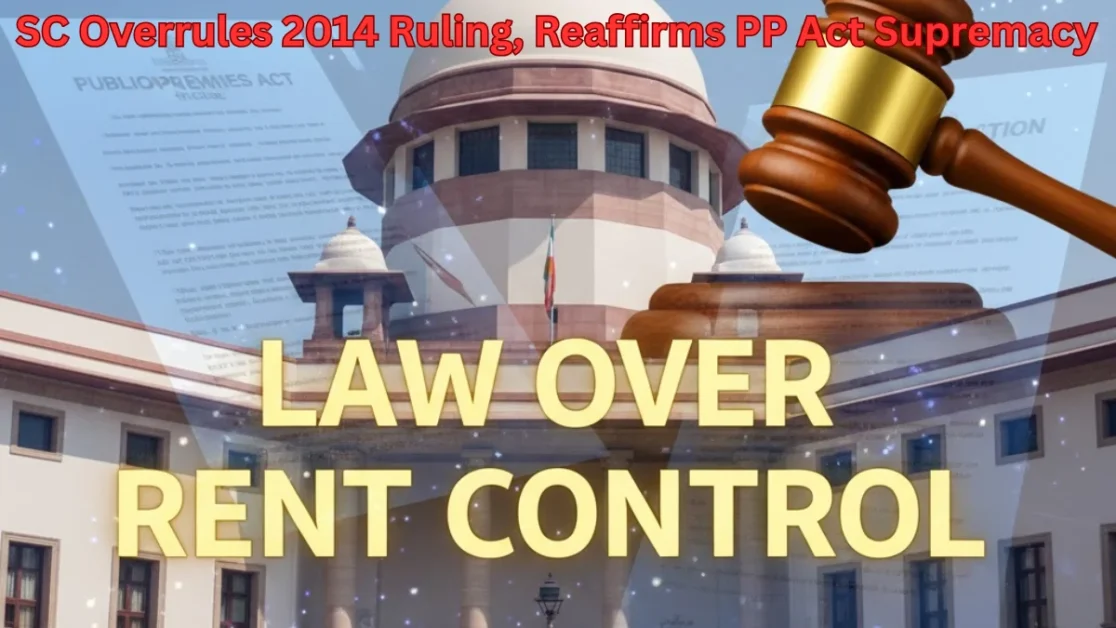
SC Overrules 2014 Ruling
By Krishna Arya | NetworkBharat.com
Supreme Court Clarifies : Supreme Court Clarifies: Public Premises Act Overrides Rent Control Laws in All Eviction Disputes. In a landmark judgment delivered on December 11, the Supreme Court of India reshaped the legal landscape governing tenancy and eviction on public properties. The ruling settles a long-standing confusion: when a property qualifies as “public premises,” and its tenancy has been legally terminated, the occupant cannot claim protection under any state Rent Control Act.
Instead, all eviction actions must proceed exclusively under the Public Premises (Eviction of Unauthorized Occupants) Act, 1971 (PP Act)—a law designed for swift and decisive action.
This authoritative clarification came from a three-judge bench comprising Justice Vikram Nath, Justice Sandeep Mehta, and Justice N.V. Anjaria, who unequivocally dismissed the 2014 precedent set in Suhas H. Pofle v. Oriental Insurance Co. as erroneous and legally unsustainable.
Public Premises Eviction Act Supreme Court Ruling 2025
⭐ Why This Judgment Matters
The ruling is not just a procedural correction—it directly affects thousands of tenancies across India involving government bodies, PSUs, LIC, banks, and statutory authorities. With this clarification, no tenant occupying public premises can claim Rent Control Act protection once their tenancy ends.
This restores the original intent of the Public Premises Act, which was enacted to prevent prolonged litigation and ensure quick recovery of public property.
🧑⚖️ Supreme Court: “We Cannot Micromanage”
During the proceedings, the Chief Justice of India firmly stated, “We cannot micromanage,” signalling that the judiciary will not dilute legislative intent or intervene to soften statutory mandates.
The Court noted that the Bombay High Court, in the case at hand, misinterpreted the law by relying on the now-overruled Suhas Pofle decision, leading to an untenable judgment.
🏠 The Case: LIC vs. Vita Private Limited
The dispute centered around a Mumbai flat leased by the Life Insurance Corporation of India (LIC) since 1957 to Vita Private Limited. After LIC terminated the tenancy, it initiated eviction proceedings under the PP Act.
Vita claimed protection under the Maharashtra Rent Control Act, arguing that long-term tenancy gave them special rights.
The Bombay High Court sided with the tenant, but LIC challenged the ruling, eventually bringing the matter before the Supreme Court.
Supreme Court Rules PP Act Overrides Rent Control Laws: Major Boost for Public Premises Evictions
🔨 What the Supreme Court Decided
The Supreme Court overturned both the Bombay High Court and the Kerala High Court decisions, reaffirming that:
1️⃣ The PP Act Is a Special and Overriding Law
If a property is classified as public premises, the PP Act prevails over all Rent Control Acts, whether state or central.
2️⃣ Unauthorized Occupants Cannot Claim Rent Control Protection
Once tenancy is terminated, any continued stay is unauthorized—no rent control statute can shield such tenants.
3️⃣ Date of Renting Does NOT Matter
Whether the tenant entered the premises in 1957 or 2024, the PP Act applies equally.
4️⃣ Suhas Pofle Judgment (2014) Overruled
The earlier ruling conflicted with the Constitution Bench’s decision in Ashok Marketing Ltd. v. Punjab National Bank (1990) and is now officially discarded.
5️⃣ Stare Decisis Must Be Respected
Courts must follow binding precedents—the Bombay High Court failed to do so, resulting in legal inconsistency.
📌 Why the 1990 Ashok Marketing Case Still Governs Today
The Supreme Court emphasized that the Constitution Bench of 1990 already clarified that eviction from public premises can only be handled under the PP Act.
This means:
- Government authorities must use the PP Act for eviction
- Tenants cannot forum-shop for protection
- Litigation timelines are significantly reduced
The current ruling reinforces the same principles and removes ambiguity created by intermediate judgments.
🏛️ What This Means for Tenants and Public Institutions
For Government Bodies / PSUs
- Faster eviction processes
- Reduced legal uncertainty
- Protection of public assets
For Tenants on Public Premises
- No long-term legal shelter under Rent Control Acts after tenancy termination
- Need for strict compliance with lease terms
- Immediate vulnerability to eviction once notice is issued
For Courts and Lawyers
- Clear legal roadmap
- No conflicting interpretations
- Restoration of doctrinal consistency
⚖️ A Strong Step Toward Legal Clarity
This ruling signals a significant shift toward strengthening public property governance. By reinforcing the supremacy of the PP Act, the Supreme Court has ensured that public assets are not tied up in decades of rent-control litigation.
For tenants of public bodies, this is a wake-up call.
For public institutions, this is a major relief.
The law is now unambiguous:
When tenancy ends, protection ends. Eviction under the PP Act begins.
#SupremeCourt #PPAAct1971 #PublicPremises #RentControlAct #LegalNewsIndia #SCJudgment #PropertyLaw #EvictionRules #StareDecisis #AshokMarketingCase #SuhasPofleOverruled #LICCase #MumbaiPropertyDispute