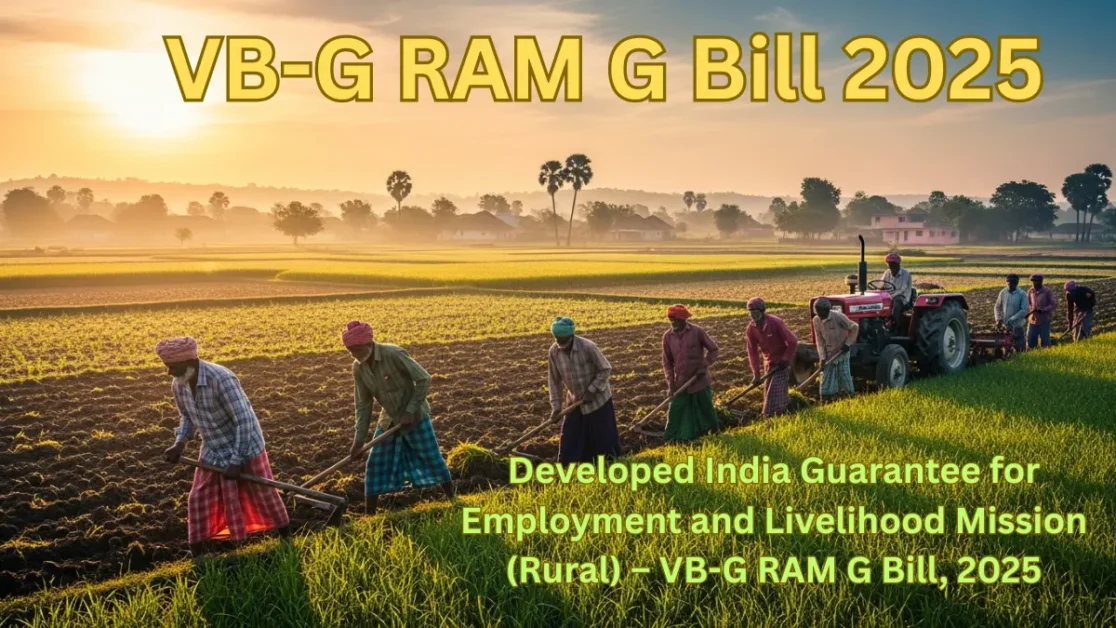
VB-G RAM G Bill 2025
Author: Krishna Arya |website https://networkbharat.com,
VB-G RAM G Bill 2025 : India has entered a new chapter in rural employment policy. Parliament has passed the Developed India Guarantee for Employment and Livelihood Mission (Rural) – VB-G RAM G Bill, 2025, officially replacing the Mahatma Gandhi National Rural Employment Guarantee Act, 2005 (MNREGA).
The bill triggered strong political debate in both Houses, yet the government claims it will create a more reliable, modern, and accountable employment framework for rural workers. With enhanced job days, weekly payments, and better planning systems, the scheme aims to push rural productivity and reduce migration.
So what really changes for rural India? Let’s break it down in simple language 👇
Developed India Guarantee for Employment and Livelihood Mission
🌱 What is VB-G RAM G Mission 2025?
The VB-G RAM G Mission is a rural livelihood guarantee scheme designed to provide employment security, transparency in payments, and stronger financial accountability between the Centre and states.
The government says the bill modernises MNREGA and aligns it with India’s goal of becoming a developed economy by 2047.
📌 Key Change #1 — More Days of Employment (100 → 125 Days)
MNREGA ensured 100 days of work.
The new bill guarantees 125 days, giving rural households:
- More income opportunities
- Increased labour stability
- Reduced seasonal unemployment
This can significantly help families dependent on agriculture, especially in drought-prone villages.
💰 Key Change #2 — Weekly Payments & Compensation Rules
One of the biggest frustrations under MNREGA was delayed payment.
VB-G RAM G fixes this by:
- Releasing weekly wage payments
- Imposing compensation after 15 days delay
- Setting delay charges at 0.05% per day after 16th day
This brings transparency, dignity, and financial security for workers who rely on these wages for daily survival.
🌾 Key Change #3 — 60-Day Non-Working Period
To protect agriculture seasons, the state can declare a 60-day break period when:
- Sowing is high
- Harvesting needs manpower
- Labour demand rises on farms
States can customise periods zone-wise, making the system more practical than MNREGA.
🏛️ Key Change #4 — New Funding Structure
MNREGA was fully funded by the Centre.
VB-G RAM G introduces shared responsibility:
- 60:40 between Centre and States
- 90:10 for hilly + northeast states
- 100% central funding for UTs without legislature
This pushes states to use funds responsibly and avoid inflated expenditure.
🗂️ Key Change #5 — National & State Steering Committees
Unlike the MNREGA-driven Panchayat-first system, the mission will now be guided by:
- National Steering Committee
- State Steering Committee
- Panchayats will implement — not decide — projects
This reduces political influence at district level and creates standard planning strategies.
📌 Why Was the Bill Opposed?
Opposition leaders argue that:
- MNREGA had a proven employment model
- Rural poor must have job demand rights
- Centralised allocation may ignore local needs
Protests were raised inside Parliament, but the bill passed both houses. Even the Supreme Court refused to hear the petition challenging it.
🌍 What Does This Mean for Rural India?
If implemented effectively, India may witness:
- Higher rural incomes
- Improved infrastructure
- Lower migration to cities
- More productive labour cycles
- Stronger state accountability
However, success depends on transparency, active monitoring, and political harmony between states and the Centre.
✔️ Final Verdict
VB-G RAM G is one of India’s biggest rural reform missions since 2005.
The bill promises to:
- Provide more working days
- Improve payment speed
- Strengthen state participation
- Modernise rural job planning
But its long-term impact will be visible only after implementation on the ground. For the rural poor, the mission could either become a new lifeline — or another bureaucratic challenge.
For now, India awaits results.
Also Read This :
Parliament Winter Session 2025 Begins Amid Controversy Over SIR, Major Bills on the Table
❓ FAQs
Q1. What is the VB-G RAM G Bill 2025?
The bill replaces MNREGA with a new rural employment mission offering 125 days of guaranteed work, weekly payments, and shared funding between Centre and states.
Q2. How is VB-G RAM G different from MNREGA?
MNREGA offered 100 days of work with 15-day payment cycles. VB-G RAM G raises job duration to 125 days and introduces weekly payment plus delay compensation.
Q3. Will the Centre still fund rural jobs fully?
No. Funding is now shared 60:40 between Centre and states, 90:10 for hilly/Northeast states.
Q4. Why was the bill controversial?
Opposition parties argue the act centralises power and weakens MNREGA’s grassroots job demand system.
Q5. Who will plan VB-G RAM G projects?
Projects will be guided by national and state steering committees, while Panchayats will implement them.
Also Read This :
UP Lekhpal Recruitment 2025–26CUET PG 2026 Registration BeginsBangladesh Extremism Rise: India AlertAvatar: Fire and Ash Indian ReleaseLionel Messi India Spiritual Visit#VBGRAMG #MNREGA #RuralEmployment #IndiaGovt #JobGuarantee #EmploymentScheme #RuralDevelopment #LokSabha #RajyaSabha #125DaysJob #WagePayment #IndiaNews #GovernmentBill #BreakingNews #PoliticsIndia #2025Updates #LivelihoodMission #AgricultureIndia #StateFunding #CentralScheme