India US Trade Deal Benefit Indian Farmers: What the Agreement Means for Agriculture
- India and the United States have reached an interim trade framework with a strong focus on exports
- Select Indian agricultural products will get zero or reduced tariff access to the US market
- Sensitive sectors like dairy, wheat, and rice remain fully protected
- The deal aims to increase farmers’ income without exposing them to subsidized foreign imports
India–US Trade Deal Explained
India and the United States have taken a significant step toward strengthening their economic partnership by finalizing an interim bilateral trade deal framework. The agreement is part of broader negotiations aimed at reducing trade barriers, improving market access, and boosting exports between the two countries.
Unlike traditional free trade agreements, this deal follows a sector-specific and calibrated approach, especially when it comes to agriculture. The Indian government has repeatedly emphasized that the interests of domestic farmers remain non-negotiable, and the structure of the agreement reflects that position.
The focus is clear: export promotion without domestic market disruption.
Why Indian Farmers Are at the Center of the Deal
Agriculture remains the backbone of India’s economy, supporting more than half of the population either directly or indirectly. Any international trade agreement involving farm products naturally draws close scrutiny from farmers, policymakers, and economists.
In this deal, agriculture is not treated as a bargaining chip but as a strategic strength. The government has positioned Indian farmers as beneficiaries rather than victims of globalization by:
- Opening export avenues instead of import channels
- Retaining policy control over sensitive crops
- Avoiding commitments that could undermine MSP or food security
This approach marks a shift from defensive trade posturing to selective global integration.
Agricultural Products Likely to Benefit
Zero or Reduced Tariff Export Items
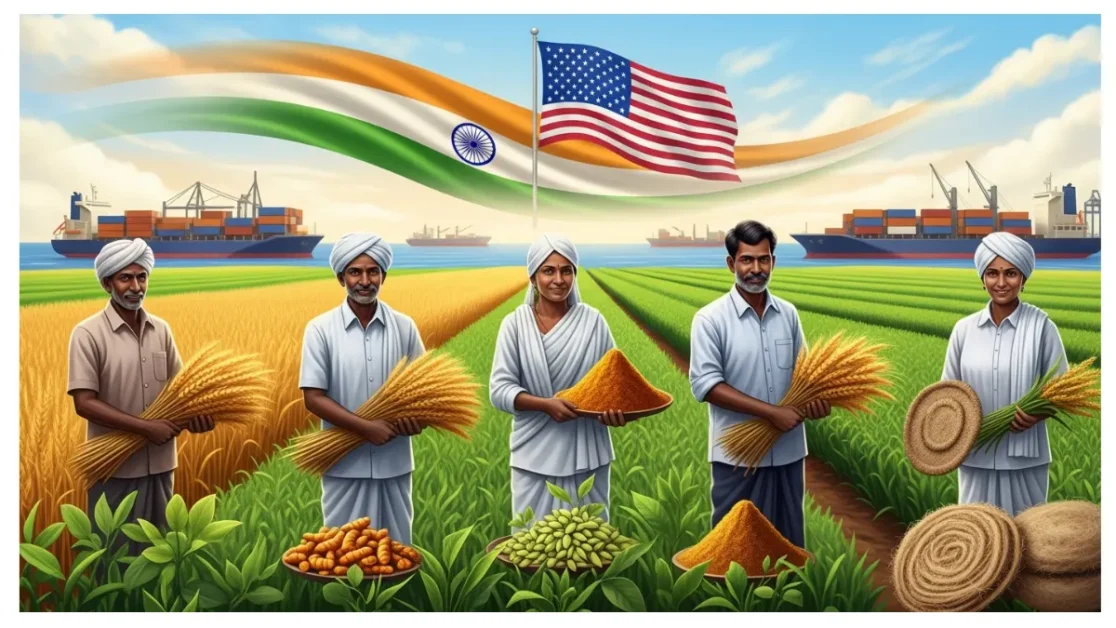
Under the trade framework, several Indian agricultural and plantation products are expected to receive zero or significantly reduced tariff access to the US market. These include:
- Spices such as turmeric, cumin, coriander, and pepper
- Tea and coffee
- Fruits and vegetables
- Coconut and coconut-based products
- Nuts and plantation crops
These are sectors where India already enjoys a comparative advantage in quality, diversity, and production scale.
How This Helps Farmers
Lower tariffs mean Indian produce becomes more competitive in the US market. This can translate into:
- Better price realization for farmers
- Increased demand for export-grade produce
- Encouragement for crop diversification
- Stronger linkage between farmers and global buyers
Over time, this can push Indian agriculture toward value-added and market-oriented farming rather than distress-driven cultivation.
What Is Protected Under the Trade Deal
Crops and Sectors Kept Outside Concessions
One of the most important aspects of the deal is what it does not include. India has clearly excluded sensitive agricultural sectors from tariff concessions, such as:
- Wheat
- Rice
- Dairy products
- Milk and animal-based farming
These sectors are politically sensitive and economically critical, involving millions of small and marginal farmers.
Why Protection Matters
The US agriculture sector benefits from heavy subsidies, advanced mechanization, and large-scale farming. Opening India’s domestic market to such imports could severely disrupt local agriculture.
By keeping these sectors protected, the government has ensured:
- No flooding of subsidized foreign produce
- Stability in domestic prices
- Continued relevance of MSP mechanisms
- Protection of smallholder farmers
This balance is central to the credibility of the trade deal.
Impact on Farm Incomes and Rural Economy
If implemented effectively, the India–US trade deal could have a multiplier effect on rural India.
Key Economic Benefits
- Higher export demand can raise farmgate prices
- Growth of agri-processing units near production clusters
- Expansion of cold chains, logistics, and storage
- Job creation in packaging, transport, and quality control
Export-oriented agriculture also encourages better farming practices, certification, and quality upgrades—benefiting farmers in the long run.
Government’s Stand on Farmers’ Interests
The government has consistently maintained that the trade deal will not hurt farmers or MSMEs. Officials have clarified that:
- No concession has been given on sensitive farm products
- The deal is export-focused, not import-driven
- Domestic agricultural policies remain untouched
This reassurance is aimed at preventing the kind of backlash seen during earlier reform attempts in the farm sector.
Concerns Raised by Farmer Groups
Despite official assurances, some farmer organizations and analysts have raised concerns.
Key Worries
- Future expansion of concessions under pressure
- Gradual opening of markets through incremental changes
- Compliance burden for small farmers in export standards
These concerns highlight the need for transparent implementation and continuous consultation with stakeholders.
How This Deal Fits Into India’s Long-Term Agriculture Strategy
The India–US trade framework aligns with India’s broader vision of transforming agriculture into a globally competitive sector.
Strategic Alignment
- Promotes high-value and export-oriented crops
- Encourages Farmer Producer Organizations
- Integrates Indian farmers into global supply chains
- Reduces over-dependence on cereal crops
This shift is essential for sustainable farm incomes in the coming decades.
What Indian Farmers Should Watch Going Forward
While the framework is promising, outcomes will depend on execution.
Farmers and agri-entrepreneurs should track:
- Product-specific notifications
- Export quality and certification requirements
- Support schemes for compliance and logistics
- Role of cooperatives and FPOs in export aggregation
Awareness and preparedness will determine who benefits most.
Conclusion
The India–US trade deal represents a measured and farmer-centric approach to global trade. By opening export opportunities while safeguarding domestic agriculture, the agreement avoids the pitfalls of blanket liberalization.
For Indian farmers, the deal offers opportunity without exposure—provided implementation remains faithful to its stated objectives. The real test lies not in the announcement, but in execution on the ground.
Also Read
- World Trade Organization Rules on Agricultural Trade: READ MORE
- Global Agricultural Trade and Farmer Income Insights by World Bank: READ MORE
- FAO Analysis on Agricultural Exports and Food Security: READ MORE
- India’s Official Trade Policy Framework and Agreements: READ MORE
- US Agricultural Trade Policies and Market Access: READ MORE
Related Articles
- Pakistan to Skip India Match in T20 World Cup 2026: Why Bangladesh and ICC Are Alarmed READ MORE
- February 2026 Bank Holidays in India: RBI State-Wise List & Full Calendar READ MORE
- Border 2 Box Office: Sunny Deol Film Crosses Rs400 Crore Worldwide, Eyes Rs500 Cr Next READ MORE
- India-China Trade Surges to Record $155.6 Billion in 2025, Marking Strategic Reset After Modi-Xi Talks READ MORE
- Mahashivratri 2026: Exact Date, Puja Timings & Significance — Is It 15 or 16 February? READ MORE