By Krishna Arya
Website: https://networkbharat.com
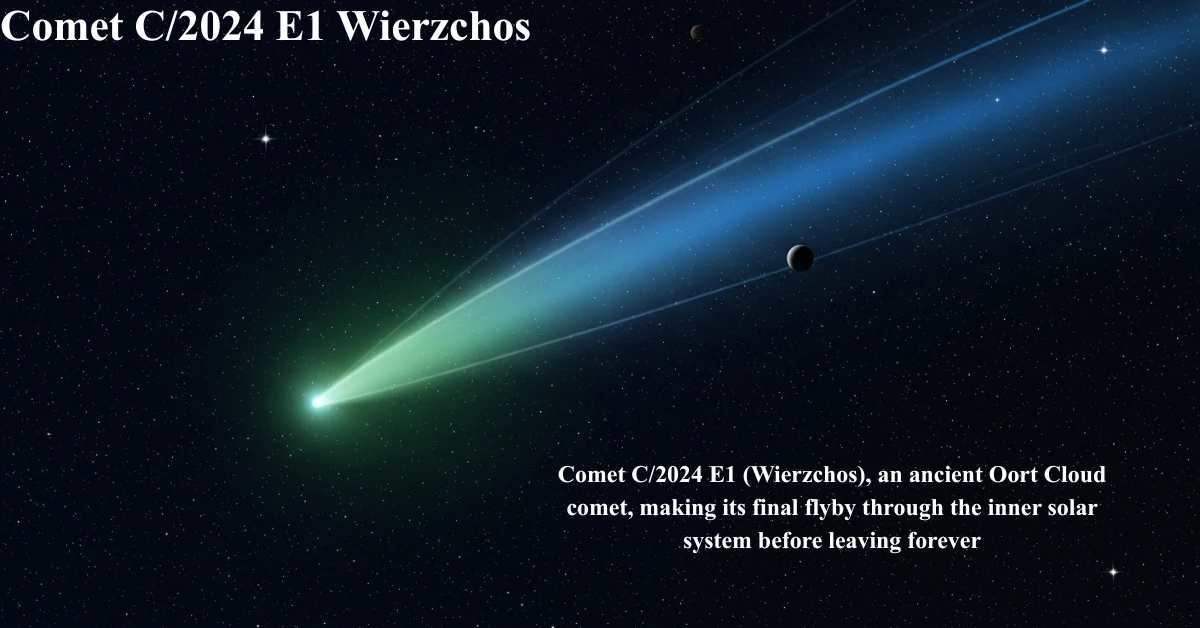
Comet C/2024 E1 Wierzchos: The universe has sent humanity a fleeting guest—one that may never return. Comet C/2024 E1 (Wierzchos), an ancient traveler from the outermost edges of our solar system, is currently making its final appearance before disappearing into deep space forever. For astronomers and skywatchers alike, this is not just another comet—it’s a rare cosmic farewell written across the night sky.
Discovered in March 2024, this comet has spent millions of years drifting in darkness before briefly meeting the warmth of our Sun. Now, after completing its closest pass, it is on a one-way journey out of the solar system, making this a once-in-a-lifetime event for observers on Earth.
After millions of years in darkness, Comet C/2024 E1 (Wierzchos) briefly lit up Earth’s skies—and will never return.
A Discovery from the Depths of Space
Comet C/2024 E1 was discovered by Polish astronomer Kacper Wierzchos during a routine sky survey. At the time of discovery, it appeared as a faint point of light in the constellation Draco—barely detectable, yet scientifically priceless.
Further observations quickly revealed something extraordinary: the comet follows a hyperbolic orbit, meaning it is not gravitationally bound to the Sun. In simple terms, once it leaves, it’s gone for good.
Scientists believe this comet originated in the Oort Cloud, a vast and distant shell of icy objects surrounding the solar system far beyond Pluto. Objects from this region are relics of planetary formation, preserving material from the earliest days of our cosmic neighborhood.
Closest Approach and a One-Way Exit
On January 20, 2026, Comet C/2024 E1 reached its closest point to the Sun at a distance of about 85 million kilometers. The heat awakened the frozen nucleus, triggering a spectacular release of gas and dust.
Shortly before that, on January 1, 2026, the comet made a relatively close pass by Venus, and later, on February 17, 2026, it approached Earth’s orbital distance—though it remained safely far from our planet.
These encounters slightly altered its path, ensuring that after this visit, the comet will be flung back into interstellar space, never to return.
What Is This Ancient Comet Made Of?
Unlike many comets that are powered by carbon monoxide, Comet C/2024 E1 showed activity dominated by carbon dioxide gas. Observations suggest that carbon monoxide may have been depleted long ago during earlier stages of its cosmic journey.
Its nucleus—the solid core of ice and dust—is now estimated to be between 2 and 10 kilometers wide, smaller than earlier predictions. Still, as it warmed near the Sun, it developed a glowing coma and a graceful tail stretching across the sky.
At its peak, the comet reached a brightness of around magnitude 6.5 to 7, making it visible with binoculars under dark skies—a remarkable feat considering its immense distance from Earth.
Best Time and Places to See Comet C/2024 E1
Skywatchers in the Southern Hemisphere have the best chance to observe this celestial visitor. During early February 2026, the comet appears low in the southwestern evening sky, especially near the constellation Sagittarius.
Observers in southern India and other southern regions may spot a faint greenish glow at the comet’s head, with a subtle bluish tail trailing behind. A small telescope or binoculars, combined with clear skies and patience, can reveal this ancient wanderer.
Why This Comet Truly Matters
Comet C/2024 E1 (Wierzchos) is more than a beautiful sight—it’s a messenger from the past. Formed billions of years ago, it carries untouched material from the birth of the solar system.
Because it is on a permanent escape trajectory, this is humanity’s only chance to observe it. Once it fades from view, it will continue its lonely voyage through interstellar space, unseen and unrecorded forever.
Moments like these remind us how small, yet how lucky, we are to witness such rare cosmic events.
Final Thoughts
If you ever needed a reason to look up at the night sky, this is it. Comet C/2024 E1 (Wierzchos) is a fleeting chapter in the universe’s endless story—brief, beautiful, and unrepeatable.
Don’t miss the chance to witness history written in starlight.
#CometC2024E1, #WierzchosComet, #RareComet, #OortCloud, #InterstellarVisitor, #AstronomyNews, #SpaceDiscovery, #Skywatching, #Comet2026, #JamesWebb, #Stargazing, #CosmicEvent, #SolarSystem