India UNSC Reform 2026
By Krishna Arya | NetworkBharat.com
India UNSC Reform 2026
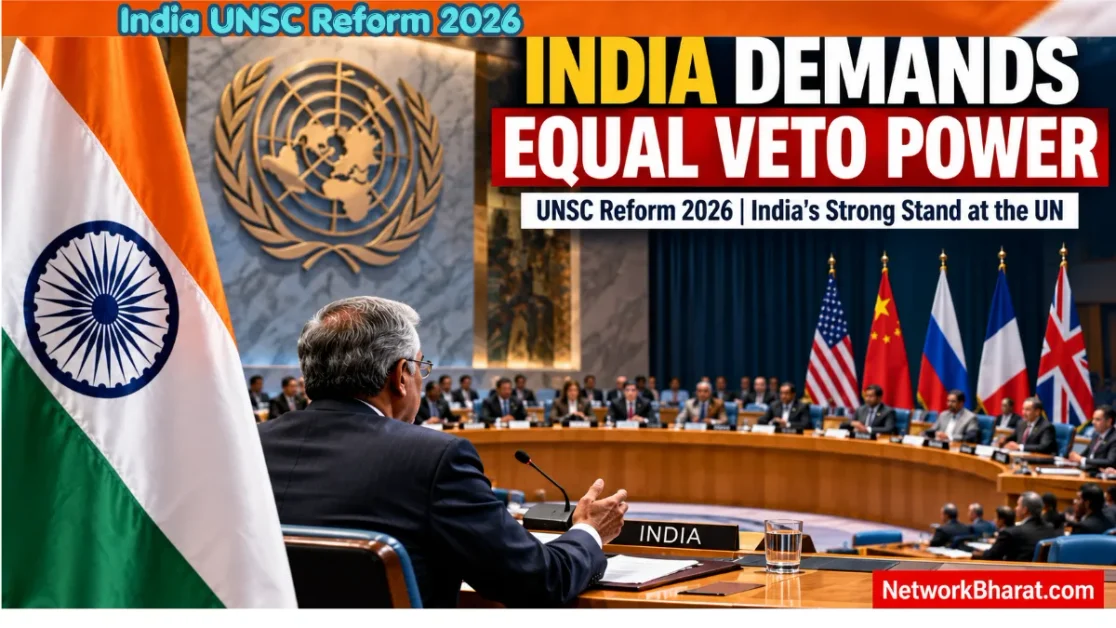
India has renewed its demand for meaningful reform of the United Nations Security Council (UNSC), arguing that any new category of permanent members without veto power would create an unequal system and leave the existing global power structure largely unchanged.
Speaking during an intergovernmental negotiation on Security Council reform at the United Nations General Assembly, India’s Permanent Representative to the UN, Ambassador Harish Parvathaneni, made it clear that if the veto system continues, every permanent member of a reformed Council should enjoy the same right.
India’s position raises a fundamental question about the future of global governance: can the United Nations become more representative if new permanent members are denied the powers enjoyed by the existing five?
For New Delhi, reform must go beyond adding seats. It must also address the imbalance in decision-making authority.
India Says New Permanent Members Should Not Have Second-Class Status
India has opposed proposals that would create a separate category of permanent members without veto rights. According to the Indian position, such an arrangement would give new members a permanent presence but deny them the same influence over major international security decisions.
Ambassador Parvathaneni reiterated that as long as the veto remains part of the Security Council system, all permanent members of a reformed Council should have this right.
India argues that creating permanent seats without veto power would leave the existing five permanent members in a privileged position. Although the Council might become larger, the fundamental distribution of power would remain largely intact.
The Indian argument is based on the principle that permanent membership should carry equal rights and responsibilities. In New Delhi’s view, adding new members without addressing the veto would not deliver the structural change that Security Council reform is intended to achieve.
What Is the UN Security Council and Why Does Veto Power Matter?
Established in 1945 after the Second World War, the United Nations Security Council is responsible for maintaining international peace and security. It can adopt resolutions, impose sanctions and authorise certain international measures in response to threats to peace.
The Council currently has 15 members:
- Five permanent members: China, France, Russia, the United Kingdom and the United States.
- Ten non-permanent members: Elected by the General Assembly for two-year terms.
The five permanent members, commonly known as the P5, hold veto power over substantive decisions.
Under the Council’s voting rules, substantive decisions generally require at least nine affirmative votes and no negative vote from a permanent member. A permanent member’s abstention does not, by itself, block a resolution.
This arrangement gives the P5 a special role in the Council’s decision-making process. Even when a proposal receives broad support from other members, a negative vote from one permanent member can prevent its adoption.
That is why veto power has become one of the most contentious issues in discussions about expanding the Council.
Why India Wants Comprehensive UNSC Reform
India has consistently argued that the Security Council’s composition reflects the international realities of 1945 rather than the political, economic and demographic landscape of the present day.
Over the decades, the number of UN member states has grown considerably, while the Council’s permanent membership has remained unchanged. India believes this has created a representation gap, particularly for developing countries and regions whose voices remain limited in the permanent decision-making structure.
New Delhi is seeking expansion in both categories of membership: permanent and non-permanent.
India maintains that increasing only the number of elected members would not sufficiently change the balance of power. Non-permanent members can contribute to debates and vote on resolutions, but they do not enjoy the same institutional position as the P5.
For India, a meaningful reform must therefore address three connected questions:
- Representation: Should the Council reflect today’s wider international community?
- Decision-making: Should new permanent members have the same rights as existing permanent members?
- Accountability: How can the Council exercise its authority more transparently and responsibly?
These questions are central to the continuing negotiations over the future structure of the United Nations.
The Veto Debate: Equality Versus the Existing Power Structure
The veto was built into the UN system when the organisation was founded. Its supporters have traditionally viewed the arrangement as a way to keep major powers engaged in collective security decisions.
However, critics argue that the veto can also prevent the Council from responding effectively when permanent members disagree over conflicts or international crises.
India’s position focuses on the inequality that could arise if the Council expands but the existing veto privilege remains exclusive to the P5.
Under a model that grants new permanent seats without veto power, new members would have a longer-term presence but would not possess the same blocking authority as China, France, Russia, the United Kingdom and the United States.
India contends that this would preserve the central advantage of the existing permanent members rather than fundamentally reform the institution.
The debate is not simply about the number of seats. It concerns who can shape international decisions, whose interests receive institutional weight and how the Council can maintain legitimacy in a changing world.
Why a Permanent Seat Matters to India
India has been seeking a permanent place on the Security Council for years. Its case is linked to its population, its role in international affairs, its participation in UN peacekeeping and its longstanding involvement in multilateral diplomacy.
India has also served as a non-permanent member of the Council on eight occasions, most recently during the 2021–2022 term.
Its previous terms were 1950–1951, 1967–1968, 1972–1973, 1977–1978, 1984–1985, 1991–1992 and 2011–2012.
These tenures have given India experience in Council deliberations, but they have not changed its status in the permanent membership structure.
A permanent seat would give India a continuing role in the Council rather than a temporary place determined by periodic elections. Whether that seat would include veto power remains tied to the broader negotiations over the design of any reformed Council.
India’s current demand is clear: if the veto is retained, the rights of permanent members in an expanded Council should not be divided into separate tiers.
India and the 2028–29 UNSC Election
Alongside its long-term campaign for permanent membership, India is also seeking a non-permanent seat for the 2028–2029 term.
According to reports published on October 27, 2026, India is set to contest the Asia-Pacific Group’s single available seat against Tajikistan in the election scheduled for June 2027.
This is a separate process from the negotiations on permanent membership and veto reform. The election will determine which country occupies the relevant non-permanent seat for the two-year term.
India’s campaign for the 2028–29 term provides another opportunity to participate in Council deliberations while its broader demand for structural reform continues.
The distinction matters: winning a non-permanent seat would not automatically advance India to permanent membership or grant it veto power.
What Could Happen Next?
Security Council reform remains a complex diplomatic issue because any change must secure broad agreement among UN member states and follow the applicable Charter amendment process.
Countries differ over how many additional seats should be created, which regions should receive greater representation and whether new permanent members should receive veto rights immediately, later or not at all.
India’s latest intervention reinforces its preference for a reform package that changes both membership and decision-making arrangements.
The central challenge is finding an agreement that addresses demands for fairer representation while resolving disagreements over the privileges and responsibilities attached to permanent membership.
For now, India’s statement puts the veto question firmly back at the centre of the debate. Any serious reform proposal will need to confront the relationship between a more representative Council and the special powers held by its existing permanent members.
Conclusion: UNSC Reform Must Go Beyond Adding Seats
India’s latest position makes one point unmistakable: expanding the United Nations Security Council without addressing the distribution of veto power may leave its most important decision-making imbalance unresolved.
For New Delhi, permanent membership without equal rights would fall short of the reform it has long advocated. Its argument is that a modern Security Council should reflect contemporary global realities while applying consistent principles to its permanent members.
Whether UN member states can agree on such a model remains uncertain. But the debate highlights a larger question about the future of international cooperation: how can an institution created after the Second World War evolve to meet the needs of today’s world?
The answer will depend not only on how many seats the Council gains, but also on whether its members can agree on a fairer distribution of authority.
#IndiaUNSCReform #UNSCReform #UnitedNations #VetoPower #IndiaAtUN #UNSecurityCouncil #IndiaNews #GlobalGovernance #InternationalRelations #HarishParvathaneni
About the Author: Krishna Arya writes on international affairs, government policy and current developments for NetworkBharat.com.
UN Security Council Voting System and Veto Power – United NationsUnited Nations Charter – Official UN WebsiteUnited Nations Security Council Reform – UN General AssemblyAbout the United Nations – Official Website