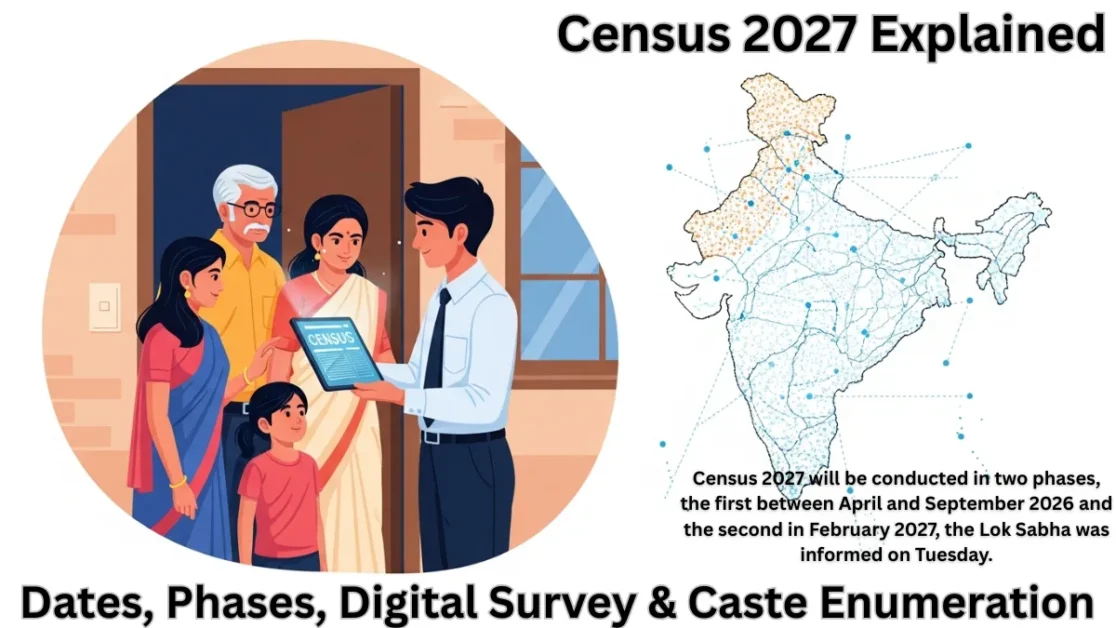
Census 2027 Explained
By Krishna Arya | Network Bharat
Website: https://networkbharat.com
Census 2027 Explained : India is preparing for one of its most ambitious national exercises — Census 2027 — a historic population count that will not only determine the country’s official demographic data for the next decade but also mark India’s first fully digital census and include caste enumeration nationwide.
After a long delay caused by the COVID-19 pandemic, the government has finally announced the official schedule and methodology for Census 2027. The new census will be conducted in two structured phases, using mobile apps, tablets, and self-enumeration portals to streamline data collection. Census 2027 will be conducted in two phases, the first between April and September 2026 and the second in February 2027, the Lok Sabha was informed on Tuesday.
Here is a complete, easy-to-understand guide on what Census 2027 means for Indian citizens, how it will work, and why it is one of the most important censuses in the country’s history.
What Is Census 2027?
The Census of India 2027 will be the country’s 16th decennial census and the first comprehensive population count since Census 2011. It is conducted every 10 years by the Office of the Registrar General and Census Commissioner, India, under the Ministry of Home Affairs.
The census provides data that helps the government:
- Design welfare schemes
- Allocate government funds
- Plan education and health infrastructure
- Define political constituencies
- Understand social, economic, and housing conditions of citizens
With the last census taking place in 2011, India will be counting its population after a 16-year gap, making Census 2027 especially critical.
Census 2027 Schedule: Two Phases Explained
The government has confirmed that the census will be conducted in two main phases:
✅ Phase 1: House Listing & Housing Census
📅 April – September 2026 (30-day window per state/UT)
This phase focuses on infrastructure and household information, including:
- Type of house (permanent/temporary)
- Ownership status
- Number of rooms
- Access to water, sanitation, electricity
- Cooking fuel and internet connectivity
- Socio-economic amenities
This data helps the government assess the nation’s living conditions and infrastructure needs.
✅ Phase 2: Population Enumeration (PE)
📅 February 2027
📌 Reference Date: 1 March 2027 (00:00 hours)
This is the main population counting phase where personal details of every resident will be recorded, including:
- Name, age, gender
- Marital status
- Education level
- Occupation
- Religion
- Caste details (for the first time nationwide)
❄ Special Schedule for Snow-Bound Regions
In high-altitude or snow-prone areas such as:
- Ladakh
- Parts of Jammu & Kashmir
- Himachal Pradesh
- Uttarakhand
Population Enumeration will be conducted earlier:
📅 September 2026
📌 Reference Date: 1 October 2026
This ensures reliable data collection before weather conditions restrict access.
Caste Enumeration in Census 2027: A Historic Move
One of the most significant announcements regarding Census 2027 is the inclusion of nationwide caste enumeration, approved by the Cabinet Committee on Political Affairs.
Why Is Caste Census Important?
India last collected comprehensive caste data in 1931. Since then, policy-making has relied largely on outdated or partial surveys.
Including caste data in Census 2027 will help:
- Improve targeting of welfare programs
- Enable accurate assessment of social inequality
- Strengthen planning for education and employment schemes
- Support evidence-based policymaking
This move is likely to reshape debates on reservation policies, social justice programs, and development planning over the next decade.
India’s First Fully Digital Census
Census 2027 will be the country’s first technology-driven census, modernizing an operation that had traditionally depended on paper forms.
🚀 Digital Tools to Be Used:
- Mobile applications for enumerators
- Tablets and GPS-enabled tracking
- Online self-enumeration portals
- Real-time monitoring dashboards
🧑💻 What Is Self-Enumeration?
For the first time, citizens can independently submit their census details through a secure government portal using OTP verification — similar to online government services.
Benefits include:
- Reduced manual errors
- Faster data processing
- Convenience for urban populations
- Lower response delays
Officials will assist households that lack internet or digital literacy, ensuring 100% population coverage across urban and rural India.
Data Privacy & Security Measures
Given the scale and sensitivity of personal data collection, the government has assured citizens that:
✅ All data will be encrypted
✅ Digital records will be stored on secure servers
✅ Information will only be used for statistical purposes
Unauthorized data sharing is legally prohibited under census laws.
Why Census 2027 Matters More Than Ever
Census 2027 holds immense national importance due to:
📊 A 16-year Data Gap
India has undergone massive changes in:
- Urban migration
- Population growth patterns
- Employment sectors
- Education access
Accurate data is urgently needed for future planning.
🏥 Welfare Distribution
Schemes like:
- PMAY (Housing)
- Ayushman Bharat
- Food Security programs
- Skill India
depend on population metrics from census data.
🗳 Electoral Delimitation
Post-census data will be used to redraw parliamentary and assembly constituency boundaries, ensuring fair voter representation.
📑 Reservation Policies
Fresh caste statistics could significantly influence discussions on:
- Quota limits
- Community representation
- Socio-economic upliftment plans
Citizen Responsibilities During Census 2027
Every Indian resident has a legal duty to participate in the census honestly.
✅ What You Should Do:
- Provide accurate personal information
- Verify digital submissions carefully
- Cooperate with census officials
- Encourage elder or offline family members to participate
⚠ False disclosures can attract penalties under Census laws.
Frequently Asked Questions (FAQs)
❓ Is census participation mandatory?
✅ Yes. The Census Act mandates full citizen participation.
❓ Will Aadhaar be required?
❌ No. Aadhaar is not mandatory for census submission.
❓ Is the caste census compulsory?
✅ Yes. It is part of official population enumeration.
❓ Is census data public?
Only aggregated data will be published. Individual data remains confidential.
#Census2027 #India #DigitalCensus #PopulationEnumeration #HouseListing #CasteCensus #2026Schedule #2027Census
Final Words
Census 2027 is more than just population counting — it represents:
- India’s digital transformation
- A renewed push for inclusive development
- The most comprehensive caste data collection in nearly 100 years
Every household’s participation will shape government decisions, budgets, and social policies for the next decade.
By engaging actively and responsibly, citizens contribute directly to India’s future roadmap.
Sources
PIB: Cabinet approves caste enumeration in the upcoming Census
Ministry of Home Affairs: Lok Sabha reply on Census 2027 schedule & phases
PIB: First-ever digital Census in 2027 – mobile apps & self-enumeration
IAS Score: First-Ever Digital Census in 2027 – Key Features & Significance
The New Indian Express: Census 2027 data to be available early, self-enumeration portal announced
Economic Times: Census 2027 to be done in two phases between April 2026 and February 2027
AP News: India will include caste details in its next census
Also Read This :
GATE 2026 Admit Card Out on Jan 2 – Direct Link & Key Exam Guidelines
UPPSC Polytechnic Lecturer Recruitment 2025–26 – 513 Vacancies & Apply Online
December 2025 Calendar: Complete List of Indian Festivals, Holidays & Special Days
December 2025 Horoscope: Monthly Zodiac Predictions for Career, Love & Finance
Why Matsya Dwadashi Is So Powerful in 2025 – Puja Vidhi, Significance & Tithi
Annapurna Jayanti 2025: Date, Puja Vidhi, Significance & Shubh Muhurat