By Krishna Arya | NetworkBharat.com
Updated: September 27, 2026
Election Commission 9 decisions 2026
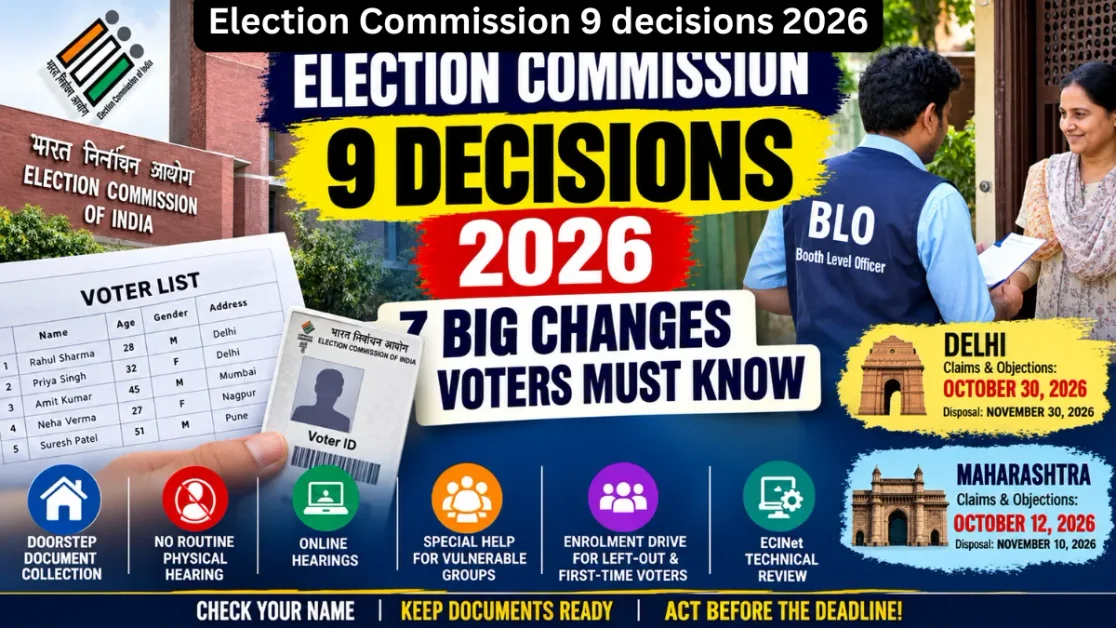
The Election Commission of India (ECI) has announced nine important decisions affecting the ongoing Special Intensive Revision (SIR) of electoral rolls and the way certain voter-related cases will be handled.
The decisions were taken at a full Commission meeting held on September 26, 2026, and cover several issues that directly concern voters—including document verification, hearings, voter enrolment, deadlines for claims and objections, and a technical review of the ECINet system.
For voters, one of the biggest changes is that people who receive SIR notices because their records are classified as “unmapped” or contain logical discrepancies will generally not have to visit an Electoral Registration Officer (ERO) or Assistant Electoral Registration Officer (AERO) office for a physical hearing.
Instead, Booth Level Officers (BLOs) will visit their homes to collect the required documents and upload them on ECINet. Hearings will be required only in exceptional circumstances, and the ECI has said that such hearings should preferably be conducted online.
Election Commission 9 Decisions 2026: What Has Changed?
The latest decisions can broadly be understood through nine major measures.
| Decision | What it means |
|---|---|
| 1. Doorstep document collection | BLOs will visit voters who receive notices for unmapped records or logical discrepancies and collect documents from their homes. |
| 2. Physical hearing no longer routine | Such voters generally will not be required to appear before ERO/AERO offices. |
| 3. Online hearing facility | If a hearing is exceptionally required, it should preferably be conducted online. |
| 4. Help for vulnerable groups | Special arrangements and assistance will be provided for people who need additional support during the process. |
| 5. Voter enrolment drive | Officials have been directed to identify and enrol eligible voters who were left out, including young and first-time voters. |
| 6. ECINet technical review | The Commission has ordered a review of the ECINet system involving an independent expert from an IIT or IIIT. |
| 7. Delhi deadline extended | Claims and objections can now be filed until October 30, 2026. |
| 8. Maharashtra deadline extended | The claims and objections deadline has been extended to October 12, 2026. |
| 9. Greater transparency in Commission meetings | Meeting agendas will be circulated in advance and minutes will be issued. |
The ECI’s official statement says these decisions followed the September 26 meeting of Chief Election Commissioner Gyanesh Kumar and Election Commissioners S.S. Sandhu and Vivek Joshi.
1. BLOs Will Visit Homes for Document Collection
One of the most significant changes concerns voters who have received notices during SIR because they are classified as unmapped or have logical discrepancies in their electoral records.
Under the new arrangement, the BLO will visit the concerned voter’s home to collect the required documents. Those documents will then be uploaded to ECINet for consideration by the ERO.
This changes the practical process for many affected voters because they will not ordinarily have to travel to an ERO or AERO office simply to submit their documents.
2. Physical ERO Hearing Is No Longer the Normal Requirement
The ECI has also clarified that voters receiving such notices do not have to be routinely called for a hearing at the ERO/AERO office.
A physical hearing may still be held in exceptional circumstances, if the ERO considers it necessary.
The Commission has also directed that online hearings should be strengthened. If a voter is required to participate in a hearing, an adult family member may be authorised by the elector to attend on their behalf where permitted under the announced procedure.
What should a voter do after receiving a notice?
A voter should not ignore the notice.
Instead:
- Check exactly what discrepancy has been identified.
- Keep the required supporting documents ready.
- Cooperate with the BLO during the verification process.
- Check the status of the electoral record after submission.
- Use the prescribed claims/objections or enrolment process where applicable.
The doorstep facility reduces the need for unnecessary travel, but it does not remove the importance of responding to an official notice.
3. Special Assistance for Vulnerable Voters
The Commission has also directed that special help desks and assistance mechanisms should be made available for people who may have difficulty navigating the SIR process.
This is particularly relevant for vulnerable and underserved sections of the electorate.
The stated objective is to make the revision process more accessible and ensure that eligible voters are able to participate in the process.
4. Left-Out and First-Time Voters Will Get Special Attention
Another important part of the September 26 decisions is the direction to conduct a special enrolment drive for voters who have been left out of electoral rolls.
The Commission specifically mentioned young and first-time voters.
According to the ECI, officials have been directed to use the continuous updation mechanism to facilitate enrolment of eligible people who are missing from the electoral rolls.
This is important because electoral-roll revision is not only about identifying discrepancies or objections. It also involves ensuring that eligible citizens who should be on the rolls can seek inclusion.
5. ECINet Will Undergo a Technical Review
The Election Commission has also ordered a review of its ECINet system.
According to the Commission, a committee headed by a Senior Deputy Election Commissioner and including an independent expert from an IIT or IIIT will review the system and submit its report.
The review is intended to examine the system’s compliance with relevant laws and rules.
This announcement comes amid public discussion about the functioning of the Commission’s digital systems.
The ECI had earlier stated that ECINet operates under data-security protocols and that authorised election officials have role-based access according to their statutory responsibilities.
6. Delhi SIR Deadline Extended to October 30
For voters in Delhi, the deadline extension is one of the most immediately relevant developments.
The Election Commission has extended the deadline for filing claims and objections to October 30, 2026.
The deadline for disposal of notices, claims and objections has been extended to November 30, 2026.
Delhi voters should remember:
Last date for claims and objections: October 30, 2026
Deadline for disposal: November 30, 2026
The extension gives eligible voters additional time to check their electoral-roll status and take appropriate action where necessary.
7. Maharashtra Deadline Extended Too
The Commission has also extended the relevant SIR timeline in Maharashtra.
The new deadline for filing claims and objections is October 12, 2026, while the deadline for disposal has been extended to November 10, 2026.
Maharashtra voters should remember:
Last date for claims and objections: October 12, 2026
Deadline for disposal: November 10, 2026
Voters should not wait until the final day if they need to submit a claim, objection or supporting documentation.
8. What About Form 6?
The Form 6 issue has also attracted attention because it is used for applying for inclusion of a person’s name in the electoral roll.
The ECI has clarified that the original Form 6 has not been changed. It has described the SIR-related requirement as an additional declaration rather than a modification of the approved Form 6 itself.
For a new voter, the practical takeaway is to carefully follow the instructions applicable to their state and the ongoing electoral-roll revision process rather than relying on older versions of forms or unofficial information.
9. More Transparency in Commission Meetings
The Election Commission has also decided that the agenda for Commission meetings will be circulated in advance and that minutes will be issued.
This is an administrative measure aimed at making the Commission’s internal decision-making process more structured and transparent.
The ECI has separately stated that internal notes, suggestions and observations are part of the deliberative process within a multi-member constitutional body and that final decisions and directions are issued through established procedures.
What Has NOT Changed?
The latest announcement does not mean that the entire SIR process has been cancelled or fundamentally withdrawn.
The Election Commission has reiterated that the June 24, 2025 SIR order was issued with the approval of the full Commission and that the relevant exercise was subsequently upheld by the Supreme Court.
The Commission has also maintained that its recent decisions concerning SIR were taken by the full Commission.
Therefore, voters should distinguish between changes to the procedure and cancellation of SIR.
The September 26 announcement mainly introduces additional facilitation, extends certain timelines and provides clarification on the handling of specific cases.
Why These Decisions Matter for Ordinary Voters
For many people, election-related procedures can become confusing when a name, address, parent/guardian linkage or other electoral detail needs verification.
The new measures attempt to shift some of that burden from the voter to the election machinery.
For example, a voter receiving a notice may now have documents collected at home rather than being routinely required to appear at an election office.
Similarly, the extension of deadlines in Delhi and Maharashtra provides additional time for eligible voters to raise claims or objections.
The ECINet review is a separate but significant administrative development because digital systems are increasingly involved in electoral-roll management.
Voter Checklist: What You Should Do Now
If you are concerned about your electoral-roll entry, consider taking these steps:
1. Check your name in the electoral roll.
Do not assume that your name is present simply because you voted previously.
2. Read any notice carefully.
If you receive an SIR-related notice, understand the reason mentioned in it.
3. Keep supporting documents ready.
If your BLO contacts you, provide the documents required under the applicable procedure.
4. Do not ignore deadlines.
Delhi voters have until October 30, while Maharashtra voters have until October 12 for claims and objections under the latest extensions.
5. First-time voters should check enrolment requirements.
Eligible young voters who are missing from the electoral roll can use the prescribed enrolment process.
6. Use official election channels.
Avoid relying solely on social-media posts or forwarded messages for election-related information.
Election Commission 9 Decisions 2026: The Bigger Picture
The September 26 announcement is significant because it addresses several different parts of the electoral-roll process at the same time.
For voters facing SIR notices, the biggest practical change is doorstep document collection and reduced dependence on physical hearings.
For Delhi and Maharashtra voters, the key development is the extension of claims and objections deadlines.
For the wider electoral system, the ECINet review and new meeting-related procedures are important administrative measures.
At the same time, the ECI has reiterated that the underlying SIR exercise remains in place and that eligible voters who have been left out should be given opportunities for enrolment through continuous updation.
#ElectionCommission #ECI #ECIUpdate #ElectionCommission2026 #SIR2026 #VoterList #VoterID #ECINet #Form6 #ElectionNews #IndiaNews #VotingRights #VoterRegistration #DelhiSIR #MaharashtraSIR
Frequently Asked Questions
What are the Election Commission’s 9 decisions in 2026?
The decisions include doorstep collection of documents by BLOs for certain SIR notices, reduced need for physical hearings, stronger online-hearing facilities, assistance for vulnerable voters, a special enrolment drive, an ECINet technical review, deadline extensions in Delhi and Maharashtra, and new procedures for Commission meetings.
What is the new Delhi SIR deadline?
The deadline for filing claims and objections in Delhi has been extended to October 30, 2026. The disposal deadline is November 30, 2026.
What is the Maharashtra SIR deadline?
The deadline for filing claims and objections in Maharashtra has been extended to October 12, 2026, with disposal extended to November 10, 2026.
Do voters receiving SIR notices have to visit the ERO office?
Not routinely. For notices concerning unmapped records or logical discrepancies, BLOs will visit the voter’s home to collect documents. A hearing may be required in exceptional cases and should preferably be conducted online.
Has Form 6 been changed?
The ECI has said that the original Form 6 has not been changed; an additional SIR-related declaration has been used alongside the existing form in the relevant process.
Final Takeaway
The Election Commission 9 Decisions 2026 announcement brings several procedural changes that voters should understand, particularly those affected by SIR notices or electoral-roll discrepancies.
The most immediate relief is the move toward home-based document collection, while the extension of deadlines in Delhi and Maharashtra gives voters additional time to submit claims and objections.
At the same time, the Commission has ordered an ECINet review and introduced additional administrative measures concerning its meetings and decision-making process.
For voters, the most important message is simple: check your electoral-roll status, read any official notice carefully, keep relevant documents ready and act before the applicable deadline.
This article is based on the Election Commission’s September 26, 2026 announcement and contemporaneous reporting. Election procedures and deadlines can change, so readers should verify the latest information through official Election Commission channels before taking action.
Author: Krishna Arya
Published on: NetworkBharat.com