By Krishna Arya
Website: Network Bharat
India anti-trafficking laws UNGA
India anti-trafficking laws UNGA
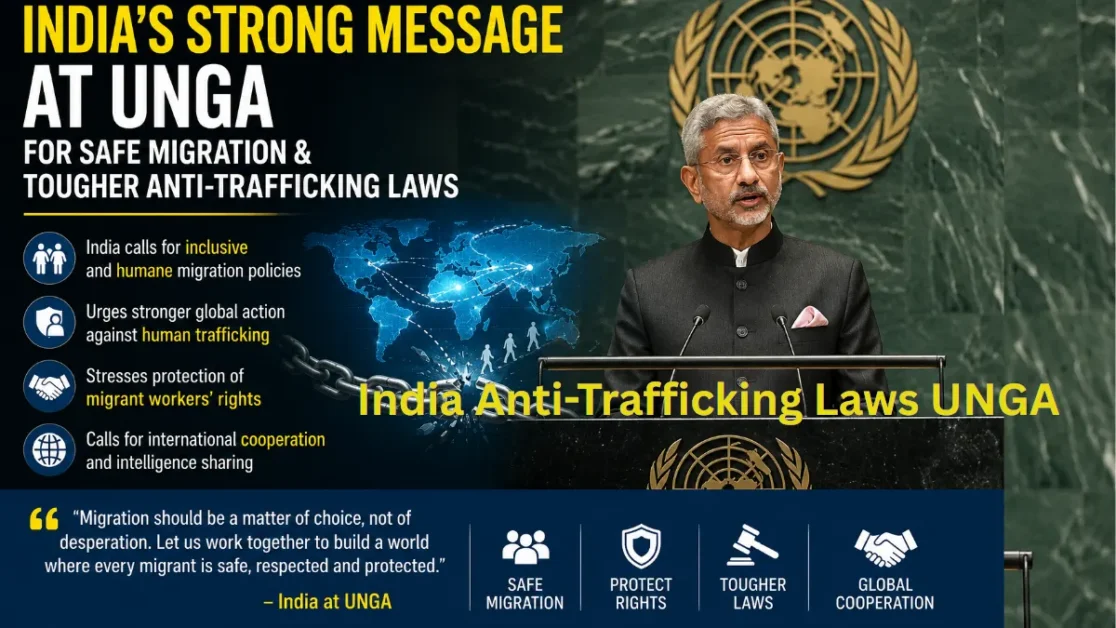
In a strong message at the United Nations General Assembly (UNGA), India has called for a more inclusive global migration system and tougher international laws to combat human trafficking. The move comes at a time when millions of migrants across the world are facing unsafe working conditions, illegal trafficking networks, border crises, and exploitation.
India’s statement at the global platform has quickly become one of the most discussed diplomatic developments, especially as countries struggle to balance migration policies with human rights and national security concerns.
Why India’s Statement at UNGA Matters
Migration is no longer just a regional issue — it has become a global challenge. Wars, climate change, economic instability, and illegal trafficking networks are forcing millions to move across borders every year.
At the UNGA discussion, India emphasized three major concerns:
- Safe and legal migration pathways
- Protection of migrant workers
- Stronger international action against human trafficking
Indian representatives highlighted that migration should not become a source of exploitation. Instead, it should remain a tool for economic growth, cultural exchange, and human dignity.
This position has gained attention because India is one of the world’s largest sources of migrant workers, with millions of Indians working in the Gulf, Europe, North America, and Asia-Pacific regions.
India Calls for Global Cooperation Against Human Trafficking
One of the strongest parts of India’s speech focused on human trafficking networks that target vulnerable people, especially women and children.
India urged countries to:
- Share intelligence across borders
- Strengthen anti-trafficking laws
- Improve victim rehabilitation systems
- Punish organized trafficking syndicates
- Increase digital surveillance against online trafficking networks
Officials warned that traffickers are increasingly using technology and fake job offers to lure people into forced labour, illegal migration, and sexual exploitation.
Global experts believe international coordination is now essential because trafficking gangs often operate across multiple countries.
The Growing Global Migration Crisis
According to international estimates, hundreds of millions of people currently live outside their country of birth. Economic migration, refugee movements, and climate-driven displacement are rising rapidly.
India argued that migration policies must become more humane and inclusive instead of purely restrictive.
The country also stressed that migrant workers contribute significantly to global economies and should receive equal labour protections, healthcare access, and legal support.
This message resonated strongly with developing nations that depend heavily on overseas employment opportunities.
Why This Could Impact India Directly
India has a massive overseas workforce that sends billions of dollars back home every year through remittances. Safer migration systems could directly benefit Indian families by reducing fraud, exploitation, and illegal recruitment.
Experts believe stronger global rules could help:
- Protect Indian workers abroad
- Reduce illegal immigration scams
- Improve overseas job safety
- Crack down on fake recruitment agencies
- Strengthen bilateral labour agreements
The issue is particularly important as digital job scams and trafficking cases linked to overseas employment continue to rise in South Asia.
Global Reaction to India’s Stand
India’s intervention at the UNGA has received positive attention from several developing countries and human rights observers.
Many nations agree that current migration systems are outdated and fail to address modern trafficking methods, cyber-enabled exploitation, and refugee vulnerabilities.
Some diplomats also noted that India’s balanced approach — focusing on both border security and human rights — could influence future international negotiations on migration governance.
The Bigger Diplomatic Picture
India’s strong position at the UNGA also reflects its growing global influence on humanitarian and policy issues.
Over the last few years, India has increasingly taken leadership roles in discussions related to:
- Global South representation
- Climate justice
- Digital governance
- Counter-terrorism
- Humanitarian protection
The migration debate adds another important dimension to India’s expanding diplomatic profile.
What Happens Next?
While UN discussions do not immediately create binding international laws, India’s push may influence future agreements, regional treaties, and policy frameworks.
Countries are expected to continue negotiations on:
- Migrant worker protections
- Refugee management
- Cross-border trafficking prevention
- International labour mobility standards
If stronger cooperation emerges, it could significantly reshape how migration is managed globally over the next decade.
Final Thoughts
India’s call at the UNGA for safer migration and tougher anti-trafficking action highlights a growing international concern that can no longer be ignored.
As migration continues to shape economies and societies worldwide, the focus is shifting toward creating systems that are secure, humane, and fair.
For millions of migrant workers and vulnerable families, these discussions are not just diplomatic speeches — they could determine safety, opportunity, and survival in the years ahead.
#IndiaAtUNGA, #HumanTrafficking, #MigrationPolicy, #GlobalMigration, #UNGA2026, #MigrantRights, #AntiTrafficking, #IndiaNews, #InternationalNews, #WorldPolitics, #SafeMigration, #BreakingNews, #Diplomacy, #GlobalAffairs, #UNNews