Rare Snowfall in Saudi Arabia Raises Climate Warning Signals for India
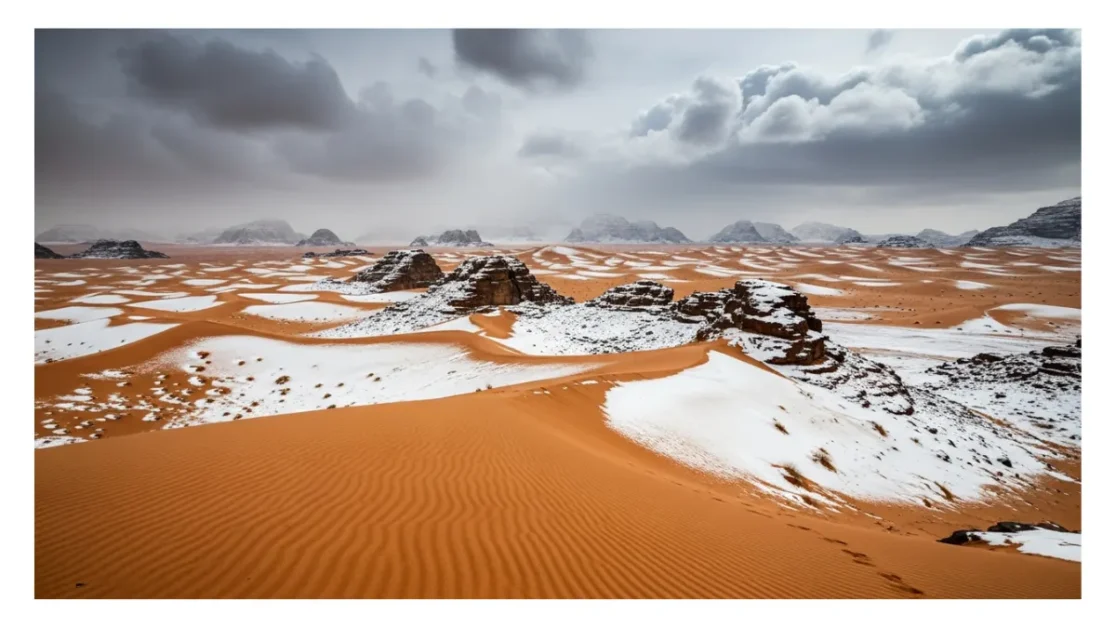
Rare snowfall in Saudi Arabia has stunned residents, meteorologists, and climate observers after parts of the kingdom’s northern desert regions witnessed snow-covered landscapes—an extremely uncommon sight in one of the world’s hottest regions. The unusual weather event has triggered global attention, with experts warning that such climate anomalies reflect growing weather volatility and could have wider implications for countries like India.
Rare Snowfall in Saudi Arabia Stuns Desert Regions
Snowfall was reported in northern areas of Saudi Arabia, particularly in the Tabuk province and surrounding high-altitude desert zones, including the mountainous area of Jabal Al-Lawz. Temperatures reportedly dropped below freezing after a powerful cold air system moved southwards, interacting with moisture-bearing clouds and creating conditions suitable for snowfall.
Videos and images showing sand dunes, rocky terrain, and desert roads lightly covered in snow quickly spread across social media platforms, drawing astonishment from local residents and global audiences alike.
Why Rare Snowfall in Saudi Arabia Is Unusual
Saudi Arabia is largely characterised by an arid desert climate, with extremely high summer temperatures and comparatively mild winters. Snowfall is rare and typically confined to isolated mountainous pockets during exceptional cold waves. Even then, such events occur infrequently and usually for short durations.
Meteorologists note that deserts receiving snow underline how traditional climate boundaries are becoming less predictable. The recurrence of such rare events has intensified scientific interest in understanding shifting atmospheric behaviour.
Climate Experts Link Rare Snowfall in Saudi Arabia to Global Weather Shifts
According to climate scientists, rare snowfall in Saudi Arabia is part of a broader pattern of increasing weather extremes worldwide. Rising global temperatures are altering atmospheric circulation, allowing cold polar air to penetrate farther south while warmer air holds more moisture. This volatile combination can result in unexpected outcomes, including snowfall in arid regions.
International climate bodies have repeatedly warned that global warming does not only mean rising temperatures but also greater instability—leading to heatwaves, intense rainfall, droughts, and sudden cold spells across different regions.
Why Rare Snowfall in Saudi Arabia Is a Warning Signal for India
The unusual weather developments in the Middle East are being closely watched in India, where climate-related disruptions have already intensified. India has experienced erratic monsoon patterns, prolonged heatwaves, unseasonal rainfall, flash floods, and cloudbursts over the past decade.
Experts caution that atmospheric systems are globally interconnected. Changes in one region can influence broader climate behaviour, including monsoon dynamics and winter weather patterns in South Asia. The rare snowfall in Saudi Arabia is therefore being viewed as a broader warning of how climate instability could increasingly affect India’s agriculture, water resources, and infrastructure.
Scientific Perspective on Weather Volatility
Meteorologists explain that rare snowfall in Saudi Arabia does not indicate a permanent climatic shift toward colder conditions. Instead, it reflects heightened variability in weather systems. Long-term climate data analysis remains essential to distinguish between short-term anomalies and deeper structural changes.
Global agencies such as the
World Meteorological Organizationhave consistently highlighted that extreme weather events are becoming more frequent as climate systems warm. In India, the
Indian Meteorological Departmenthas also warned that climate change is increasing the unpredictability of seasonal weather patterns.
The Bigger Climate Picture
The rare snowfall in Saudi Arabia has captured public imagination because of its visual contrast, but scientists stress that it should be viewed as a serious indicator rather than a novelty. Similar anomalies—ranging from desert snowfalls to record-breaking heat—have been reported globally in recent years.
For policymakers and planners, such developments reinforce the urgency of investing in climate-resilient infrastructure, early warning systems, and adaptive strategies to mitigate future risks.
What Lies Ahead
As rare snowfall in Saudi Arabia continues to draw global attention, climate experts emphasise that preparedness and adaptability will determine how societies respond to an increasingly uncertain climate future. For India and other climate-vulnerable nations, strengthening disaster management frameworks and integrating scientific forecasting into policy decisions are now seen as critical priorities.