By Krishna Arya | Network Bharat
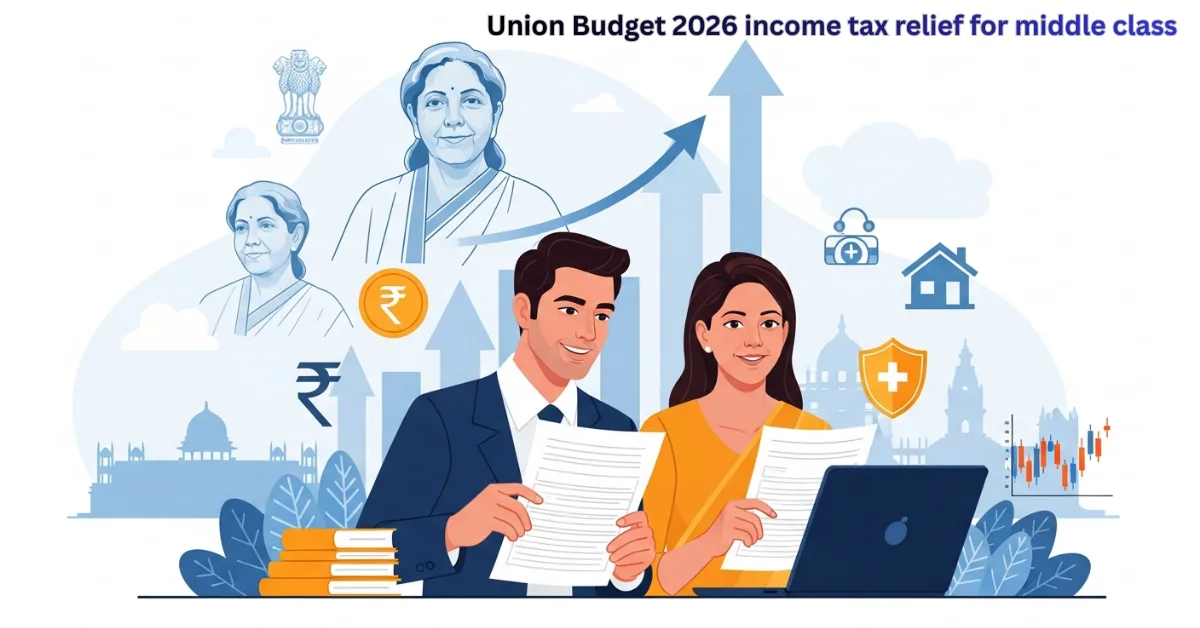
Union Budget 2026 income tax relief for middle class
Union Budget 2026 income tax relief for middle class As India stands on the brink of the Union Budget 2026, expectations are running high—especially among the middle class, salaried employees, and retail investors. With household expenses rising and inflation continuing to squeeze monthly budgets, taxpayers are looking towards February 1 with renewed hope.
Finance Minister Nirmala Sitharaman is expected to strike a careful balance between fiscal discipline and taxpayer relief. With the new Income Tax Act set to take effect from April 1, Budget 2026 could mark a decisive step toward a simpler, more taxpayer-friendly system.
Experts believe this year’s budget may not bring dramatic overhauls—but small, targeted changes could deliver meaningful relief to millions.
A Clear Push Towards Simpler Tax Laws
Over the past few years, the government has consistently signaled its intention to simplify India’s complex tax structure. The rollout of the new tax regime, followed by the announcement of a revamped Income Tax Act, reflects this long-term strategy.
Instead of frequent exemptions and complicated calculations, the focus has shifted towards:
- Fewer deductions
- Clearer slabs
- Predictable tax liabilities
Budget 2026 is expected to reinforce this direction, making tax compliance easier while reducing confusion for ordinary taxpayers.
Standard Deduction: A Big Relief on the Cards?
One of the most closely watched announcements in Budget 2026 is the standard deduction.
At present, salaried individuals under the new tax regime can claim a standard deduction of ₹75,000. However, sources and tax experts suggest this limit could be raised to ₹1,00,000.
If implemented, this move would:
- Directly increase take-home salary
- Offset rising living costs
- Benefit millions of salaried employees without additional paperwork
For middle-class households dependent on fixed incomes, this could be one of the most impactful changes in the budget.
Home Loan Interest Deduction May Get a Boost
Homebuyers are another group watching the budget closely.
Currently, under Section 24(b) of the Income Tax Act, taxpayers can claim up to ₹2 lakh as a deduction on home loan interest—but only under the old tax regime.
There is growing expectation that Budget 2026 may:
- Increase this limit to ₹3 lakh, or
- Introduce a modified benefit under the new tax regime
With EMIs rising due to higher interest rates, any enhancement in home loan tax benefits would provide much-needed relief to middle-class families investing in their first homes.
Health Insurance Deductions: A Possible Game-Changer
Healthcare costs in India have surged sharply in recent years, making health insurance a necessity rather than a luxury.
Currently, deductions on health insurance premiums under Section 80D are available only in the old tax system. Experts believe the government may now consider extending this benefit to the new tax regime as well.
If this happens:
- The new tax system would become far more attractive
- Families would get financial relief on rising medical expenses
- Insurance penetration could increase nationwide
Such a move would also align with the government’s broader goal of strengthening social security.
Capital Gains Tax: Investors Hope for Rationalisation
Retail investors are also keeping a close eye on Budget 2026, especially after changes introduced in recent years.
At present:
- Short-term capital gains (STCG) on equities are taxed at 20%
- Long-term capital gains (LTCG) above ₹1.25 lakh are taxed at 12.5%
Market participants argue that higher short-term taxes discourage small investors and reduce market participation. While no official signal has been given, experts believe the government may consider fine-tuning capital gains taxation to strike a balance between revenue needs and investor confidence.
Even a modest adjustment could boost market sentiment.
A Look Back: What Budget 2025 Delivered
The optimism surrounding Budget 2026 is largely driven by the relief announced last year.
In Union Budget 2025, the government made:
- Annual income up to ₹12 lakh tax-free under the new tax regime
- Effective exemption up to ₹12.75 lakh for salaried taxpayers
This decision significantly boosted disposable income and was widely welcomed by the middle class. Taxpayers now expect Budget 2026 to build on this momentum, rather than reverse it.
Why Budget 2026 Matters More Than Ever
Budget 2026 comes at a crucial time:
- Household costs are rising
- Aspirations of the middle class are growing
- Investors want stability and clarity
Even incremental tax reforms could have a powerful ripple effect—strengthening household finances, improving consumption, and reinforcing trust in the tax system.
Final Word
While the final announcements will only be known on February 1, all indicators suggest that Union Budget 2026 could be a taxpayer-focused budget. From a higher standard deduction and improved home loan benefits to possible health insurance and capital gains relief, the government appears committed to gradual but meaningful reform.
For millions of Indians, Budget Day is not just about numbers—it’s about hope, stability, and financial breathing room.
All eyes are now on Parliament as the Finance Minister prepares to unveil what could be one of the most middle-class-friendly budgets in recent years.
#UnionBudget2026, #Budget2026, #TaxRelief2026, #MiddleClassIndia, #IncomeTaxRelief, #StandardDeduction, #HomeLoanBenefits, #CapitalGainsTax, #NewTaxRegime, #IndianEconomy, #BudgetExpectations