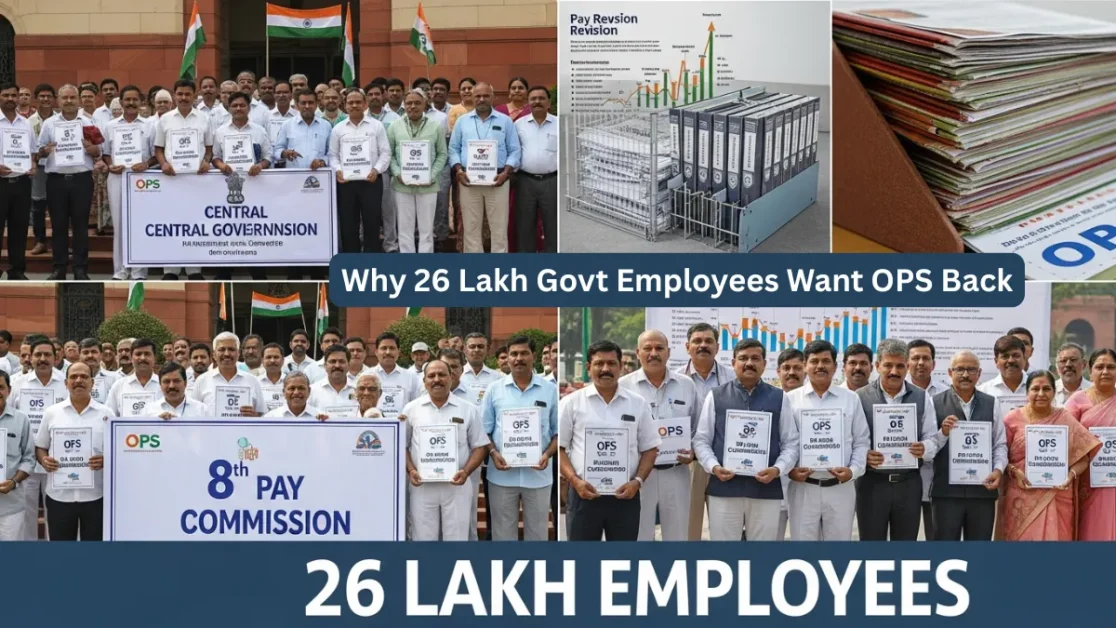
Why 26 Lakh Govt Employees Want OPS Back
Why 26 Lakh Govt Employees Want OPS Back : As India prepares for the 8th Central Pay Commission (8th CPC), a massive wave of expectations has begun building among Central Government employees and pensioners. More than 26 lakh Central Government employees—particularly those who joined service after 2004—are now strongly pushing for the restoration of the Old Pension Scheme (OPS).
This demand has quickly gained momentum after major employee bodies wrote to Prime Minister Narendra Modi, calling for urgent changes in the 8th CPC’s Terms of Reference (ToR) to ensure fair retirement benefits for all.
But why is there such widespread concern, and what makes OPS such a big issue?
Let’s break it down in a clear, humanised way.
🔵 Why Employees Want the Old Pension Scheme Back
Employees who joined after 2004 were moved from OPS to the National Pension System (NPS)—a market-linked pension plan that depends on stock-market performance. This means:
- No guaranteed pension
- No lifelong family pension in many cases
- Market risks affect retirement income
- High uncertainty during old age
In contrast, OPS provided:
- A guaranteed lifelong pension
- A clear formula (50% of last drawn salary)
- Family pension benefits
- Zero uncertainty or market risk
For lakhs of employees, OPS isn’t just a benefit—it’s financial dignity after retirement.
📌 What 26 Lakh Employees Have Demanded in the 8th CPC
Employee organisations have urged the government to include the following points in the 8th CPC:
1️⃣ Restore OPS for all employees who joined service after Jan 1, 2004
They argue that switching to NPS without proper consultation was unfair and left employees with insecure retirements.
2️⃣ Fair pension revision for India’s 69 lakh existing pensioners
Many pensioners believe inflation has eroded their savings and that they deserve regular, realistic, and automatic pension updates.
3️⃣ Transparent, employee-friendly Terms of Reference (ToR)
Employee bodies want the Pay Commission to focus not just on salary hikes—but also on:
- Pension sustainability
- Work-life balance
- Better allowances
- Health benefits for retirees
🔵 Why NPS Is a Growing Concern for Employees
Most employees under NPS say:
- Their pension amount is far too low to survive on
- Market crashes can wipe out years of savings
- An uncertain pension affects long-term family planning
- OPS provided stability that NPS cannot replicate
A recent trend shows increasing anxiety among employees nearing retirement age—who now fear insufficient pension despite 30+ years of service.
📢 The Big Question: Will the Government Bring Back OPS?
While some states have already restored OPS, the Central Government has maintained a cautious stance.
However:
- With General Elections approaching
- Employee unions growing louder
- And 26 lakh families directly affected
—there is significant pressure on policymakers.
The coming months will determine whether the government introduces a revised, hybrid or fully restored OPS for central employees.
🔍 How the 8th CPC Could Change the Future of Govt Employees
If OPS is restored or modified, it could:
- Reduce financial anxiety among employees
- Improve retirement security
- Boost morale and work efficiency
- Strengthen long-term savings behaviour
For pensioners, a fairer revision system could help maintain healthy living standards as inflation rises.
🌟 Final Thoughts
The demand for OPS is not just about money—it’s about security, dignity, and fairness. With the 8th CPC’s recommendations set to shape India’s government workforce for the next decade, millions are watching closely.
Network Bharat will continue tracking every update, recommendation, and government response to keep readers informed.
#8thPayCommission #OldPensionScheme #OPS #CentralGovernmentEmployees #PensionRevision #NPS #GovernmentPensions #EmployeeBenefits #IndiaGovtEmployees #RetirementSecurity