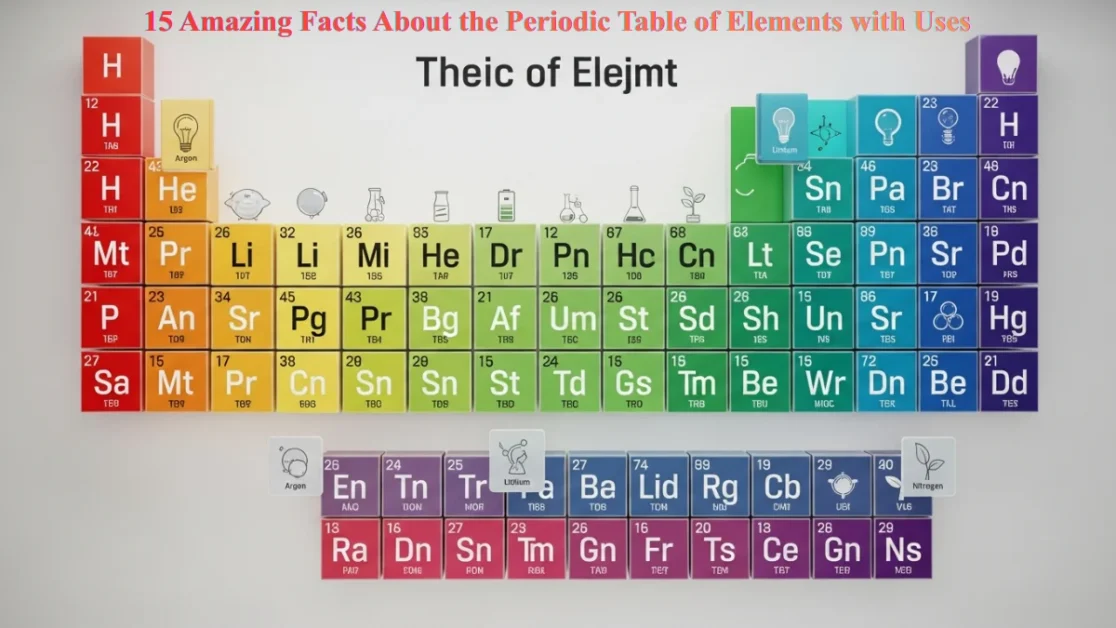
15 Amazing Facts About the Periodic Table of Elements with Uses
The Periodic Table of Elements with Uses is not just a chart—it’s one of the most powerful scientific tools ever created. From classrooms to cutting-edge laboratories, the periodic table helps us understand the building blocks of everything around us. Whether it’s the oxygen we breathe, the gold in jewelry, the silicon in smartphones, or the uranium used for nuclear power, each element plays a vital role in our lives. In this article, we explore 15 amazing facts that will help you understand the Periodic Table of Elements with Uses in a simple and meaningful way.
What Is the Periodic Table of Elements with Uses?
The Periodic Table of Elements with Uses showcases all known chemical elements along with their applications, properties, and behavior. It organizes elements according to their atomic number, electronic configuration, and chemical properties. Once you understand the table, chemistry becomes far more exciting and easy to learn.
1. The Periodic Table Was Created by Dmitri Mendeleev
In 1869, Russian chemist Dmitri Mendeleev created the first version of the periodic table. Surprisingly, he left empty spaces for elements that had not yet been discovered. His predictions were so accurate that when those elements were later found, they matched his theories perfectly—an early example of genius forecasting in science.
2. The Table Contains 118 Confirmed Elements
The modern Periodic Table of Elements with Uses has 118 confirmed elements as recognized by IUPAC. These include naturally occurring metals, synthetic radioactive elements, noble gases, and more.
3. Elements Are Arranged by Atomic Number
Atomic number is the number of protons in an atom’s nucleus. This number determines how an element behaves chemically. Mendeleev originally arranged elements by atomic mass, but the modern table uses atomic number for better accuracy.
4. Each Element Has Real-World Uses
The beauty of the Periodic Table of Elements with Uses is that it tells us how every element contributes to the world.
Examples:
- Carbon → Used in diamonds, graphite, fuels, and organic compounds
- Silicon → Essential for computer chips and solar panels
- Helium → Used for cooling MRI machines
- Iron → Backbone of construction and manufacturing
5. Group and Period Numbers Hold Hidden Meaning
The table is divided into vertical columns (groups) and horizontal rows (periods).
- Groups tell you how elements react chemically.
- Periods show how electrons are arranged in shells.
This makes the periodic table a map of chemical behavior.
6. Metals, Nonmetals & Metalloids Are Strategically Placed
Most elements in the Periodic Table of Elements with Uses are metals. They are placed on the left side and center. Nonmetals like oxygen, sulfur, and chlorine are on the right. Metalloids such as silicon and boron form a staircase between metals and nonmetals, showing mixed properties.
7. Noble Gases Don’t React Easily
Elements like neon, argon, and xenon (Group 18) are called noble gases because they are “inert,” meaning they rarely react with other elements. These gases are used in lighting, lasers, and medical imaging.
8. Hydrogen Is the Odd One Out
Although hydrogen appears above Group 1, it does not behave like the other alkali metals. It is placed there purely for convenience—even today, scientists debate where it truly belongs.
9. Lanthanides and Actinides Are Placed Separately
The two rows at the bottom of the periodic table contain rare earth metals (lanthanides) and radioactive elements (actinides). This placement keeps the main table compact and easy to read.
10. The Heaviest Natural Element Is Uranium
Uranium (atomic number 92) is the heaviest naturally occurring element. Elements from 93 to 118 are man-made in laboratories.
11. Gold and Silver Are Part of the Transition Metals
Transition metals like gold, silver, copper, and iron are famous for their conductivity, malleability, and shiny appearance. Gold is so stable that it does not rust for thousands of years.
12. Oxygen Is the Most Abundant Element in Earth’s Crust
About 46% of the Earth’s crust is oxygen. Combined with silicon, it forms silicates—the main components of rocks.
13. The Periodic Table Can Predict Behavior
If you know an element’s position, you can predict how it reacts, what compounds it forms, and even how toxic it might be. This predictive power makes the Periodic Table of Elements with Uses vital for chemistry students.
14. Element Symbols Are Universal
Every country in the world uses the same symbols:
- H = Hydrogen
- O = Oxygen
- Na = Sodium
- Fe = Iron
This universal language makes the periodic table globally important.
15. New Elements Are Still Being Added
Even today, scientists continue to create new synthetic elements by smashing atomic nuclei together. Elements 113, 115, 117, and 118 were officially named only a few years ago.
Final Thoughts
The Periodic Table of Elements with Uses is more than a chemistry chart—it’s a complete knowledge system. It explains everything around us, from the water we drink to the stars in the universe. Understanding it helps students, researchers, and science lovers see the world through the lens of elemental science.