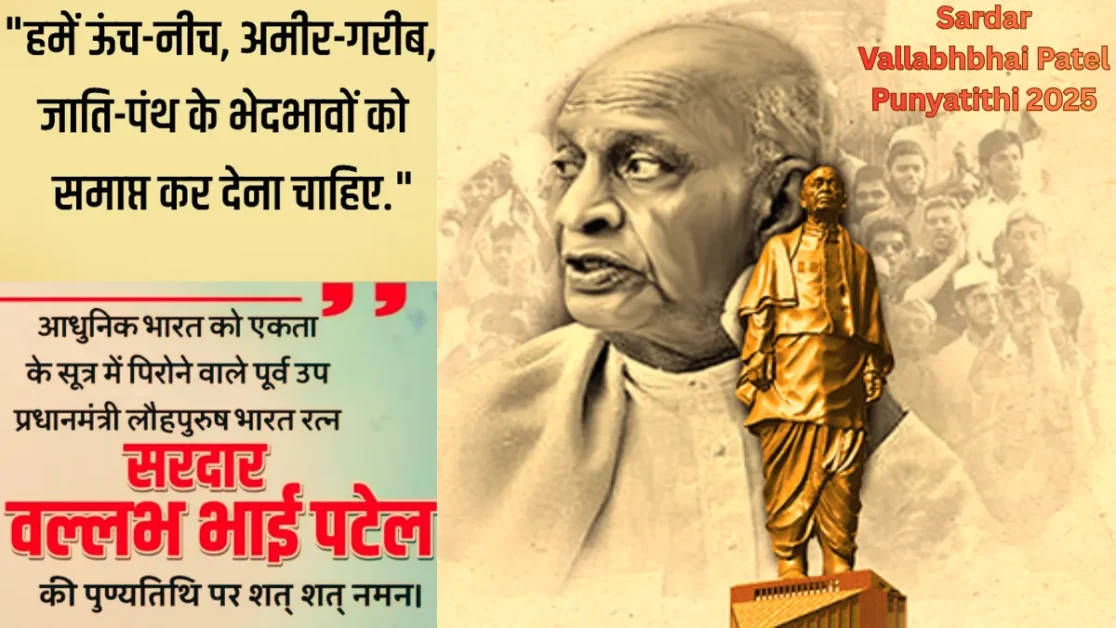
Sardar Vallabhbhai Patel Punyatithi 2025
By Krishna Arya | Network Bharat
Website: https://networkbharat.com
A Leader India Can Never Forget
Sardar Vallabhbhai Patel Punyatithi 2025 : Every nation has moments that define its destiny, and every era produces leaders who rise above politics to become the conscience of history. For India, Sardar Vallabhbhai Patel stands tall among such rare figures. On 15 December 1950, the nation lost a freedom fighter, a statesman, and a unifier — but gained a legacy that continues to guide India even today.
Remembered as the “Iron Man of India”, Sardar Patel was not merely a leader; he was the steel backbone of a newly independent nation struggling to find unity amid diversity. On his Punyatithi, Indians across generations bow in remembrance to a man whose resolve shaped the geographical and political soul of modern India.
Who Was Sardar Vallabhbhai Patel?
Born on 31 October 1875 in Nadiad, Gujarat, Vallabhbhai Patel emerged from humble beginnings to become one of the most influential architects of independent India. A trained lawyer and a fearless nationalist, Patel was deeply inspired by Mahatma Gandhi and soon became a pillar of the Indian freedom movement.
However, what truly set him apart was not just his participation in the freedom struggle — it was his ability to take hard decisions when the nation needed strength more than sentiment.
The Iron Man of India: Why the Title Matters
The title “Loh Purush” (Iron Man) was not symbolic; it was earned.
At the time of Independence in 1947, India was fragmented into over 560 princely states, many of which were reluctant or openly hostile to joining the Indian Union. The possibility of a broken, Balkanised India was real.
As India’s first Deputy Prime Minister and Home Minister, Sardar Patel took on what many believed was an impossible task:
👉 Unifying India into one sovereign nation
Through a mix of diplomacy, persuasion, and when absolutely necessary, firm action, Patel succeeded where few thought success was possible.
Without Sardar Patel, the India we know today may never have existed.
Architect of National Unity
Sardar Patel’s greatest contribution was the integration of princely states. From Hyderabad to Junagadh, from Bhopal to Travancore, Patel worked tirelessly to ensure that regional ambitions did not fracture national unity.
He believed firmly that:
“A united India was not an option; it was a necessity.”
His approach was practical, decisive, and rooted in realism — qualities that made him indispensable during the fragile early years of independence.
Role in the Freedom Struggle
While Patel is often remembered for post-independence achievements, his role in the freedom movement was equally profound:
- Leader of the Kheda Satyagraha
- Central figure in the Bardoli Satyagraha, which earned him the title “Sardar”
- Key organiser of Congress at the grassroots level
- A bridge between Gandhian ideals and administrative discipline
Patel understood the pulse of farmers, workers, and ordinary Indians — and earned their trust through action, not rhetoric.
A Leader of Discipline and Integrity
Sardar Patel believed that freedom without discipline would lead to chaos. As Home Minister, he laid the foundations of:
- India’s civil services
- Law and order framework
- Strong federal governance
He famously warned against weak administration and appeasement politics, emphasising national interest above all else.
In many ways, Patel’s vision of governance feels even more relevant in today’s India.
15 December 1950: The Day India Lost Its Iron Pillar
On 15 December 1950, Sardar Vallabhbhai Patel passed away in Mumbai. The nation mourned deeply — not just for a leader lost, but for a guardian whose presence had provided reassurance during uncertain times.
Jawaharlal Nehru described Patel as:
“A tower of strength… one of the strongest men of the age.”
His death marked the end of an era — but not the end of his influence.
Statue of Unity: A Modern Tribute to an Eternal Legacy
In 2018, India paid a historic tribute by unveiling the Statue of Unity in Gujarat — the world’s tallest statue at 182 metres.
Facing the Narmada River, the statue is more than a monument:
- It symbolises national unity
- It honours decisive leadership
- It reminds future generations of the cost of freedom and unity
The Statue of Unity stands as a visual reminder that Patel’s legacy is not confined to history books — it is carved into India’s present and future.
Why Sardar Patel Matters Today More Than Ever
In an age of polarisation, misinformation, and identity politics, Sardar Patel’s life offers powerful lessons:
- Unity over division
- National interest over personal ambition
- Action over rhetoric
- Strength guided by moral clarity
Remembering Patel is not about nostalgia — it is about reclaiming values that can strengthen India today.
Conclusion: An Eternal Guardian of India
On this Punyatithi of Sardar Vallabhbhai Patel, India does not merely remember a leader — it salutes an idea.
An idea of a united, strong, self-respecting nation.
An idea that leadership must be fearless yet responsible.
An idea that history rewards those who act when it matters most.
Sardar Patel may have left us on 15 December 1950, but his iron resolve continues to protect the soul of India.
India remembers. India salutes. 🇮🇳
#SardarVallabhbhaiPatel, #SardarPatelPunyatithi, #IronManOfIndia, #December15, #IndianFreedomFighter, #BharatRatna, #UnitedIndia, #NationalUnity, #IndianHistory, #StatueOfUnity, #DeshKeSardar