By Krishna Arya
Published on Network Bharat
Australian Open Handshake Controversy
Sabalenka Svitolina handshake controversy Australian Open
Sports are often called a universal language — a space where competition rises above politics, borders, and conflict. But at the Australian Open semi-final in Melbourne, that belief was once again put to the test.
The high-profile clash between Aryna Sabalenka and Elina Svitolina was expected to be a thrilling tennis battle. Instead, even before the first serve was hit, the match became the centre of a global debate — not because of racquets or rallies, but because of a missing handshake.
A Semi-Final That Began With Silence
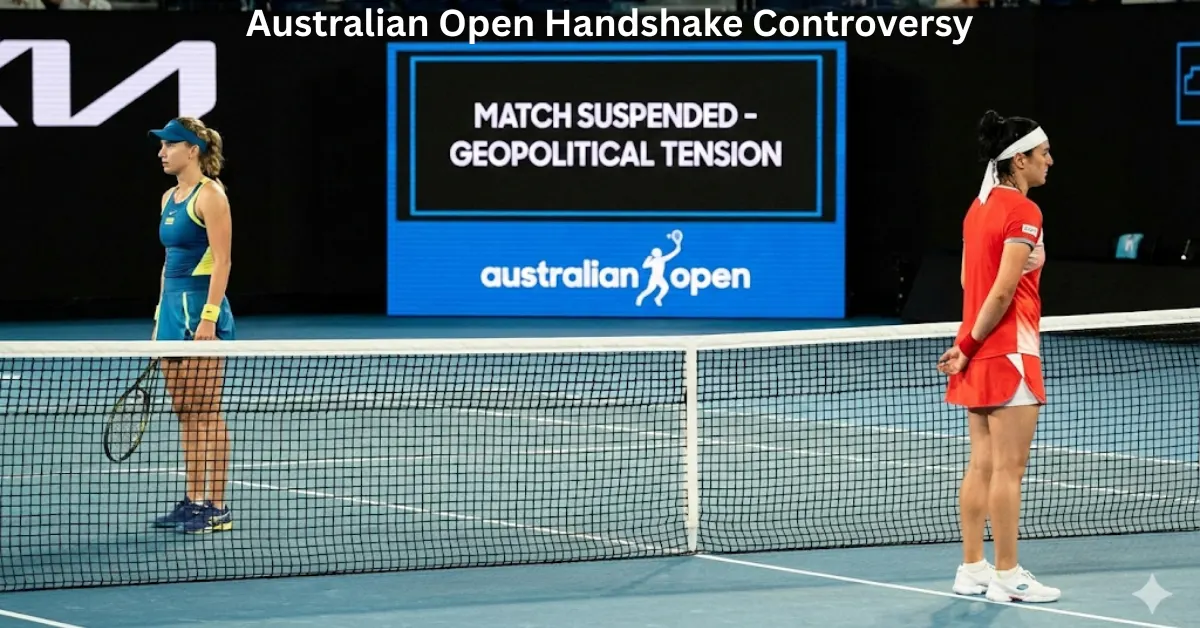
As fans settled into Rod Laver Arena, a surprising message flashed on the giant screen:
There would be no handshake between the players before the match.
For casual viewers, this might have seemed unusual. In tennis, pre-match and post-match handshakes are more than rituals — they symbolise respect, sportsmanship, and fair play. But for Svitolina, a Ukrainian player whose country has been ravaged by war since 2022, the decision carried far deeper meaning.
Sabalenka, a Belarusian national, entered the court knowing the moment would be watched far beyond tennis circles. Belarus has been a close ally of Russia, and since the war began, Ukrainian athletes have chosen not to engage in traditional gestures with Russian and Belarusian players.
That silent moment before the match said more than words ever could.
The Match, The Tension, The Result
Once play began, Aryna Sabalenka showed why she is one of the most dominant forces in women’s tennis today. She defeated Svitolina convincingly, 6-2, 6-3, securing her place in her fourth consecutive Australian Open final.
She now stands on the brink of history, set to face Elena Rybakina once again — a repeat of the 2023 final — with a chance to lift the Australian Open trophy for the third time in her career.
Yet, despite the clean scoreline, the tension never fully disappeared. At one point, the chair umpire even warned Sabalenka for excessive noise after a shot — a moment that further highlighted how emotionally charged the atmosphere had become.
Svitolina’s Voice Beyond Tennis
After the match, Elina Svitolina did not speak about forehands or unforced errors. Instead, she spoke about home.
She reminded the world that while she was playing on Centre Court, millions in Ukraine were waking up to air-raid sirens, destruction, and fear.
“People in Ukraine are living a truly horrific and terrifying life,” she said.
“I’m very lucky to be here, to represent my country, and to use my voice for my people.”
For Svitolina, tennis has become more than competition. It is a platform — a way to keep global attention focused on a war that many fear is slowly fading from headlines.
She also revealed how messages of support from fans back home motivate her every day, turning her matches into an emotional exchange between athlete and nation.
Neutral Flags, Heavy Realities
The controversy also highlights another important reality in modern tennis. Belarusian and Russian players are currently not allowed to compete under their national flags, instead representing a neutral status.
While this rule aims to separate athletes from government actions, it has not erased the emotional weight carried onto the court. Some Ukrainian players have even refused handshakes with opponents who changed citizenship, showing that for them, the issue goes beyond paperwork or nationality labels.
When Sports Reflect the World
This was not the first time sports mirrored global conflict. From cricket fields to football stadiums, political tensions have increasingly found their way into international competitions.
What made this moment different was the stage.
A Grand Slam semi-final.
Millions watching.
A silent protest broadcast across the world.
The Australian Open handshake controversy forced fans, players, and officials to confront an uncomfortable truth — that in times of war, even sport cannot fully remain untouched.
A Debate That Won’t End Soon
Some argue that sports should stay neutral, free from political statements. Others believe athletes have a responsibility to reflect reality, especially when their countries are suffering.
There is no easy answer.
What is clear, however, is that the Sabalenka vs Svitolina semi-final will be remembered not just for its result, but for the powerful message it carried — one of pain, resistance, and the human cost of conflict.
As tennis moves forward, this match will stand as a reminder that behind every scoreboard are real lives, real stories, and real struggles.
#AustralianOpen, #HandshakeControversy, #Sabalenka, #Svitolina, #TennisNews, #GrandSlamDrama, #UkraineWarImpact, #SportsAndPolitics, #AO2026, #TennisDebate, #GlobalSports, #BreakingSportsNews
Stay informed. Stay aware. Because sometimes, the loudest moment in sport is the one where nothing happens at all.