By Krishna Arya | Network Bharat
Website: https://networkbharat.com
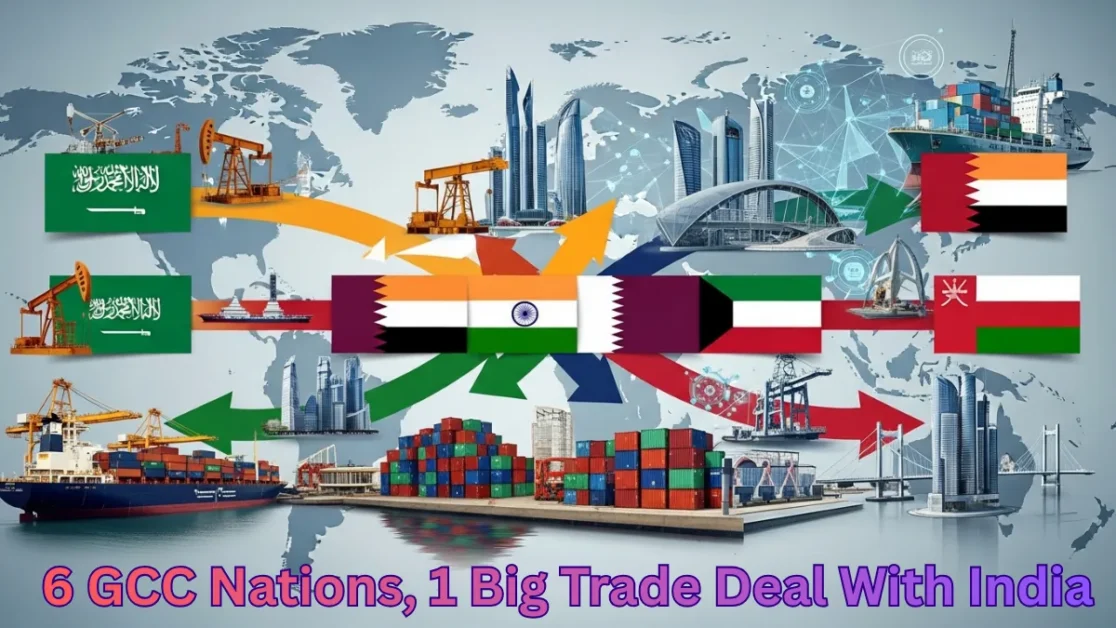
6 GCC Nations, 1 Big Trade Deal With India
India GCC FTA talks
6 GCC Nations, 1 Big Trade Deal With India : India has taken a decisive step toward reshaping its economic engagement with West Asia. After years of pause, India and the Gulf Cooperation Council (GCC) have formally agreed to begin negotiations for a Free Trade Agreement (FTA), bringing together six Gulf nations and one of the world’s fastest-growing major economies under a single trade vision.
The move signals more than just a trade negotiation—it reflects a strategic reset at a time when global supply chains, energy security, and economic partnerships are being redefined.
What Is the GCC and Why It Matters to India
The GCC is a powerful regional bloc comprising Saudi Arabia, the United Arab Emirates, Qatar, Kuwait, Oman, and Bahrain. Together, these nations sit at the heart of the global energy market and are increasingly diversifying into infrastructure, technology, logistics, and manufacturing.
For India, the relationship is deeply rooted:
- Nearly 10 million Indians live and work in GCC countries
- The region is a key source of crude oil and natural gas
- Bilateral trade has crossed $179 billion annually
Few trade partnerships combine energy, employment, remittances, and strategic geography the way India–GCC ties do.
FTA Talks Resume After a Long Gap
While this announcement feels new, the idea is not. India and the GCC previously held two rounds of FTA talks in 2006 and 2008, but negotiations stalled after the GCC suspended discussions with multiple global partners.
Now, with both sides facing global economic uncertainty, the talks are back—with renewed urgency and political will.
The Terms of Reference (ToR) for the agreement were signed in New Delhi, formally setting the scope, structure, and negotiation framework for the proposed FTA.
India’s Big Push for Trade Stability
The signing ceremony was chaired by Piyush Goyal, India’s Commerce and Industry Minister, who described the agreement as a natural progression of a relationship that spans thousands of years.
According to the government, the proposed FTA aims to:
- Reduce or eliminate customs duties
- Remove non-tariff trade barriers
- Create policy stability and predictability
- Encourage two-way investment
- Strengthen food and energy security
India brings strength in food grains, skilled manpower, IT services, and manufacturing, while GCC nations offer energy resources, capital, and rapidly expanding markets.
Trade Numbers That Tell the Story
India’s trade with the GCC has been growing steadily:
- Exports to GCC: ~$57 billion
- Imports from GCC: ~$121.7 billion
- Total bilateral trade: ~$178.7 billion
The UAE stands as India’s third-largest trading partner, while Saudi Arabia ranks fifth. Qatar remains critical for India’s LNG imports, and Oman continues to be a strategic maritime and logistics partner.
Despite strong trade volumes, India runs a trade deficit with most GCC nations—something the FTA is expected to address by boosting Indian exports in goods and services.
Why This Deal Is a Big Opportunity for Indians
Beyond trade figures, the FTA could directly benefit Indian citizens and businesses:
- More opportunities for Indian professionals in IT, healthcare, construction, and services
- Lower costs for Indian exporters, improving competitiveness
- Infrastructure collaboration across ports, logistics, and petrochemicals
- Expanded scope for Indian startups and digital firms in Gulf markets
India’s young, skilled workforce is seen as a major asset for GCC countries pursuing economic diversification beyond oil.
Built on Recent Trade Successes
India’s GCC strategy is not starting from zero. The country already has:
- A Comprehensive Economic Partnership Agreement (CEPA) with the UAE (since 2022)
- A CEPA with Oman, signed in December 2025
- Nine trade agreements covering 38 countries concluded in recent years
The GCC-wide FTA would unify and expand these bilateral gains into a single, region-wide framework.
A Strategic Signal to the World
GCC negotiators have described the agreement as a message of cooperation amid global economic volatility. At a time when protectionism is rising in many regions, India and the GCC are choosing collaboration over isolation.
If concluded successfully, this FTA could become one of India’s most consequential trade deals, linking South Asia with one of the world’s most resource-rich and investment-ready regions.
#IndiaGCCFTA, #IndiaTradeNews, #GulfCountries, #WestAsiaTrade, #IndianEconomy, #FreeTradeAgreement, #EnergySecurity, #GlobalTrade, #ExportGrowth, #BusinessNews
The Road Ahead
Negotiations are expected to be complex, covering goods, services, investments, standards, and mobility. But with strong political backing on both sides, momentum appears firmly in place.
For India, the message is clear: one trade deal, six Gulf nations, and a future-ready economic partnership.