By Krishna Arya
Published on Network Bharat
Decarbonising Everything Is Impossible
Decarbonising Everything Is Impossible : Climate change has pushed governments, corporations, and environmental groups across the world to rally behind one powerful goal — Net Zero emissions. From electric cars and solar panels to green hydrogen and carbon capture technologies, the world is investing trillions to reduce carbon emissions and slow global warming.
But an uncomfortable question is now emerging in scientific and policy circles:
Can humanity really decarbonise everything?
Many experts believe the answer may be far more complicated than political speeches and climate campaigns suggest. While renewable energy is growing rapidly, several industries remain deeply dependent on fossil fuels, and replacing them completely may not be technically, economically, or even physically possible in the near future.
Here’s the hidden reality behind the global decarbonisation challenge.
What Does “Decarbonisation” Actually Mean?
Decarbonisation refers to reducing or eliminating carbon dioxide (CO₂) emissions from human activities. This includes shifting away from coal, oil, and natural gas toward cleaner energy sources like solar, wind, hydro, and nuclear power.
Countries including India, the United States, China, and members of the European Union have announced ambitious Net Zero targets, aiming to balance emissions by removing as much carbon from the atmosphere as they produce.
On paper, it sounds achievable.
In reality, some sectors are proving extremely difficult to clean up.
The Industries That Cannot Easily Go Green
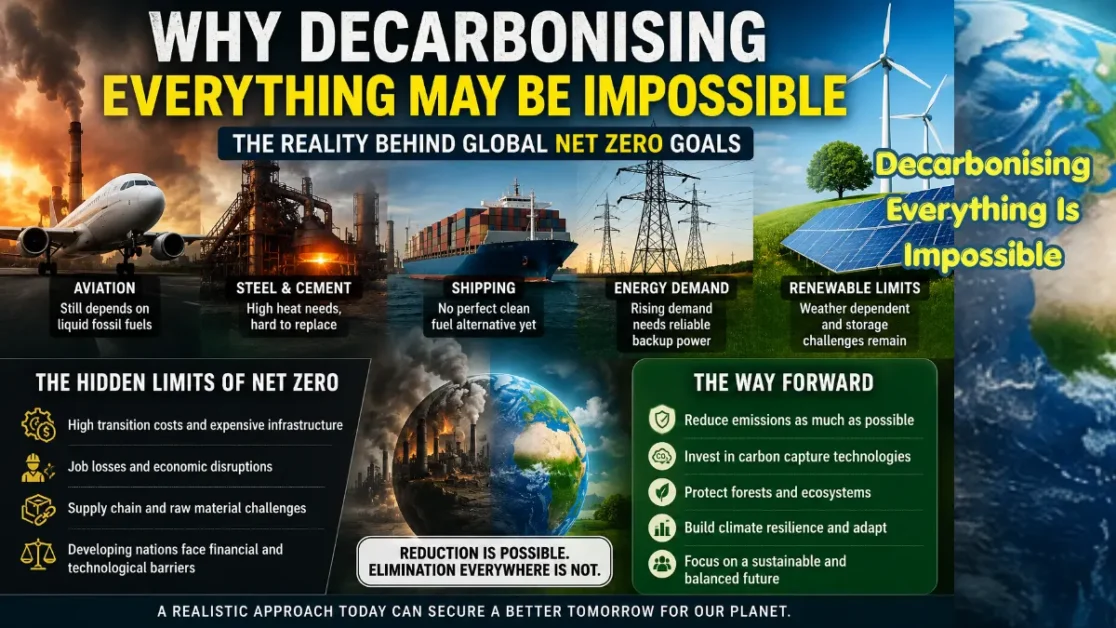
1. Aviation Still Depends on Liquid Fuel
Airplanes require extremely energy-dense fuel to fly long distances. Current battery technology is too heavy for most commercial aviation needs.
While sustainable aviation fuels and hydrogen-powered aircraft are being explored, experts say replacing conventional jet fuel worldwide could take decades.
For now, global air travel still relies heavily on fossil fuels.
2. Steel and Cement Production Emit Massive Carbon
Steel and cement are essential for buildings, bridges, roads, railways, and infrastructure. However, producing them requires enormous heat — often generated using coal.
Even with green hydrogen and cleaner technologies under development, large-scale transformation remains expensive and slow.
This creates a major challenge because modern economies cannot function without these industries.
3. Shipping Has No Perfect Alternative Yet
Global trade depends on cargo ships transporting food, fuel, electronics, and raw materials across oceans.
Most ships run on heavy fuel oil, one of the dirtiest fossil fuels. Cleaner alternatives like ammonia, methanol, or hydrogen are still in early stages and face infrastructure limitations.
Decarbonising global shipping may require rebuilding major parts of the international supply chain.
4. Electricity Demand Is Exploding
As countries electrify transport, industries, and households, electricity demand is rising dramatically.
Renewable energy sources like solar and wind are cleaner, but they also depend on weather conditions. Without large-scale battery storage or stable backup systems, many nations still rely on coal and gas power plants to avoid blackouts.
This is especially true in developing countries where affordable energy remains critical for economic growth.
The Hidden Cost of Going Fully Net Zero
Transitioning to a low-carbon world is not just a technological challenge — it is also an economic one.
Experts warn that rapid decarbonisation could lead to:
- Higher electricity prices
- Expensive infrastructure upgrades
- Job losses in fossil fuel industries
- Supply chain disruptions
- Rising costs for consumers
Developing nations also argue that wealthy countries became rich using fossil fuels and now expect poorer nations to transition faster without adequate financial support.
This global inequality remains one of the biggest obstacles in climate negotiations.
Can Renewable Energy Alone Solve Climate Change?
Renewable energy is absolutely reducing emissions in many regions. Solar and wind power are expanding faster than ever before.
However, critics say there is growing overconfidence in the idea that renewables alone can completely replace fossil fuels within a few decades.
The reality is more complex.
Solar panels, batteries, electric vehicles, and wind turbines themselves require mining, industrial manufacturing, rare earth materials, and global transportation — all of which still produce emissions.
In other words, even the clean energy transition currently depends partly on carbon-intensive systems.
Why Experts Say “Decarbonising Everything” May Be Impossible
Some scientists and energy analysts now believe that instead of aiming for “zero emissions everywhere,” the world may need to focus on:
- Reducing emissions as much as possible
- Improving energy efficiency
- Developing carbon capture technologies
- Protecting forests and ecosystems
- Building climate resilience
- Adapting to unavoidable climate impacts
This approach accepts that certain emissions may continue for decades, especially in hard-to-abate industries.
Rather than perfection, the goal becomes meaningful reduction.
India’s Position in the Global Climate Debate
India faces a unique challenge.
As one of the world’s fastest-growing economies, the country needs affordable energy to support manufacturing, infrastructure, transportation, and rising living standards.
At the same time, India is rapidly expanding solar energy, electric mobility, and green hydrogen initiatives.
Balancing development and environmental responsibility will likely define India’s climate strategy in the coming decades.
The Future of Net Zero
The dream of a completely carbon-free world remains inspiring, but experts increasingly warn against unrealistic expectations.
Technology will continue improving. Renewable energy will keep expanding. Cleaner industries will emerge.
Yet some emissions may remain unavoidable for longer than many policymakers initially predicted.
The real challenge may not be eliminating every molecule of carbon — but building a sustainable world that can continue growing while drastically lowering environmental damage.
And that debate is only just beginning.
#Decarbonisation #NetZero #ClimateChange #CleanEnergy #GlobalWarming #RenewableEnergy #Sustainability #CarbonEmissions #GreenEnergy #ClimateCrisis #EnergyTransition #EcoFriendly #FutureOfEnergy #EnvironmentalNews #CarbonNeutral
Final Thoughts
Climate action is still essential. But understanding the limits of decarbonisation may help governments create more realistic, practical, and balanced strategies for the future.
The road to Net Zero is not a straight line — and for some industries, it may never truly reach zero at all.
Written by Krishna Arya for Network Bharat
External Links :
- Decarbonising Everything Is Impossible – Here’s Why
- Global Net Zero Debate: Why Complete Decarbonisation May Never Happen
- Experts Explain Why Some Industries Cannot Go Fully Green
- Heavy Industries Could Cut Energy Use by 45% by 2050
- India’s Path Towards Net Zero and Sustainable Growth
- Research on Decarbonisation Challenges in Transportation and Industry