SBI data leak 2026
By Krishna Arya | NetworkBharat.com
Updated: October 22, 2026
SBI data leak 2026
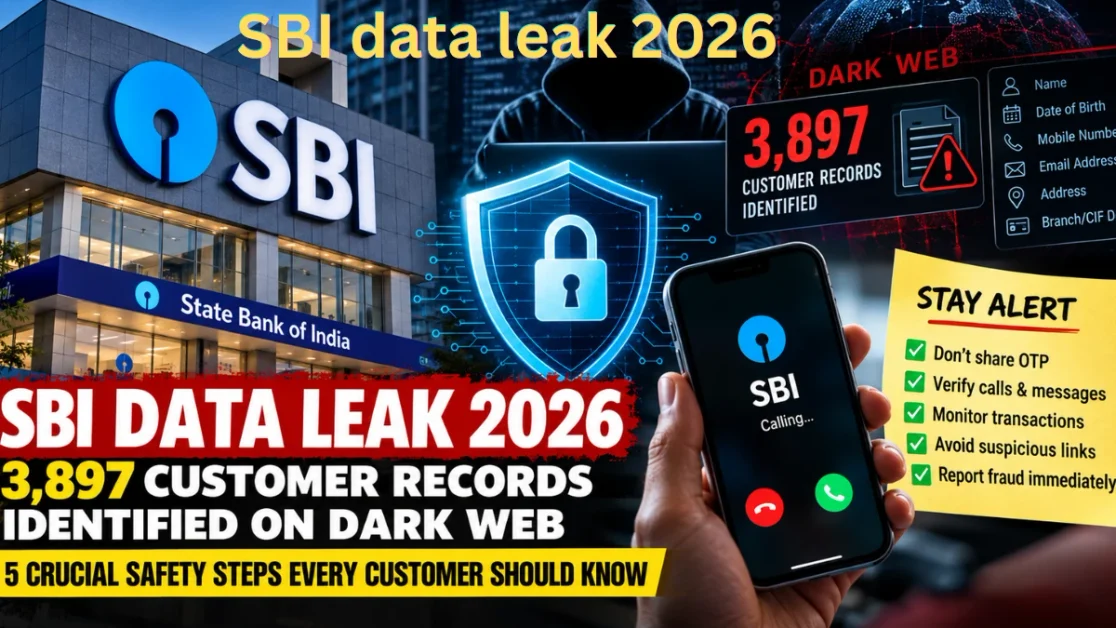
The State Bank of India (SBI) has disclosed a data-loss incident after a preliminary examination identified 3,897 customer records containing personally identifiable information in a larger dataset of approximately 3.75 lakh records found on the dark web.
The bank informed the stock exchanges about the incident on October 21, 2026, stating that it had received alerts about the suspected exposure on October 16. SBI has initiated an investigation with the assistance of an independent cybersecurity agency empanelled by the Indian Computer Emergency Response Team (CERT-In).
The disclosure has raised concerns about the privacy of banking customers and the potential misuse of personal information. However, several important questions remain unanswered, including the source of the exposed data, its full extent and the number of customers who may ultimately be affected.
For SBI customers, the immediate priority is to understand what the bank has disclosed, what remains unknown and how to reduce the risk of phishing and other forms of online fraud.
SBI Data Leak 2026: What Happened?
According to reports published by The Indian Express and Hindustan Times, SBI received communications from its threat intelligence service provider, the Defence Cyber Agency and CERT-In concerning the suspected availability of customer data on the dark web.
The bank subsequently examined approximately 3.75 lakh records and identified 3,897 customer records containing personally identifiable information.
SBI described the matter as an incident involving the loss of certain data. It activated its cyber incident response and containment protocols and engaged an independent CERT-In-empanelled cybersecurity agency to investigate.
The investigation is intended to establish the authenticity and completeness of the data, determine its possible source and extent, and assess the associated risks to customers and the bank.
SBI has stated that the incident has had no material impact on its core business operations, financial performance or business continuity.
An important distinction: The 3,897 records represent the customer records identified during the preliminary analysis. They should not be treated as the final number of all potentially affected individuals. The bank has said that further investigation is necessary.
What SBI Customer Information Was Reportedly Exposed?
Published reports identify several categories of personal information among the records associated with the incident.
| Data category | Information reported |
|---|---|
| Personal details | Names, dates of birth and gender |
| Contact details | Registered mobile numbers and email addresses |
| Residential details | Home addresses |
| Banking identifiers | Branch details and Customer Information File (CIF) identifiers |
| Application-related information | Lead IDs and metadata associated with loan and lead records |
These details are based on media reports describing SBI’s disclosure. The bank has not yet established publicly the full authenticity and completeness of the dataset.
It is also important not to confuse personal-data exposure with the confirmed compromise of banking credentials.
The publicly reported disclosure does not establish that customers’ passwords, ATM PINs, UPI PINs or account balances were exposed as part of this incident. Nor does it establish that unauthorised withdrawals occurred.
Those questions should be assessed on the basis of verified findings rather than speculation.
Is Your SBI Bank Account Safe After the Data Leak?
This is a natural concern for customers following news of a banking data exposure.
SBI has stated that the incident has not materially affected its core business operations, financial performance or business continuity. That statement is reassuring regarding operational disruption, but it does not replace the need to investigate the privacy implications of the incident.
A data leak and an unauthorised bank transaction are two different events.
Personal details such as a phone number, date of birth or residential address can potentially be used to make fraudulent calls and messages appear more convincing. A criminal may impersonate a bank representative and attempt to persuade a customer to disclose confidential information or approve a transaction.
However, the exposure of personal information does not automatically mean that a person’s account has been accessed or that money has been stolen.
Customers should remain alert, review their transactions and independently verify unexpected communications claiming to come from SBI.
5 Safety Steps SBI Customers Should Follow
Customers do not need to panic, but they should take sensible precautions to protect their banking information.
1. Never Share Your OTP, ATM PIN or UPI PIN
Never disclose your one-time password (OTP), ATM PIN, UPI PIN or internet banking password to someone who contacts you unexpectedly.
A caller may know your name, mobile number or other personal information. That alone does not establish that the caller represents SBI.
Do not approve an unexpected transaction or enter your banking credentials on a website reached through an unverified link.
2. Verify Suspicious Calls and Messages
Be cautious if someone contacts you claiming that your SBI account will be blocked, your KYC details must be updated immediately or your debit card requires urgent verification.
Such messages can be used in phishing and impersonation scams.
End suspicious calls and contact the bank independently through its official website, verified customer-service channels or your branch. Do not rely on contact details supplied by an unknown caller.
3. Monitor Transactions and Banking Alerts
Review your recent account transactions and pay attention to notifications about payments or changes you did not authorise.
Watch for:
- Unrecognised debit transactions.
- Unexpected payment requests.
- Alerts about changes to registered contact details.
- Notifications about banking access you did not initiate.
If you identify suspicious activity, contact SBI promptly and follow its instructions to secure your account.
4. Avoid Unverified Links and Banking Applications
Do not install applications or files sent by strangers claiming to help resolve the data leak.
Use trusted app stores and official banking websites. Avoid unknown APK files, suspicious customer-care numbers and remote-access tools suggested by unsolicited callers.
Never allow an unknown person to control your phone or computer while you are using banking services.
5. Report Suspected Cyber Fraud Immediately
If you notice an unauthorised financial transaction or believe you have been targeted by a banking scam, report it to SBI through an official channel.
In India, suspected cyber financial fraud can also be reported through the National Cyber Crime Reporting Portal:
Official portal: https://cybercrime.gov.in/
Cyber fraud helpline: 1930
Keep relevant transaction references, messages and complaint numbers where possible. Report the incident promptly and follow the bank’s instructions.
What Has SBI Confirmed—and What Remains Unknown?
Understanding the difference between confirmed information and unanswered questions is essential when reporting a cybersecurity incident.
| Question | Current position |
|---|---|
| Has SBI acknowledged a data-loss incident? | Yes. The bank disclosed an incident involving the loss of certain data. |
| How many customer records were identified? | 3,897 records containing personally identifiable information in a preliminary analysis. |
| How large was the dataset examined? | Approximately 3.75 lakh records found on the dark web. |
| What information was reportedly involved? | Personal, contact, residential and certain banking or application-related identifiers. |
| Has the source of the exposure been established publicly? | The source had not been conclusively established in the reports reviewed. |
| Has the full extent of the incident been determined? | No. SBI said a detailed investigation was required. |
| Has SBI reported a material impact on core operations? | No. The bank said there was no material impact on its core operations, financial performance or business continuity. |
| Have all affected customers been confirmed as notified? | The reports reviewed did not establish whether every affected customer had been notified. |
These points reflect the information available in published reporting as of October 22, 2026. The findings may change as SBI’s investigation progresses.
Why the SBI Data Leak Matters for Digital Banking
Banks hold substantial amounts of customer information to provide account services, process applications and comply with regulatory requirements. Protecting that information is therefore an important part of maintaining customer trust.
The potential consequences of data exposure extend beyond the immediate publication of personal details.
If information is authentic and can be linked to particular individuals, it may potentially be used for targeted phishing, impersonation attempts or other forms of social engineering. The actual risk depends on the information exposed, its accuracy and whether it can be combined with data from other sources.
For customers, the practical lesson is to verify unexpected banking communications and never share confidential authentication details.
For financial institutions, incidents of this kind underline the importance of data access controls, security monitoring, incident response and independent technical investigation.
The source and full scope of the SBI incident must be established before conclusions can be drawn about the specific security weakness involved.
F A Q
1. How many SBI customer records were identified in the data leak?
SBI’s preliminary analysis identified 3,897 customer records containing personally identifiable information among approximately 3.75 lakh records examined on the dark web.
2. What information was reportedly exposed?
Media reports identified names, dates of birth, gender, registered mobile numbers, email addresses, residential addresses, branch and CIF identifiers, lead IDs, and metadata associated with loan and lead records.
The authenticity and completeness of the dataset remain subject to investigation.
3. Has SBI confirmed that customers’ money was stolen?
The reports reviewed do not establish that money was stolen as a result of this incident. SBI stated that the incident had no material impact on its core business operations, financial performance or business continuity.
Customers should nevertheless monitor their accounts and promptly report suspicious transactions.
4. Should SBI customers change their passwords?
The reported disclosure does not establish that all customer passwords were exposed. If you suspect unauthorised access, have reused a compromised password or receive a verified security warning, change the relevant password through the bank’s official website or application.
Never share an OTP, PIN or password with a caller claiming to investigate the leak.
5. Has SBI identified the source of the data exposure?
The source and full extent had not been conclusively established in the published reports reviewed for this article. SBI has engaged an independent CERT-In-empanelled cybersecurity agency to investigate.
6. Where can customers report online banking fraud?
Customers should contact SBI through its official channels. Suspected cyber financial fraud can also be reported at https://cybercrime.gov.in/ or by calling 1930.
Conclusion
The SBI data leak reported in October 2026 highlights the importance of protecting customer information in an increasingly digital banking environment.
The bank’s preliminary analysis identified 3,897 customer records containing personally identifiable information within a larger dataset of approximately 3.75 lakh records found on the dark web. SBI has initiated a detailed investigation, but the source and full extent of the exposure remain unresolved in the reporting reviewed.
Customers should not assume that their bank accounts have been compromised solely because of this news. They should, however, take reasonable precautions: protect their authentication details, verify suspicious communications, monitor transactions and report suspected fraud immediately.
Further verified findings from SBI and the relevant cybersecurity authorities will be important in understanding the full implications of the incident.
Stay informed, verify before you trust, and protect your personal banking information.
By Krishna Arya | NetworkBharat.com
#SBIDataLeak, #SBIDataBreach, #SBI, #StateBankOfIndia, #CyberSecurity, #DarkWeb, #BankingNews, #OnlineFraud, #DigitalSafety, #CustomerData, #IndiaNews, #NetworkBharatCopy hashtags
Sources
- The Indian Express: SBI data breach explained: What customer information was exposed online?
- Hindustan Times: SBI flags data leak involving 3,897 customer records
- The New Indian Express: SBI reports data-loss incident; 3,897 customer records found exposed on dark web
- State Bank of India: Official website
- National Cyber Crime Reporting Portal: Official reporting website
Editorial note: This article distinguishes SBI’s reported disclosures from unresolved questions. Update it if the bank or a competent authority publishes new findings. Do not describe the incident as a confirmed compromise of passwords, PINs or account balances unless verified evidence supports that claim.