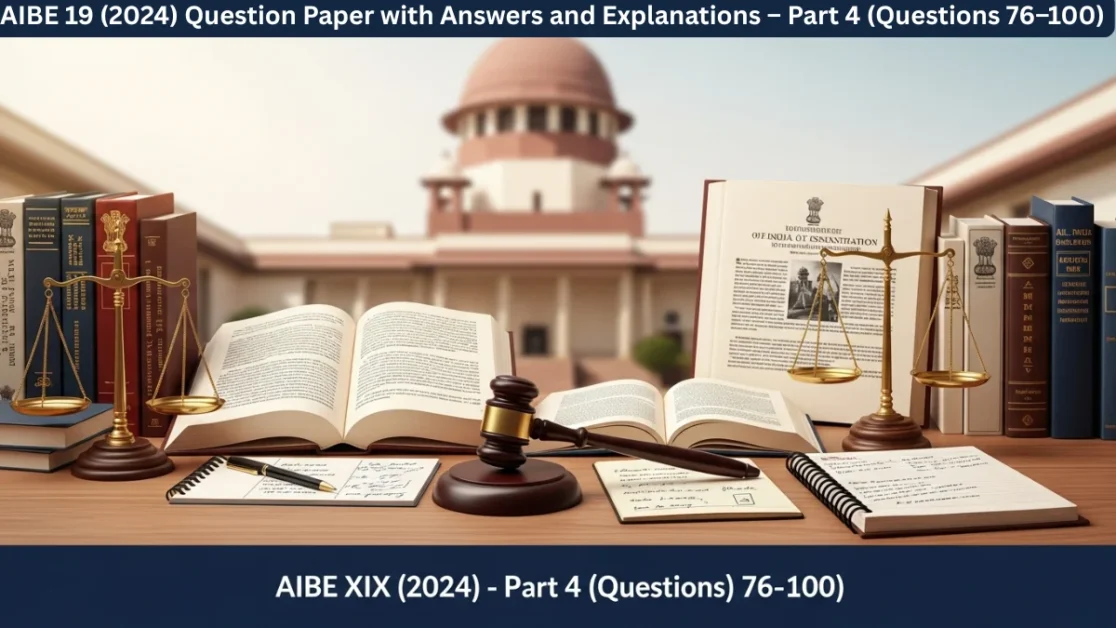
AIBE 19 (2024) Question Paper with Answers and Explanations – Part 4 (Questions 76–100)
Author: Krishna Arya
Published on: Network Bharat
🔗 https://networkbharat.com/aibe-19-2024part-4/
📘 Introduction
The All India Bar Examination (AIBE XIX 2024) is a crucial step for every law graduate aiming to practice law in India. To help aspirants prepare comprehensively, Network Bharat continues its exclusive series — AIBE XIX (2024) Question Paper with Answers and Explanations.
This Part 4 (Questions 76–100) covers important topics from the Indian Constitution, Bharatiya Sakshya Adhiniyam (BSA) 2023, and the Code of Civil Procedure (CPC) — three key subjects frequently tested in AIBE. Each question below is carefully selected and explained to help you understand the reasoning behind the correct answer.
AIBE XIX (2024) – Part 4 (Questions 76–100) with Answers and Explanations
Q76. How many Schedules are there in the Indian Constitution?
(A) 10 (B) 11 (C) 12 (D) 13
✅ Answer: (C) 12
Explanation: The Indian Constitution currently contains Twelve Schedules, each detailing various aspects like distribution of powers, official languages, and administration.
Q77. Under the Constitution, who has the power to dissolve the Lok Sabha?
✅ Answer: (B) President
Explanation: Under Article 85, the President of India holds the authority to dissolve the Lok Sabha on the advice of the Council of Ministers.
Q78. Who can remove the Governor from office?
✅ Answer: (B) President
Explanation: As per Article 156, the Governor holds office “during the pleasure of the President,” meaning they can be removed anytime by the President.
Q79. The Supreme Court of India came into existence on—
✅ Answer: (C) 28 January 1950
Explanation: The Supreme Court of India was officially inaugurated on 28 January 1950, two days after the Constitution came into force.
Q80. Which Article provides for special leave to appeal by the Supreme Court?
✅ Answer: (A) Article 136
Explanation: Article 136 empowers the Supreme Court to grant special leave to appeal from any judgment or order in any case.
Q81. Which section of BSA corresponds to Section 60 of the Indian Evidence Act, 1872?
✅ Answer: (D) Section 59
Explanation: Section 59 of the Bharatiya Sakshya Adhiniyam (BSA) 2023 corresponds to the old Section 60, dealing with direct oral evidence.
Q82. A confession caused by inducement is inadmissible under which section of BSA?
✅ Answer: (C) Section 24
Explanation: Section 24 BSA 2023 renders a confession inadmissible if obtained by inducement, threat, or promise.
Q83. Under BSA, when is secondary evidence admissible?
✅ Answer: (A) When the original is destroyed
Explanation: Sections 63–65 BSA allow secondary evidence when the original document is lost, destroyed, or cannot be produced.
Q84. Which section of BSA deals with relevancy of motive, preparation, and conduct?
✅ Answer: (D) Section 8
Explanation: Section 8 BSA discusses the relevancy of motive, preparation, and conduct of parties in legal proceedings.
Q85. Under BSA, what is “Judicial Notice”?
✅ Answer: (A) Fact that need not be proved
Explanation: Section 57 BSA states that certain facts are so well-known that courts take judicial notice of them without requiring proof.
Q86. A dying declaration is admissible under which section of BSA?
✅ Answer: (C) Section 32
Explanation: Section 32 BSA 2023 provides for the admissibility of dying declarations made by persons who are deceased.
Q87. Expert opinion is dealt with in which section of BSA?
✅ Answer: (B) Section 45
Explanation: Section 45 BSA recognizes expert opinions on technical subjects like handwriting, fingerprints, and science.
Q88. In BSA, which section provides that burden of proof lies on the person who asserts?
✅ Answer: (A) Section 101
Explanation: Section 101 BSA emphasizes that the burden of proof lies on the person asserting a fact, not denying it.
Q89. Which section of BSA provides for estoppel?
✅ Answer: (A) Section 115
Explanation: Section 115 BSA introduces the doctrine of estoppel, preventing a person from denying statements previously made.
Q90. Which section of BSA deals with presumptions as to documents?
✅ Answer: (A) Section 90
Explanation: Section 90 BSA deals with presumptions as to documents thirty years old, presuming authenticity unless disproved.
Q91. Under CPC, a decree is defined in which section?
✅ Answer: (B) Section 2(2)
Explanation: Section 2(2) CPC defines a “decree” as the formal expression of adjudication determining rights in a suit.
Q92. Which section defines “Judgment”?
✅ Answer: (B) Section 2(9)
Explanation: Section 2(9) CPC defines “judgment” as a statement by the judge of the grounds of a decree or order.
Q93. Mesne profits are defined under which section?
✅ Answer: (C) Section 2(12)
Explanation: Section 2(12) CPC defines “mesne profits” as profits the person in wrongful possession of property actually received.
Q94. The term “foreign court” is defined under which section?
✅ Answer: (D) Section 2(7)
Explanation: Section 2(7) CPC defines a foreign court as a court situated outside India not established by Indian authority.
Q95. A decree which finally disposes of a suit is called—
✅ Answer: (B) Final decree
Explanation: A final decree completely disposes of a suit, leaving no matter pending.
Q96. Which section of CPC provides for suits relating to public nuisance?
✅ Answer: (A) Section 91
Explanation: Section 91 CPC allows suits for public nuisance or wrongful acts affecting the public.
Q97. A suit relating to charitable or religious trust is filed under which section?
✅ Answer: (B) Section 92
Explanation: Section 92 CPC governs suits related to charitable or religious trusts.
Q98. Under CPC, “foreign judgment” is defined in—
✅ Answer: (C) Section 2(7)
Explanation: Section 2(7) defines a foreign judgment as the judgment of a foreign court.
Q99. In a civil suit, an order rejecting a plaint is—
✅ Answer: (A) Decree
Explanation: As per Order VII Rule 11 CPC, rejection of a plaint is deemed a decree.
Q100. Which section of CPC empowers courts to frame rules for their own procedure?
✅ Answer: (A) Section 122
Explanation: Section 122 CPC empowers High Courts to frame procedural rules for themselves and subordinate courts.
📥 Download AIBE XIX (2024) Questions 76–100 (PDF)
👉 Click Here to Download PDF
(Includes all questions with answers and explanations in a printable format.)
📚 Read Other Parts of the Series
- AIBE XIX (2024) Questions 1–25 – Part 1
- AIBE XIX (2024) Questions 26–50 – Part 2
- AIBE XIX (2024) Questions 51–75 – Part 3
- You’re Reading: AIBE XIX (2024) Questions 76–100 – Part 4
#AIBE19 #AIBEXIX #LawExams #LegalEducation #NetworkBharat #AIBE2024 #BarCouncil #LawStudents
Sources:
Official All India Bar Examination (AIBE) Website
Bar Council of India – Official Portal
The Constitution of India – Legislative Department
India Code – Repository of All Central Acts
PRS India – Legal and Policy Research Updates
LiveLaw – Latest Legal News and Judgments
Supreme Court Observer – Key Constitutional Cases and Analysis
Indian Kanoon – Free Access to Indian Case Law
AIBE Preparation Guide – Vikaspedia
AIBE Exam Updates – Aglasem Careers
Also Read This :
AIBE 19 (2024) Part 2: Full Solved Question Paper (Q26–50) with Explanations
AIBE 19 (2024) Part 1: Solve Guide (Q1–25) with Answers and Explanations
AIBE 20 (2025): BCI Extends Registration Deadline to October 31, Exam on November 30
AIBE 2025 Eligibility Criteria – Age Limit, Qualification & Attempts
AIBE 2025 Syllabus & Exam Pattern – Subject-Wise Weightage and Preparation Tips
AIBE 2025 Notification Out – Check Exam Dates, Syllabus & Certificate of Practice Details
AIBE 2025 Eligibility Criteria – Age, Attempts & Enrollment Rules Explained
Disclaimer: Network Bharat is not responsible for the accuracy of the questions. These are sourced from various online resources.