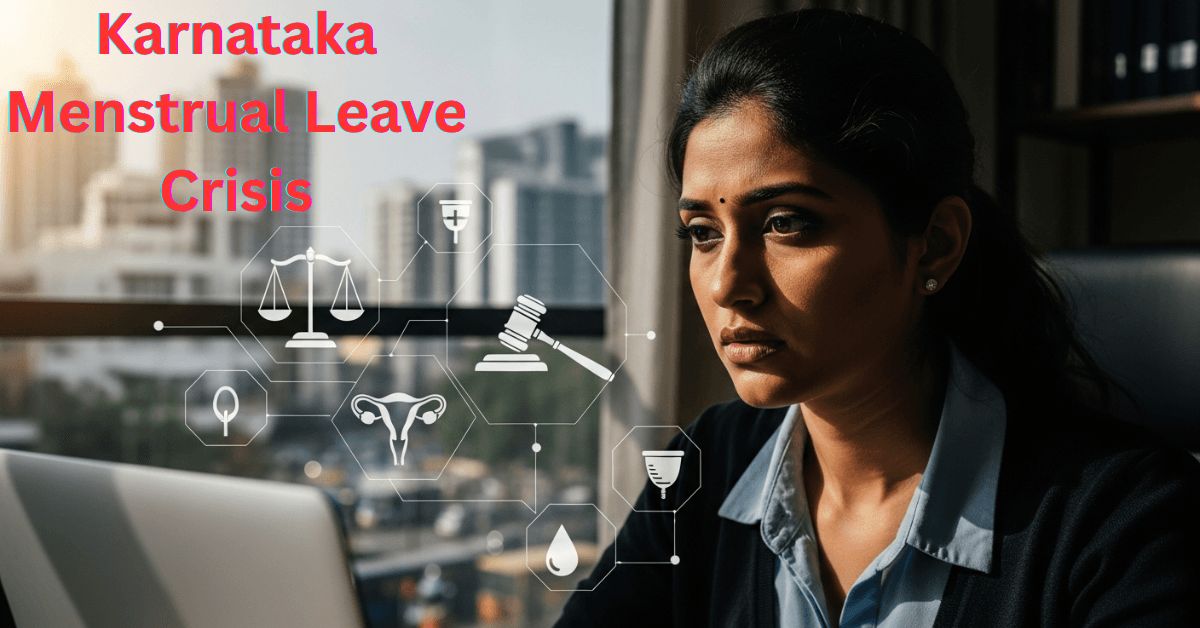
Karnataka Menstrual Leave Crisis
By Krishna Arya | Network Bharat
Karnataka menstrual leave policy for private sector : In late 2025, Karnataka appeared to make history. By announcing 12 days of mandatory paid menstrual leave for women in the private sector, the state positioned itself as a leader in gender-sensitive labour reform. The move was celebrated as a long-overdue recognition of menstrual health as a workplace issue—one grounded in constitutional morality and the promise of substantive equality for women.
But within weeks, this progressive decision landed in the Karnataka High Court. What initially looked like a victory for women has now exposed a far deeper crisis—one that goes beyond menstrual leave and strikes at the heart of India’s digital workforce.
In an era where employees can work from anywhere, can a state-specific labour right actually travel with a woman across state borders?
When Progressive Policy Meets Digital Reality
The Karnataka government issued the menstrual leave order using its executive power under Article 162 of the Constitution. On paper, the order applies to all private establishments operating within the state.
Yet the modern workplace is no longer confined to physical offices.
Today, a software engineer may be hired by a Bengaluru-based company but work permanently from Noida, Mumbai, or even a tier-2 city. The “establishment” is in Karnataka, but the “workplace” is elsewhere. This creates a legal grey zone that labour law was never designed to handle.
Traditionally, labour regulation follows the principle of lex loci laboris—the law of the place where work is performed. In remote work arrangements, that location becomes fluid, fragmented, and often invisible.
So the critical question arises:
If a woman employee works remotely outside Karnataka and is denied menstrual leave, does the Karnataka Labour Commissioner have jurisdiction to intervene?
Without a clear statutory framework, enforcement becomes nearly impossible.
Executive Power Has Limits
Indian constitutional law has long held that executive orders cannot create obligations that infringe upon rights unless backed by legislation. Courts have consistently ruled that executive action must operate within the boundaries set by law.
This is where Karnataka’s menstrual leave order begins to look fragile.
Without a central statute recognising menstrual leave as a legal entitlement, the government order risks becoming symbolic rather than enforceable—especially for remote employees. For thousands of women working from outside the state, menstrual leave may exist only on paper, subject entirely to corporate goodwill and HR policies.
In such a scenario, constitutional protection quietly gives way to managerial discretion.
A New Barrier to Free Trade?
The problem doesn’t stop at enforcement.
By imposing a financial obligation on companies operating in Karnataka—one that neighbouring states do not—the policy may inadvertently create economic distortions. Employers looking to minimise compliance costs may simply prefer hiring remote workers from states without such mandates.
This creates a troubling outcome:
- Women located in progressive states become “costlier” employees.
- Women in less regulated states become more attractive for remote hiring.
- Gender justice becomes a competitive disadvantage.
India’s Constitution envisions free trade and movement across state borders. When labour costs differ sharply due to state-level mandates, the free flow of labour—and opportunity—can be indirectly restricted.
In the digital economy, where hiring decisions are increasingly borderless, such distortions are amplified.
Ease of Doing Business vs Ease of Living
The deeper structural issue lies in India’s labour law transformation.
The Social Security Code, 2020 was introduced with the promise of “one nation, one labour market.” By consolidating multiple laws, the government aimed to simplify compliance and improve India’s Ease of Doing Business rankings.
But simplification came at a cost.
Labour welfare provisions—especially those unique to women—were diluted or left undefined. Menstrual leave was not codified as a statutory right. As a result, it remains vulnerable to being classified as a “discretionary benefit” rather than a legal entitlement.
For companies operating across states, the Code makes payroll and compliance easier. For workers, especially women, it weakens the state’s ability to enforce localized welfare protections.
In the digital workplace, efficiency has quietly overtaken empathy.
The Gig Economy Blind Spot
Perhaps the most glaring omission in Karnataka’s notification is its silence on gig and platform workers.
Bengaluru is widely regarded as India’s gig economy hub. Delivery partners, beauty professionals, and service workers form the backbone of app-based platforms. Many of these workers are women, often performing physically demanding tasks under algorithmic pressure.
Yet the menstrual leave order offers them nothing.
The Social Security Code recognises “platform workers” as a category but deliberately stops short of granting them employee status. This distinction allows companies to avoid obligations under laws like the Maternity Benefit Act, 1961.
The result is a hierarchy of rights:
- White-collar corporate employees receive menstrual leave.
- Gig workers—often facing greater physical stress—are excluded.
- Contract type, not human need, determines dignity.
Such arbitrary classification raises serious equality concerns and risks deepening structural gender injustice.
Why Menstrual Rights Must Be Portable
The ongoing litigation highlights a fundamental truth:
Social justice cannot be a geographical accident.
In a digital economy, rights tied to physical location are destined to fail. For menstrual health protections to be meaningful, they must be portable—attached to the worker, not the workplace.
This requires structural reform, not symbolic announcements.
The Way Forward: Three Urgent Legal Reforms
To ensure menstrual leave does not become another unfulfilled promise, India must move beyond executive orders.
- Amend the Maternity Benefit Act, 1961
Menstrual health leave must be explicitly recognised as a statutory right, applicable across sectors and states. - Harmonise Labour Codes with Remote Work Reality
Central labour laws must address jurisdiction and enforcement in work-from-anywhere arrangements. - Include Gig and Platform Workers
The definition of “employee” must be expanded to reflect economic dependency, not contractual labels.
Only then can menstrual leave move from being a progressive headline to a lived reality.
Conclusion: Rights That Travel With Women
Karnataka’s initiative deserves recognition—but also honest scrutiny. In its current form, menstrual leave risks becoming a privilege for a few rather than a right for all.
As India’s workforce becomes increasingly digital, labour law must evolve from geography-based control to person-centric protection. Women’s health cannot depend on where a laptop is opened or which state issues an offer letter.
True progress will come not when policies sound good—but when rights follow women wherever they work.
#MenstrualLeaveIndia, #WomenAtWork, #LabourLawReform, #RemoteWorkIndia, #GigWorkersRights, #GenderJustice, #KarnatakaHighCourt, #ConstitutionalRights, #MenstrualHealth, #WorkplaceEquality, #DigitalWorkforce, #Article15
❓ People Also Ask (PAA)
1. What is Karnataka’s menstrual leave policy for private sector employees?
Karnataka announced 12 days of paid menstrual leave for women in the private sector in 2025. The policy aims to recognize menstrual health as a workplace issue but currently faces legal scrutiny due to the lack of statutory backing.
2. Does menstrual leave apply to remote workers employed by Karnataka companies?
This remains legally unclear. While the employer may be based in Karnataka, labour laws traditionally apply where work is performed, creating enforcement challenges for remote employees working outside the state.
3. Is menstrual leave a legal right in India?
As of now, menstrual leave is not a statutory right under central labour laws. Without amendments to the Maternity Benefit Act or Labour Codes, it remains dependent on state policies or company discretion.
4. Why is Karnataka’s menstrual leave order challenged in court?
The challenge questions whether the state government can impose financial obligations on private employers through executive orders without legislative approval.
5. Are gig workers covered under menstrual leave policies?
No. Gig and platform workers are not classified as “employees” under current labour laws, which excludes them from benefits like menstrual or maternity leave.
6. Can state-specific labour laws affect companies across India?
Yes. State-level mandates can influence hiring decisions, compliance costs, and remote recruitment, raising concerns about free trade and labour mobility across states.
7. How does the Social Security Code, 2020 impact women workers?
While it simplifies labour compliance, critics argue that it prioritizes Ease of Doing Business over worker welfare, leaving many women-specific protections undefined or optional.