Parliamentary Panel Agenda 2026-27
By Krishna Arya | NetworkBharat.com
India’s foreign policy is set to receive a comprehensive parliamentary review in 2026-27, with important issues ranging from India-Pakistan relations and China’s growing regional influence to United Nations reforms and India’s ambition for a permanent seat on the UN Security Council (UNSC).
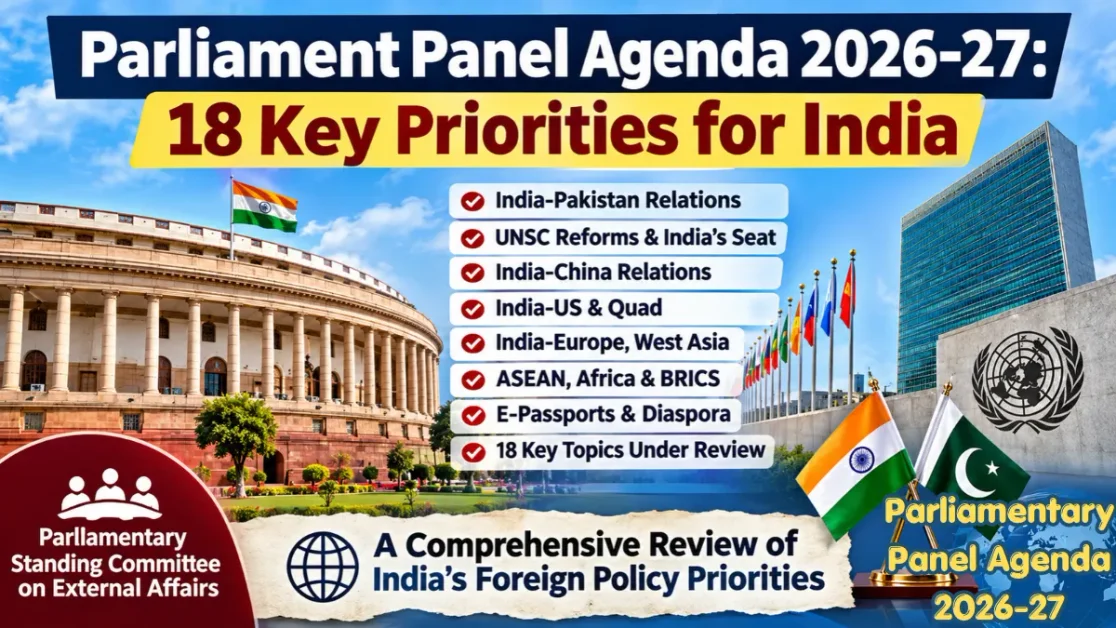
The Parliamentary Standing Committee on External Affairs has selected 18 important subjects for examination during the 2026-27 period. The wide-ranging agenda reflects India’s evolving diplomatic priorities, strategic interests, international partnerships and the need to strengthen its diplomatic institutions.
According to a bulletin issued by the Lok Sabha Secretariat on November 16, the committee will examine India’s relations with major global powers, regional organisations, passport services, overseas Indian welfare and the functioning of diplomatic institutions.
The Parliamentary Panel Agenda 2026-27 is particularly significant because it brings together traditional foreign policy concerns and emerging priorities such as international mobility, cultural diplomacy, investment promotion and knowledge partnerships.
Let’s look at all 18 major subjects selected by the parliamentary committee and understand why they matter for India.
Parliamentary Panel Agenda 2026-27: What Has Been Announced?
The Committee on External Affairs has selected subjects covering India’s bilateral relations, multilateral diplomacy, regional cooperation and institutional development.
The agenda includes some of the most important questions facing Indian diplomacy today:
- How should India manage its relations with Pakistan and China?
- What steps are needed to strengthen India’s demand for permanent UNSC membership?
- How can India expand its strategic partnerships with the United States and Europe?
- Are India’s passport and emigration systems prepared for growing international mobility?
- How can Indian diplomatic institutions become more effective?
These questions make the committee’s annual agenda important not only for policymakers but also for citizens, international businesses and the Indian diaspora.
18 Key Priorities in the Parliamentary Panel Agenda 2026-27
1. India-Europe Relations: Opportunities and Challenges
India’s relationship with European countries has become increasingly important for trade, technology, investment, defence cooperation and international diplomacy.
The committee will examine the opportunities and challenges in India’s relationship with Europe.
Key areas of interest include economic cooperation, emerging technologies, energy security, supply chains, climate action and strategic partnerships.
Stronger India-Europe relations could create new opportunities for Indian businesses, exporters, students and professionals.
2. Passport Issuance System and E-Passports
The committee will review the performance of India’s passport issuance system, including the introduction of e-passports.
It will also examine the Indian Passport Act and related rules.
This subject directly affects ordinary citizens. Faster passport services, improved digital systems, better security features and accessible passport facilities are important as more Indians travel abroad for education, employment, business and tourism.
The review could help identify areas where passport services require further improvement.
3. India-China Relations: Understanding the Way Forward
India-China relations remain one of the most important strategic subjects for Indian foreign policy.
Both countries have significant economic and geopolitical influence, but border-related concerns, regional competition and strategic differences continue to shape their relationship.
The parliamentary committee will examine the present situation and the future direction of bilateral relations.
The review is important for understanding how India can protect its national interests while managing diplomatic engagement with its neighbour.
4. Recent Developments in India-Pakistan Relations
India-Pakistan relations remain a major concern from the perspective of national security and regional stability.
The committee has selected recent developments in bilateral relations for examination.
Issues surrounding cross-border terrorism, security concerns, diplomatic engagement and regional developments are likely to form part of the broader discussion.
For India, maintaining national security while responding to developments in the neighbourhood remains an important foreign policy priority.
5. India-US Relations and the Role of the Quad
The United States is one of India’s most important strategic partners.
Cooperation between the two countries covers defence, trade, technology, education, energy and regional security.
The committee will examine India-US relations, including the role of the Quadrilateral Security Dialogue, commonly known as the Quad.
The Quad brings together India, the United States, Japan and Australia.
Its cooperation covers areas such as maritime security, infrastructure, critical technologies, resilient supply chains and a free and open Indo-Pacific.
The parliamentary review will provide an opportunity to examine the challenges and opportunities in this important partnership.
6. India’s Relations with West Asia
West Asia holds enormous importance for India because of energy supplies, trade, investment, employment and the presence of millions of Indian nationals in the region.
India maintains important relationships with countries across the region.
Developments in West Asia can directly influence India’s energy security, shipping routes, economic interests and the safety of Indian citizens working overseas.
The committee’s examination of this relationship is therefore significant for India’s economic and diplomatic interests.
7. United Nations Reforms and India’s Permanent UNSC Seat
One of the most strategically important subjects on the agenda is reforming the United Nations and India’s bid for permanent membership of the UN Security Council.
India has consistently argued that the present structure of the Security Council does not adequately reflect contemporary global realities.
The UN Security Council has five permanent members: China, France, Russia, the United Kingdom and the United States.
India has been seeking a greater role in global decision-making, including permanent membership in an expanded Security Council.
The parliamentary review will examine India’s position on UN reforms and its continuing diplomatic efforts.
A stronger role in global institutions would provide India with greater opportunities to contribute to international peace, security and governance.
8. Act East Policy and Partnership with ASEAN
India’s Act East Policy is an important pillar of its engagement with Southeast Asia and the wider Indo-Pacific region.
The committee will examine the policy and India’s partnership with the Association of Southeast Asian Nations (ASEAN).
Cooperation with ASEAN is important for trade, connectivity, maritime security, investment, tourism and regional stability.
Improved connectivity with Southeast Asian countries can also strengthen India’s economic links with the wider Indo-Pacific region.
9. India-Africa Strategic Partnership
India and African countries share longstanding diplomatic, economic and cultural connections.
The committee will examine India’s strategic partnership with Africa.
Important areas include development cooperation, healthcare, education, agriculture, digital technology, infrastructure and trade.
Africa is also becoming increasingly important in global economic and geopolitical discussions.
Strengthening this partnership can create opportunities for Indian businesses while supporting development cooperation across the continent.
10. India’s Engagement with BRICS
BRICS has emerged as an important platform for cooperation among major emerging economies.
The committee will review India’s engagement with the grouping.
The areas of interest include economic cooperation, development finance, international trade, global governance and coordination among member countries.
For India, BRICS offers an additional platform to raise concerns about the interests of developing economies and advocate reforms in international institutions.
11. India’s Soft Power and Cultural Diplomacy
India’s international influence is not limited to economic and military strength.
Its cultural heritage, yoga, traditional knowledge, cinema, literature, food and democratic institutions contribute to its global image.
The committee will examine India’s soft power and cultural diplomacy.
Cultural diplomacy can help build international understanding, strengthen people-to-people connections and expand India’s influence across different regions.
It also creates opportunities to promote Indian tourism, educational institutions and cultural industries.
12. Nalanda University and South Asian University
The committee will examine the functioning of Nalanda University and South Asian University.
The review will cover governance, international participation and their contribution to knowledge diplomacy.
Educational institutions can strengthen India’s international relationships by attracting students, researchers and academic experts from other countries.
Their performance is therefore relevant to India’s broader diplomatic and educational ambitions.
13. Functioning of Indian Missions Abroad
Indian embassies, high commissions and consulates play a crucial role in representing the country’s interests overseas.
They provide consular assistance, support Indian citizens, facilitate trade and investment, and strengthen diplomatic relationships.
The committee will review the functioning of Indian missions abroad.
The subject is especially important as the number of Indians travelling, studying and working overseas continues to create demand for effective diplomatic and consular services.
14. Emigration, Skilled Professionals and Welfare of the Indian Diaspora
Millions of Indians live and work outside the country.
Their welfare, safety, legal protection and employment opportunities are important national concerns.
The committee will examine emigration-related issues, international mobility of skilled professionals and the welfare of the Indian diaspora.
The review may help identify challenges involving overseas employment, worker protection, recruitment practices and consular support.
India also has an opportunity to strengthen its position as a major source of skilled professionals for the global economy.
15. India-Bhutan Bilateral Relations
Bhutan is one of India’s important neighbouring partners.
The two countries share close historical, economic and cultural relationships.
Their cooperation includes hydropower, infrastructure, connectivity, education, trade and regional development.
The committee’s examination of India-Bhutan relations will help assess the importance of this partnership in India’s neighbourhood policy.
16. Strengthening the Indian Foreign Service
India’s international responsibilities are expanding, making an effective diplomatic workforce increasingly important.
The committee will examine ways to strengthen the Indian Foreign Service.
Diplomats represent India in international negotiations, manage bilateral relationships, protect overseas citizens and promote economic interests.
Adequate staffing, professional training, specialised expertise and modern diplomatic capabilities are important for meeting India’s growing global responsibilities.
17. Role of States and Union Territories in External Engagement
Foreign policy is primarily handled by the Union Government, but states and Union Territories can contribute significantly to India’s international engagement.
The committee will examine their role in external engagement, including diaspora outreach and investment promotion.
States can attract foreign investment, promote exports, develop international partnerships and strengthen cultural connections.
This approach can help connect India’s international diplomatic objectives with regional economic development.
18. Ministry of External Affairs’ Engagement with Think Tanks and Academic Institutions
The final subject concerns the Ministry of External Affairs’ engagement with think tanks and academic institutions.
Research organisations and universities can provide valuable insights into international developments, geopolitical challenges, economic trends and emerging technologies.
Stronger cooperation between policymakers, researchers and academic institutions can improve the quality of foreign policy discussions and strategic planning.
It can also encourage informed public debate about India’s international role.
Why Is the Parliamentary Panel Agenda 2026-27 Important for India?
The selection of these subjects is important because it reflects the wide range of responsibilities facing Indian diplomacy.
The agenda goes beyond traditional discussions about neighbouring countries and international security.
It also addresses issues that directly affect citizens, including passport services, overseas employment, skilled migration and the welfare of Indians living abroad.
Three broader priorities stand out.
First, strategic security and global influence: India-Pakistan relations, China, the United States and UN reforms highlight India’s continuing focus on national security and its international position.
Second, economic and regional partnerships: Relations with Europe, ASEAN, Africa, Bhutan and BRICS demonstrate the importance of expanding India’s economic and diplomatic partnerships.
Third, stronger diplomatic institutions: Passport services, Indian missions, the Foreign Service, universities and research organisations highlight the need to improve the institutions supporting India’s international engagement.
Together, these priorities reflect the growing complexity of India’s foreign policy responsibilities.
Will the Committee Announce New Recommendations or Government Policies?
It is important to understand that selecting a subject for parliamentary examination does not mean that a new policy has already been approved.
The committee will examine the selected subjects through its parliamentary process. This may involve discussions with government representatives, expert consultations, evidence and deliberations.
Its observations and recommendations, if adopted and presented, can contribute to parliamentary scrutiny and policy discussions.
Therefore, the 2026-27 agenda should be viewed as a roadmap for parliamentary examination rather than a list of newly announced government decisions.
What Does This Mean for India’s Future Foreign Policy?
India’s international role is expanding as global politics, economic relationships and security challenges continue to change.
The country must balance relationships with major powers, strengthen partnerships with neighbouring countries, protect its overseas citizens and participate more actively in international institutions.
The subjects selected by the parliamentary committee reflect these interconnected priorities.
The review of India’s foreign policy will also be important for assessing whether existing diplomatic institutions and international partnerships are equipped to meet future challenges.
Conclusion
The Parliamentary Panel Agenda 2026-27 represents a broad examination of India’s diplomatic priorities, strategic relationships and institutional capabilities.
From India-Pakistan relations and China to UN reforms, e-passports, the Indian diaspora and international partnerships, the 18 selected subjects cover several important dimensions of India’s global engagement.
The committee’s examination will provide an opportunity to assess India’s foreign policy priorities and identify areas requiring greater attention.
At a time when international relations are becoming increasingly complex, effective parliamentary scrutiny can play an important role in strengthening India’s diplomatic preparedness and protecting its national interests.
For India, the challenge is not simply to expand its global presence but to build the diplomatic capacity needed to turn international influence into long-term national progress.
Source: Lok Sabha Secretariat bulletin dated November 16, 2026; Press Trust of India report dated November 17, 2026.
Author: Krishna Arya | NetworkBharat.com
#ParliamentaryPanel, #IndiaForeignPolicy, #IndiaPakistanRelations, #UNSCReforms, #IndiaUNSC, #ShashiTharoor, #IndianParliament, #IndiaChinaRelations, #IndiaUSRelations, #Quad, #BRICS, #ActEastPolicy, #IndianDiplomacy, #BreakingNews, #IndiaNews