By Krishna Arya | Network Bharat
Website: https://networkbharat.com
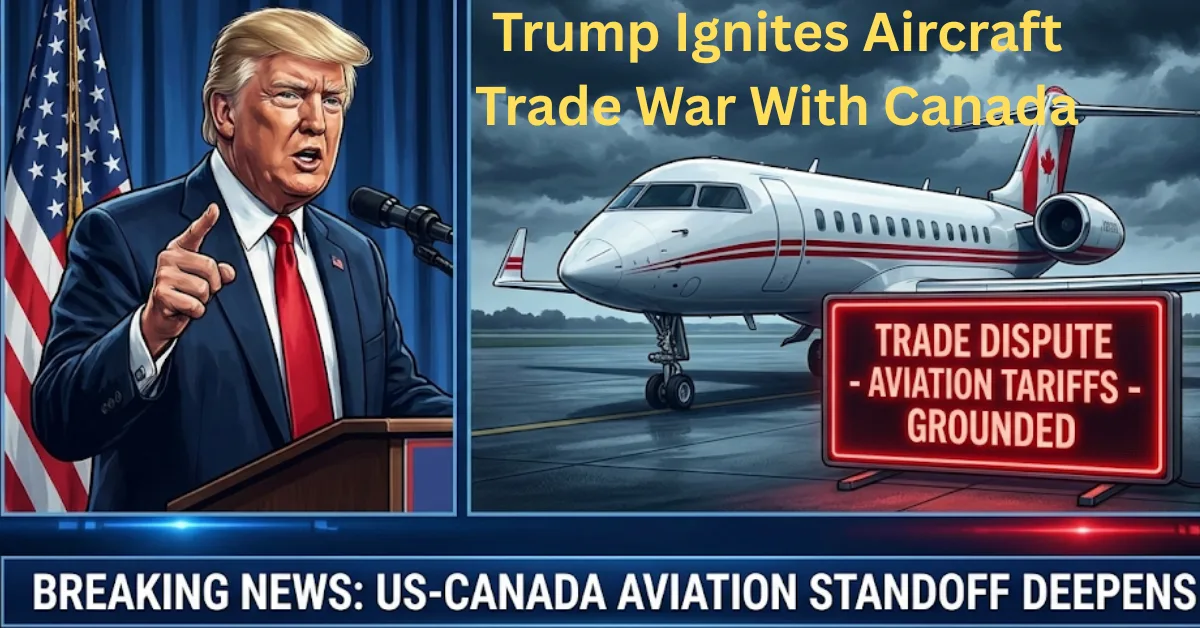
Trump Ignites Aircraft Trade War With Canada
Donald Trump Canada aircraft trade war : A new flashpoint has emerged in the already fragile relationship between the United States and Canada — and this time, it’s flying at 40,000 feet.
In a dramatic escalation of the trade war, U.S. President Donald Trump has threatened to decertify Canadian-made aircraft and impose a 50% tariff on planes sold in the U.S., accusing Canada of unfairly blocking certification of American-made Gulfstream business jets.
The move has sent shockwaves through the global aviation industry, rattled investors, and raised serious questions about whether political retaliation is now spilling into aviation safety — a domain traditionally kept free from trade wars.
What Triggered Trump’s Aircraft Ultimatum?
At the center of the controversy lies Canada’s refusal to certify Gulfstream 500, 600, 700, and 800 business jets. Trump described these aircraft as “the greatest, most technologically advanced airplanes ever made” and called Canada’s stance “wrong and illegal.”
Posting on Truth Social, Trump warned that unless Canada immediately reverses its decision, the U.S. would:
- Decertify Bombardier Global Express jets
- Decertify all aircraft made in Canada
- Impose a 50% tariff on all Canadian aircraft sold in the U.S.
The ultimatum marked a rare moment where aircraft certification — usually handled by independent regulators — became a weapon in a geopolitical dispute.
Bombardier in the Crosshairs
Canada’s aviation giant Bombardier stands to suffer the most if Trump follows through.
Bombardier aircraft are deeply embedded in the U.S. aviation ecosystem:
- American Airlines’ regional fleet operates nearly 200 CRJ aircraft
- Delta’s regional partners fly over 150 CRJ jets
- Hundreds of Bombardier business jets are already in service across the U.S.
Any decertification would not just hurt future sales — it could disrupt leasing, maintenance, insurance, and long-term fleet planning for American carriers themselves.
Aviation Experts Sound the Alarm
Industry analysts have reacted with alarm.
Richard Aboulafia, Managing Director at AeroDynamic Advisory, warned that presidential involvement in aircraft certification is “a very bad idea.” He also questioned whether the U.S. President even has the authority to override aviation regulators.
That concern is widely shared because aircraft certification in the U.S. is handled by the Federal Aviation Administration, which operates independently of political offices.
So far, the FAA has declined to comment, referring all questions back to the White House.
Why Gulfstream Is Central to the Dispute
Ironically, Gulfstream Aerospace announced last year that its flagship G800 jet had already received certification from both the FAA and Europe’s aviation regulator.
This raises a critical question:
If certification already exists, why has the issue exploded now?
Analysts believe the certification dispute is a pressure point, not the real reason.
The Bigger Picture: Politics, China & USMCA
The aircraft threat is part of a much larger geopolitical standoff.
Trump has reportedly been angered by:
- Remarks from Canadian Prime Minister Mark Carney at the World Economic Forum in Davos, where he openly criticized Trump’s economic worldview
- Canada’s recent trade engagement with China, including deals involving canola exports and electric vehicle quotas
- Canada’s efforts to diversify trade away from U.S. dominance
Trump has already threatened:
- 100% tariffs on Canadian goods if Ottawa deepens trade with China
- New penalties on countries supplying oil to Cuba
- Fresh trade pressure ahead of the USMCA renegotiation
In this context, aviation appears to be the latest — and most symbolic — battleground.
Could This Actually Happen?
Despite the aggressive rhetoric, major obstacles remain:
- Aircraft safety certification is governed by law, not executive tweets
- U.S. airlines themselves rely heavily on Canadian aircraft
- Retaliatory measures from Canada could hit U.S. aerospace firms hard
Still, markets don’t wait for legal clarity — and uncertainty alone can freeze billion-dollar aircraft orders.
What This Means for Global Aviation
If politics begins dictating aircraft certification:
- Global aviation safety norms could be undermined
- Aircraft makers may face fragmented approval systems
- Airlines could see higher costs, delays, and legal risks
More importantly, it would set a precedent where national pride overrides technical safety assessments — a scenario that alarms regulators worldwide.
Final Take: A Dangerous Line Has Been Crossed
Trump’s aircraft decertification threat is not just another tariff headline — it represents a dangerous overlap of politics, trade, and aviation safety.
Whether the threat materializes or fades, one thing is clear:
The skies over North American trade relations have never been more turbulent.
As Canada and the U.S. edge toward USMCA renegotiations, the world will be watching to see whether cooler heads prevail — or whether this trade war truly takes flight.
#TrumpCanadaTradeWar, #AircraftTariffs, #GulfstreamJets, #Bombardier, #USCanadaRelations, #TradeWar2026, #AviationNews, #GlobalTrade, #USMCA, #EconomicTensions, #BreakingNews, #WorldPolitics
Stay informed with Network Bharat for trusted, human-focused explainers on global politics, economy, and policy.