UK Citizenship Crisis
By Krishna Arya
Website: https://networkbharat.com
UK Citizenship Crisis : Britain is facing one of the most serious citizenship debates in its modern history. A new report has sent shockwaves across communities by warning that under current UK laws, nearly 9 million people — around 13 percent of the population — could legally be stripped of their British citizenship. What makes this revelation more disturbing is not just the scale, but who is most at risk.
According to the report published jointly by the Runnymede Trust and Reprieve, these extraordinary powers disproportionately threaten Muslims, South Asians, and people of African and Middle Eastern descent, effectively creating what critics describe as a two-tier citizenship system in the United Kingdom.
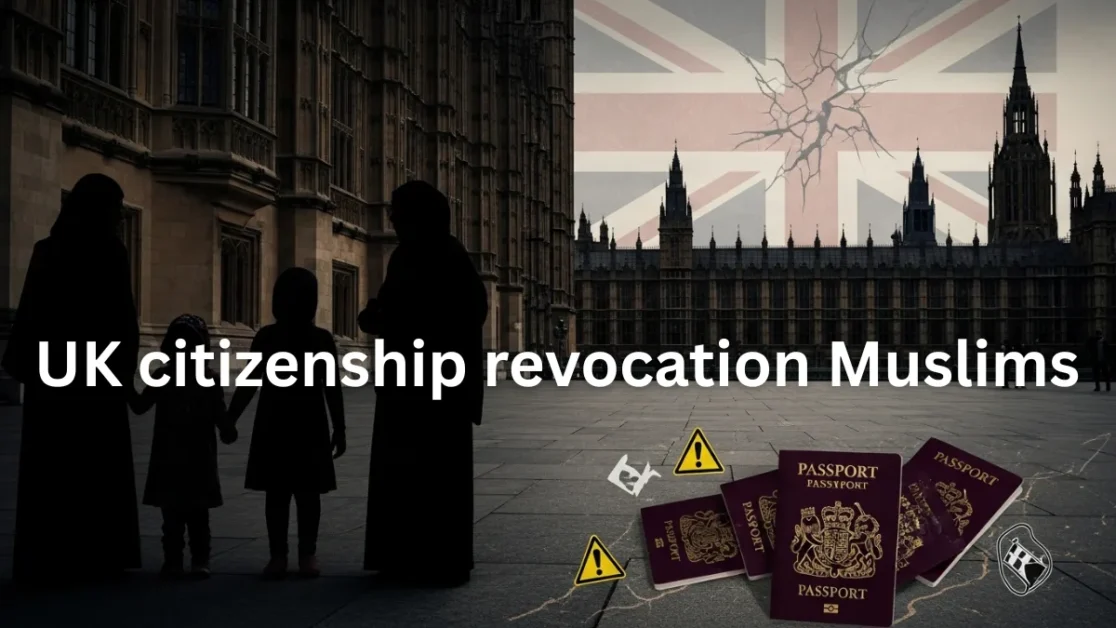
UK citizenship revocation Muslims
A Power Few Knew Existed — But Millions May Face
Under Section 40(2) of the British Nationality Act, the UK Home Secretary has the authority to revoke citizenship if doing so is considered “conducive to the public good.” Crucially, the law allows this action even if the person has never lived in, visited, or had any meaningful connection with another country, as long as they are deemed eligible for another nationality.
The report calls this power “extreme, secretive, and fundamentally discriminatory.”
At the centre of this debate is Home Secretary Shabana Mahmood, Britain’s first Muslim Home Secretary. While her appointment was initially welcomed as a step toward representation and inclusivity, the report argues that the powers of her office — regardless of who holds it — pose an existential threat to Muslim communities.
This is not about individual intentions. It is about unchecked authority embedded in law.
Who Is Most at Risk — And Why It Matters
The findings reveal a stark racial imbalance:
- Three out of every five people of colour in Britain could theoretically be stripped of citizenship
- Compared to just one in 20 white British citizens
- This means people of colour are 12 times more likely to be affected
The groups most exposed include British citizens with ancestral links to:
- India (98.4 million people globally)
- Pakistan (67.9 million)
- Bangladesh
- Somalia
- Nigeria
- North Africa and the Middle East
For millions of British Muslims, citizenship is not just a legal status — it is a source of security, belonging, and identity. The idea that this status can be revoked without warning has created a deep sense of fear and alienation.
From Citizens to “Conditional Belonging”
One of the most troubling aspects of the report is its conclusion that UK law has created two classes of citizenship:
- Permanent citizenship — largely enjoyed by white British citizens
- Conditional citizenship — applied to Muslims and ethnic minorities
In effect, some citizens must continually “prove” their right to belong, while others never have to think about it.
This undermines a fundamental democratic principle: citizenship should be equal and secure, not dependent on ethnicity or heritage.
Lessons Britain Failed to Learn from the Windrush Scandal
The report draws chilling parallels with the Windrush scandal, one of the darkest chapters in recent British history.
Thousands of Caribbean-origin British citizens — many of whom had lived in the UK for decades — were wrongly classified as illegal immigrants. They lost jobs, homes, healthcare access, and in some cases, were detained or deported.
At the time, the British government admitted “institutional failure” and promised reform.
Yet, critics argue that citizenship deprivation laws repeat the same mistakes, only this time with far wider reach.
Laws That Quietly Expanded State Power
Two major legal changes have intensified concern:
🔴 2022 Amendment
The UK government introduced a provision allowing citizenship to be revoked without notifying the individual if notice was deemed “not reasonably practicable.”
In simple terms: a person could lose their nationality without even knowing it.
🔴 2025 Update
Even more alarming, a new rule states that if a court later finds the revocation unlawful, citizenship will not be automatically restored until all appeals are exhausted — a process that can take years.
Legal experts warn this creates a dangerous precedent where unlawful decisions still carry life-altering consequences.
Shamima Begum: A Case That Changed Everything
The most well-known example of citizenship deprivation is Shamima Begum, who left the UK as a teenager to join ISIS.
In 2019, her British citizenship was revoked on the grounds that she was eligible for Bangladeshi nationality — a claim Bangladesh categorically rejected.
The case exposed a legal loophole:
A British citizen can be rendered effectively stateless, despite international law prohibiting it.
Since 2010, more than 200 people — mostly Muslims — have had their citizenship revoked under “public interest” justifications.
Many cases remain shrouded in secrecy, limiting public accountability.
What Happens If Citizenship Is Taken Away?
For most affected individuals, losing British citizenship would not mean relocation to a familiar homeland.
Instead, they may be forced to seek refuge in countries they have never lived in, such as India, Pakistan, or Bangladesh — nations already grappling with population pressure and limited resources.
For families, this could mean:
- Separation from children and spouses
- Loss of employment and healthcare
- Psychological trauma and social isolation
Experts describe this as a form of “civil death” — the loss of rights without a criminal conviction.
Why Muslim Communities Feel Targeted
While the law is framed as religion-neutral, its impact tells a different story.
National security narratives, counter-terrorism policies, and post-9/11 politics have disproportionately focused on Muslims. The report warns that if nationalist politics gain momentum, these powers could be expanded even further.
The fear is not hypothetical. It is grounded in lived experience.
As one legal expert quoted in the report notes:
“Citizenship should never be a privilege that can be withdrawn — it is the foundation of all other rights.”
Demands Growing Louder: Repeal Section 40(2)
Human rights organisations are calling for:
- Immediate suspension of citizenship deprivation powers
- Full repeal of Section 40(2) of the British Nationality Act
- Transparent oversight and parliamentary accountability
They argue that national security does not require abandoning equal citizenship.
Thus far, the UK Home Office has declined to comment on the report.
A Question Britain Must Answer
At its core, this debate is not only about law — it is about what kind of country Britain wants to be.
Can a democracy justify laws that make millions of its citizens feel permanently insecure?
Can equality exist when some passports are more fragile than others?
For Britain’s Muslim and minority communities, these are not abstract questions. They shape daily life, identity, and trust in the state.
Conclusion: Citizenship Should Unite, Not Divide
The warning issued by the Runnymede Trust and Reprieve is clear:
Unchecked citizenship powers risk eroding the very idea of equal belonging in Britain.
History has already shown the consequences of such policies. The question now is whether Britain will learn — or repeat its mistakes on a much larger scale.
As this debate unfolds, one truth remains undeniable:
Citizenship should be a bond of trust, not a tool of fear.
#UKCitizenship, #CitizenshipCrisis, #MuslimsInUK, #BritishNationalityAct, #HumanRightsUK, #MinorityRights, #ImmigrationLaws, #ShamimaBegum, #WindrushScandal, #UKPolitics, #NationalSecurityLaw, #CitizenshipRights, #SouthAsianDiaspora, #MuslimCommunity, #CivilLiberties
Also Read This :
Human Rights Concerns in the UKUK Immigration and Citizenship Laws ExplainedWindrush Scandal: Britain’s Citizenship CrisisShamima Begum Citizenship Case ExplainedExternal Sources
Runnymede Trust Report on Citizenship LawsReprieve on UK Citizenship Deprivation PowersUK Home Office – Citizenship PolicyAmnesty UK on Immigration and Citizenship RightsUnited Nations on Human Rights Protections📌 Disclaimer
Disclaimer:
This article is published for informational and public awareness purposes only. It is based on publicly available reports, expert opinions, and documented sources at the time of writing. The content does not constitute legal advice, political advocacy, or an official interpretation of UK law.References to laws, policies, individuals, or communities are intended solely for journalistic analysis and discussion. Readers are advised to consult qualified legal professionals or official government sources for accurate and up-to-date legal guidance.
Network Bharat and the author do not intend to promote discrimination, fear, or misinformation against any country, religion, community, or individual. Any perceived implications are unintentional.
Views expressed in this article are based on independent research and do not represent the official position of the UK government or any related authority.