By Krishna Arya | NetworkBharat.com
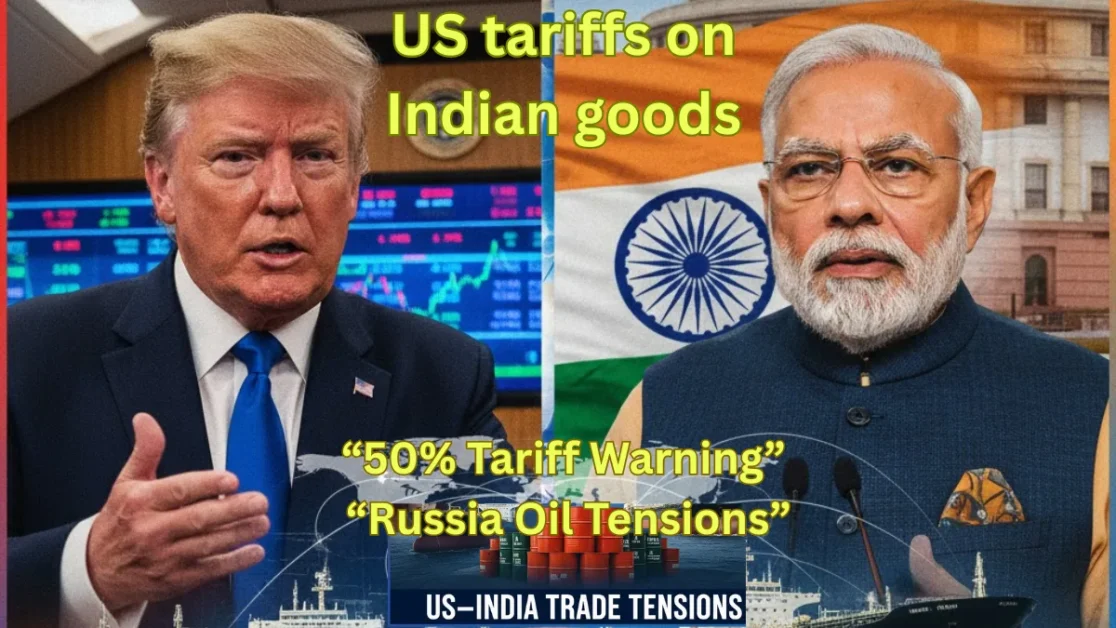
US tariffs on Indian goods : Tensions between Washington and New Delhi are once again in the spotlight after Donald Trump warned that the United States could impose steep tariffs on Indian goods if India does not cooperate with American concerns over its continued purchases of Russian oil.
Speaking to reporters aboard Air Force One, Trump struck a mix of praise and pressure while referring to Narendra Modi.
“PM Modi is a very good man. He’s a good person. He knew I wasn’t happy. They do trade, and we can put tariffs on them very quickly,” Trump said.
The remarks signal renewed uncertainty in US–India trade relations, even as both countries publicly describe each other as strategic partners.
Why Russian Oil Is at the Center of the Dispute
Since the start of the Russia-Ukraine war in 2022, India has emerged as the largest buyer of discounted Russian seaborne crude oil. The move helped India manage inflation and protect domestic fuel prices during a period of global energy volatility.
However, the strategy has drawn criticism from Western nations, particularly the United States, which argue that oil revenues help fund Russia’s war efforts against Ukraine.
Washington has repeatedly urged New Delhi to reduce its dependence on Russian energy—pressure that India has resisted.
Tariffs, Trade Talks and a Tough Standoff
The US was already seeking to reduce its trade deficit with India when it doubled import tariffs on Indian goods to 50% last year, citing India’s growing Russian oil imports as a key reason.
While many major economies managed to renegotiate trade terms with Washington and soften earlier tariff hikes, India–US negotiations hit a wall.
According to sources familiar with the talks:
- Discussions stalled in late July after India refused to open its agricultural markets to US products.
- New Delhi also rejected Trump’s offer to mediate a minor India–Pakistan issue, which reportedly irritated Washington.
- In August, the US responded by doubling tariffs on select Indian goods.
Despite the friction, back-channel communication between Trump and Modi never fully stopped.
Did India Promise to Stop Buying Russian Oil?
Trump claimed in October that Modi had assured him India would halt Russian oil purchases. New Delhi, however, has publicly denied making any such commitment.
Indian officials maintain that:
- Russian oil remains critical for India’s energy security.
- Sudden withdrawal could spike fuel prices for millions of Indians.
- Energy decisions are based on national interest, not political pressure.
At the same time, data suggests the situation may already be shifting.
Russian Oil Imports Fall Sharply
According to shipping data and analytics firm Kpler, India’s Russian oil imports fell to a three-year low of around 1.2 million barrels per day in December.
That figure marks:
- A 40% drop from the June peak of nearly 2 million barrels per day
- The impact of tightening US and EU sanctions on Russian shipping and payments
While India has not officially changed its policy, the numbers indicate that global sanctions are indirectly reshaping India’s oil sourcing.
What This Means for Indian Businesses and Consumers
If the US follows through on higher tariffs:
- Indian exporters—especially in textiles, engineering goods and chemicals—could face higher costs
- Trade uncertainty may impact foreign investment sentiment
- Fuel prices could remain volatile if India is forced to diversify energy imports quickly
For Washington, aggressive tariffs risk straining ties with one of its most important partners in the Indo-Pacific region.
The Road Ahead: Pressure vs Partnership
Despite tough rhetoric, analysts believe a complete breakdown is unlikely. Both sides have strong incentives to keep talks alive:
- The US sees India as a counterbalance to China
- India values access to American markets and technology
Yet, as Trump’s comments show, Russian oil remains the biggest obstacle in an otherwise expanding relationship.
Whether diplomacy prevails over tariffs will depend on how much flexibility both leaders are willing to show in the coming months.
🔍 People Also Ask (PAA)
❓ Why is the US threatening tariffs on Indian goods?
The US says India’s large purchases of discounted Russian oil undermine sanctions meant to limit Russia’s war funding, prompting tariff threats.
❓ How much tariff has the US imposed on Indian products?
The US has doubled import tariffs on certain Indian goods to 50%, citing trade imbalance and Russian oil concerns.
❓ Why does India continue buying Russian oil?
India argues Russian oil is cheaper and essential for energy security, helping control fuel prices for millions of consumers.
❓ Has India agreed to stop buying Russian oil?
India has not officially agreed; New Delhi publicly denies making any firm commitment despite US claims.
❓ How much has India’s Russian oil import fallen recently?
India’s Russian oil imports dropped to about 1.2 million barrels per day in December, nearly 40% lower than mid-2024 levels.
❓ Are India and the US still negotiating a trade deal?
Yes, trade talks have resumed, but disagreements over agriculture, tariffs, and Russian oil remain unresolved.
❓ Could higher US tariffs affect Indian consumers?
Yes, higher tariffs could hurt exporters, weaken trade sentiment, and indirectly impact prices and jobs in export-linked sectors.
#USIndiaRelations, #TrumpTariffs, #RussianOil, #IndiaEnergySecurity, #ModiTrump, #GlobalTrade, #UkraineWar, #EconomicNews, #NetworkBharat