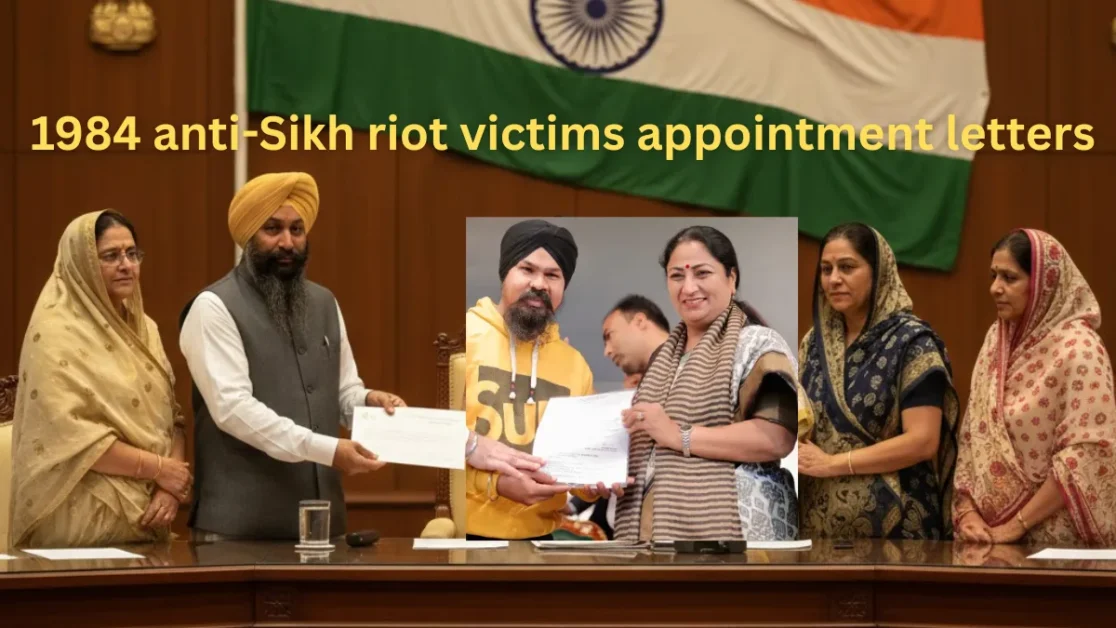
1984 anti-Sikh riot victims appointment letters
By Krishna Arya | Network Bharat
Website: https://networkbharat.com
A Promise Fulfilled After Four Decades of Waiting
1984 anti-Sikh riot victims appointment letters : For thousands of Sikh families scarred by the horrors of the 1984 anti-Sikh riots, justice has long felt like a distant dream. Lives were lost, homes were destroyed, and generations grew up carrying trauma, loss, and unanswered questions. This week, Delhi witnessed a moment that many believed would never come.
In a historic and deeply emotional move, Delhi Chief Minister Rekha Gupta handed over appointment letters to families and dependents of the 1984 anti-Sikh riot victims, marking the first time in India’s history that such direct government employment has been granted as a form of justice and rehabilitation.
The announcement is being widely seen not just as a welfare measure, but as moral recognition of decades-long suffering — a step that bridges the painful gap between memory and accountability.
What Happened in 1984: A Wound That Never Healed
The 1984 anti-Sikh riots erupted following the assassination of then Prime Minister Indira Gandhi. What followed was one of the darkest chapters in independent India’s history. Thousands of Sikhs were killed, families were displaced, and entire neighbourhoods were reduced to ashes.
Despite numerous commissions, inquiries, and court cases over the years, many victims felt forgotten. Compensation schemes were often delayed, poorly implemented, or insufficient. Employment promises made by successive governments remained largely on paper.
For survivors, justice was not just about punishment — it was about dignity, livelihood, and acknowledgement.
Rekha Gupta’s Move: Why This Is Truly Historic
Chief Minister Rekha Gupta’s decision stands out because it goes beyond symbolic gestures. By offering actual government jobs, the Delhi government has addressed one of the most pressing needs of affected families — economic stability.
During the appointment letter distribution ceremony, emotions ran high. Elderly parents who lost sons, widows who raised children alone, and families that struggled for decades were finally acknowledged by the state.
This is the first structured employment-based rehabilitation initiative for 1984 riot victims implemented at a government level, making it a landmark moment in India’s political and social history.
Manjinder Singh Sirsa: “What Others Promised, We Delivered”
Delhi Minister Manjinder Singh Sirsa, who has been closely associated with Sikh welfare issues, emphasised that this initiative was long overdue.
He stated that previous governments had repeatedly announced relief plans but failed to implement them meaningfully. According to Sirsa, this administration chose action over announcements.
“This is not charity. This is justice delayed, now delivered,” he said, adding that the government remains committed to ensuring no eligible family is left behind.
His remarks resonated strongly with the Sikh community, many of whom have expressed cautious optimism after years of disappointment.
More Than Jobs: A Step Towards Healing
While employment provides financial relief, the impact of this move goes much deeper. Sociologists and human rights experts believe that state acknowledgment plays a crucial role in collective healing.
For decades, many victims felt that their pain was minimised or politicised. This initiative sends a clear message — that the state recognises the injustice and is willing to take responsibility, even after 40 years.
The appointment letters symbolise something priceless: recognition, dignity, and closure.
Voices from the Ground: Families React
Several beneficiaries described the moment as overwhelming. Some families shared that they had almost lost hope of ever receiving justice.
One beneficiary said that while nothing could bring back lost loved ones, the job offers would secure their children’s futures — something their parents never lived to see.
Others expressed relief that the younger generation would no longer have to bear the economic consequences of a tragedy they never caused.
Why This Matters for India’s Democracy
India’s democracy is often judged by how it treats its most vulnerable citizens. Addressing historical injustices is not easy — it requires political will, empathy, and courage.
This move sets a precedent for how governments can address unresolved tragedies, not just through compensation but through long-term empowerment.
It also raises an important question: should other states and governments revisit unresolved cases of mass violence and injustice?
Political and Social Impact Ahead
The initiative has already sparked conversations nationwide. Supporters see it as a model for restorative justice, while critics argue it should have happened much earlier.
However, most agree on one point — delayed justice is still better than denied justice.
For Delhi’s administration, this move strengthens its image as one willing to confront uncomfortable truths rather than ignore them.
The Road Ahead: What More Can Be Done?
While this initiative is historic, experts believe it should be part of a broader framework that includes:
- Faster legal closure of pending riot cases
- Mental health support for survivors
- Educational support for children of affected families
- Public memorialisation and historical documentation
Justice is not a single event; it is a continuous process.
A Moment That Will Be Remembered
Forty years is a lifetime. Many who suffered in 1984 did not live to see this day. Yet, for those who remain, this moment restores faith in the idea that justice, though slow, can still arrive.
Delhi CM Rekha Gupta’s decision will be remembered not just as a political announcement, but as a rare instance where governance intersected with humanity.
For the families of the 1984 anti-Sikh riot victims, this is more than employment — it is validation, dignity, and a long-awaited acknowledgment of truth.
#1984AntiSikhRiots, #HistoricJustice, #RekhaGupta, #DelhiGovernment, #SikhCommunity, #JusticeAfter40Years, #ManjinderSinghSirsa, #HumanRightsIndia, #BreakingNewsIndia, #IndianPolitics
External Sources
Indian Laws & Justice Framework – India CodeNational Human Rights Commission of India
Universal Declaration of Human Rights – United Nations
Stay connected with Network Bharat for credible, human-focused stories that matter.