Pax Silica Explained: Why the US-Led AI & Silicon Alliance Leaves India Out
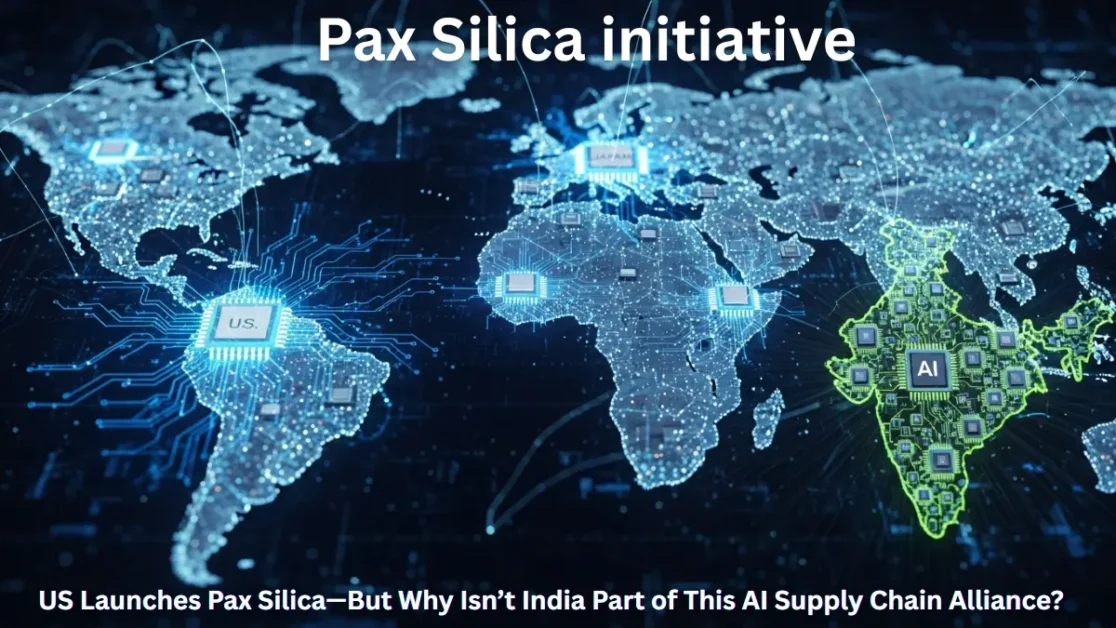
Pax Silica initiative
The United States has launched a bold new strategic initiative—Pax Silica—signalling a major shift in how global power will be defined in the age of artificial intelligence. Rooted in deep cooperation with trusted allies, the initiative aims to build a secure, innovation-driven silicon supply chain, from critical minerals to advanced AI infrastructure.
US Launches Pax Silica—But Why Isn’t India Part of This AI Supply Chain Alliance?
Yet, as Pax Silica makes headlines, one question dominates global policy circles: why is India not part of it?
What Is Pax Silica?
According to the US State Department, Pax Silica is a new kind of international partnership designed to reduce coercive dependencies, protect AI-critical materials, and ensure that aligned nations can develop and deploy transformative technologies at scale.
The initiative brings together countries that host the world’s most advanced technology companies, including Japan, South Korea, Singapore, the Netherlands, the UK, Israel, Australia, the UAE, Canada, and the European Union.
At its core, Pax Silica reflects a growing consensus in Washington:
Economic security is national security—and national security is economic security.
Why Pax Silica Matters in the AI Age
AI is no longer just about software. It depends on semiconductors, rare minerals, energy inputs, data infrastructure, and advanced manufacturing. Control over these layers now determines geopolitical influence.
Pax Silica aims to:
- Strengthen supply chain resilience
- Eliminate single points of failure
- Build trusted technology ecosystems
- Secure AI infrastructure and advanced manufacturing
- Counter coercive economic practices
The initiative aligns with President Donald Trump’s call for a new era of economic statecraft, where private investment and free enterprise underpin global stability.
The India Question: Why Was New Delhi Left Out?
India’s absence is striking—especially since all other Quad nations (the US, Japan, and Australia) are included.
This exclusion does not indicate a breakdown in US–India relations. Instead, experts point to:
- India’s non-aligned strategic posture
- Its emerging—not dominant—semiconductor ecosystem
- Ongoing efforts to build domestic chip manufacturing capacity
- A preference for Global South leadership rather than bloc-based alignments
Notably, India is charting its own AI path.
India’s Alternative Vision: The India-AI Impact Summit 2026
In a powerful counterbalance, Prime Minister Narendra Modi has announced the India-AI Impact Summit 2026, to be hosted in New Delhi on February 19–20, 2026.
This will be:
- The first-ever global AI summit hosted in the Global South
- Focused on People, Planet, and Progress
- A platform for inclusive, ethical, and sustainable AI development
India’s approach emphasizes AI for development, not dominance—positioning itself as a voice for emerging economies rather than exclusive tech blocs.
A New Global Tech Order Is Taking Shape
With Pax Silica, the US and its allies are formalising a reality that has been quietly unfolding: control over AI supply chains equals global influence.
As additional signatories are expected to join, Pax Silica could reshape:
- Semiconductor geopolitics
- AI infrastructure investments
- Global manufacturing networks
- Energy and mineral refining partnerships
India may not be inside Pax Silica—for now—but its independent AI leadership strategy ensures it remains a central player in shaping the future.
#PaxSilica #AIAlliance #GlobalTechPolitics #SemiconductorRace #AIGeopolitics #USLedInitiative #IndiaAndAI #QuadNations #TechDiplomacy #EconomicSecurity #NationalSecurity #FutureOfAI #SiliconSupplyChain
External Sources
US State Department: AI, Economic Security & Strategic Technology InitiativesWorld Economic Forum: Global AI Governance & Supply Chain Security
Center for Strategic and International Studies (CSIS): Technology & Geopolitics Analysis
Brookings Institution: Semiconductors, AI Policy & Global Power Shifts
OECD: Trusted Technology, Semiconductor Policy & Economic Security
IMF on Technology, Supply Chains & Global Economic Stability
White House Office of Science &
Also Read This :
Global Power Shifts and Human Rights in the AI EraTechnology, Governance and Digital India Explained
US State Department Official Statements
World Economic Forum on AI and Supply Chains