By Krishna Arya | Network Bharat
India Digital Census 2027
India Digital Census 2027 : In a historic shift toward digital governance, India is preparing to conduct its first-ever fully digital Census in 2027, marking a transformational moment in how the nation counts and understands its population.
For a country of over 1.4 billion people, this is not just another census—it’s a tech-powered revolution that could redefine policymaking, welfare distribution, and governance for decades to come.
🚀 A Digital Leap in Governance
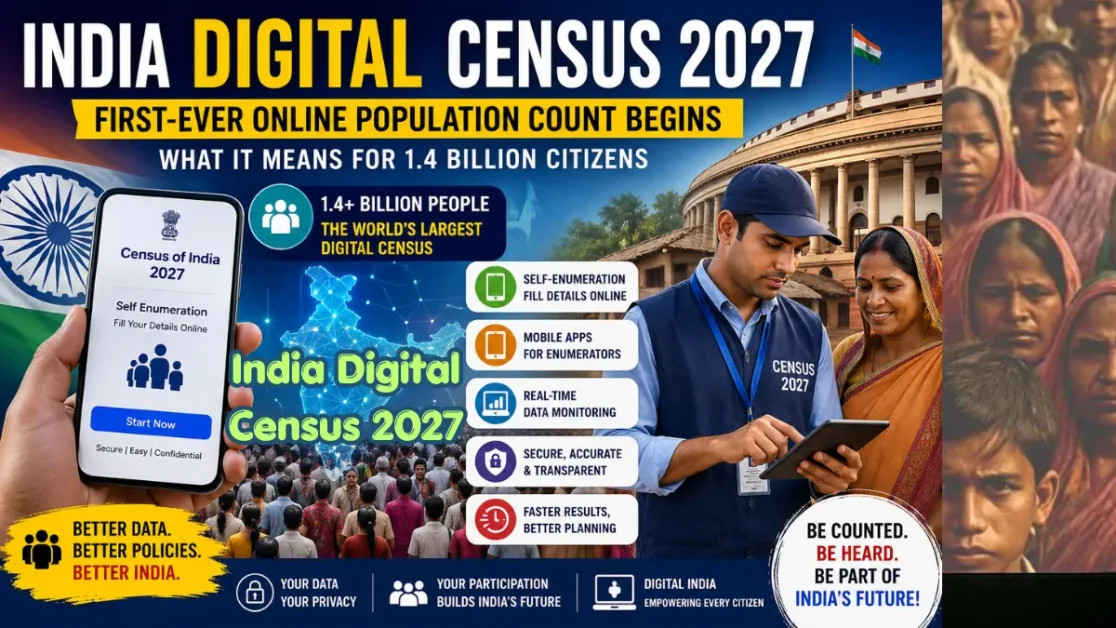
Unlike previous censuses that relied heavily on paper-based data collection, Census 2027 will be conducted using mobile apps, online portals, and real-time monitoring systems.
Enumerators will use smart devices to record data instantly, reducing errors and speeding up processing time. Even more significantly, citizens will have the option of self-enumeration, allowing them to submit their details online from the comfort of their homes.
This move aligns strongly with the government’s Digital India vision, bringing transparency, speed, and efficiency to one of the largest administrative exercises in the world.
📊 What Makes Census 2027 Different?
1. Self-Enumeration Option
For the first time, individuals can log into a government portal and fill in their own census details, reducing dependency on field visits.
2. Real-Time Data Monitoring
Authorities will track progress live through a centralized system, ensuring faster error detection and improved accuracy.
3. Two-Phase Structure
The census will be conducted in two key phases:
- House Listing Phase – Capturing housing conditions, amenities, and assets
- Population Enumeration Phase – Collecting demographic, economic, and social data
4. Faster Data Release
Digitization is expected to significantly cut down delays, meaning quicker access to critical national data for decision-makers.
🤔 Why This Census Matters More Than Ever
Census data is the backbone of national planning. It determines how resources are allocated, how policies are designed, and how development is measured.
With a digital-first approach, Census 2027 will provide sharper, faster, and more reliable insights into:
- Population growth trends
- Employment patterns
- Urbanization and migration
- Access to basic facilities
This means better-targeted welfare schemes, improved infrastructure planning, and smarter governance.
👨👩👧👦 What It Means for You
For ordinary citizens, this census could directly impact everyday life in ways you may not immediately realize:
- Faster government services due to accurate population data
- Improved access to schemes and subsidies
- Better urban planning, roads, and public facilities
- Enhanced digital participation in governance
The introduction of self-enumeration also empowers citizens, giving them a more active role in shaping national data.
⚠️ Challenges to Watch
While the move is promising, it does come with challenges:
- Digital literacy gaps in rural areas
- Concerns around data privacy and cybersecurity
- Need for robust infrastructure to handle massive data loads
Addressing these issues will be key to ensuring the success of this ambitious initiative.
🌐 The Bigger Picture
India’s Census 2027 is expected to be the largest digital population exercise ever conducted globally. If executed effectively, it could become a model for other nations exploring digital governance solutions.
More importantly, it signals a future where data-driven decisions replace outdated systems—making governance more responsive, inclusive, and efficient.
✍️ Final Thoughts
The India Digital Census 2027 is not just about counting people—it’s about understanding a nation in real time. As technology reshapes governance, this initiative stands as a powerful step toward a smarter, more connected India.
For citizens, policymakers, and the global community alike, this is a moment to watch closely.
#Census2027, #DigitalIndia, #IndiaCensus, #PopulationData, #TechInGovernance, #IndiaNews, #DigitalTransformation, #SelfEnumeration, #SmartGovernance, #BreakingNewsIndia, #DataDrivenIndia, #FutureOfIndia
Sources
India–South Korea Strategic Partnership 2026
New Labour Code 2026 Explained
Press Information Bureau (Official Updates)