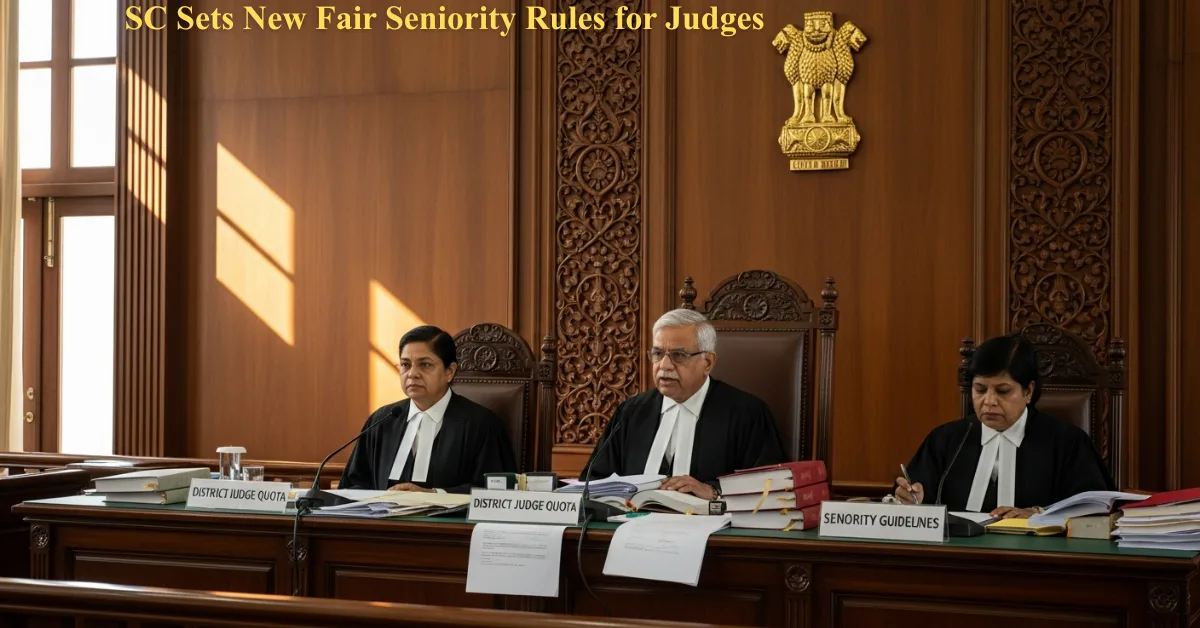
SC Sets New Fair Seniority Rules for Judges
Author: Krishna Arya | NetworkBharat.com
SC Sets New Fair Seniority Rules for Judges
: In a major development that could shape the future of India’s judicial structure, the Supreme Court of India has ruled that there will be no special quota for judicial officers in appointments to the District Judge posts. Along with this, the top court has also released new, uniform guidelines for determining seniority under the Higher Judicial Service (HJS).
This landmark ruling seeks to bring clarity, transparency, and uniformity into a system that has seen inconsistent interpretations across states.
No Quota for Judicial Officers in District Judge Posts: Supreme Court Issues New Seniority Rules—What It Means for India’s Judiciary
⭐ Why This Ruling Matters
The District Judiciary is the backbone of India’s justice delivery system. Any ambiguity in promotions, seniority, or recruitment directly impacts:
- the speed of judicial processes
- the quality of judgments
- and the morale of judicial officers across states
With this verdict, the Supreme Court has attempted to remove long-standing confusion about how seniority should be determined between promotee officers and direct recruits.
🏛️ What Exactly Did the Supreme Court Say?
1️⃣ No Quota for Judicial Officers in District Judge Posts
The Court made it clear:
There will be no special quota or reserved pathway only for judicial officers to become District Judges.
This means:
- Merit-based recruitment will continue
- No shortcut routes or exclusive reservations
- A competitive and transparent selection system
2️⃣ New Uniform Seniority Rules for HJS
The Supreme Court has issued a structured framework to determine seniority in the Higher Judicial Service:
● Seniority Must Reflect Date of Appointment
Promotee officers and direct recruits will be assigned seniority based primarily on:
- the date they join service, and
- the rotation/roster points assigned to their mode of entry
● No Arbitrary Advantage to Either Category
The Court emphasized that the goal is to maintain balance between:
- those promoted from subordinate judiciary
- those selected directly through competitive examinations
● Selection Grade & Promotion Clarity
Rules related to:
- selection grade
- super time scale
- limited departmental competitive exams
…must be applied uniformly.
🔎 Why Was the Clarification Needed?
Different states and High Courts followed different interpretations regarding:
- how seniority should be decided
- how roster points were to be allocated
- how direct recruits vs promotees should be placed
This led to:
- legal disputes
- service grievances
- court challenges
- administrative delays
The Supreme Court’s guidelines now standardize the entire system, reducing future conflicts.
📌 How This Impacts Judicial Officers
✔ More Transparency
Officers will now clearly understand how their seniority will be calculated.
✔ Reduced Litigation
Uniform rules prevent unnecessary legal battles among officers.
✔ Fair Competition
Everyone—whether promotee or direct recruit—will be evaluated fairly.
✔ Enhanced Judicial Efficiency
With reduced administrative confusion, focus will shift back to core judicial duties.
🔥 Impact on District Judiciary Across India
This ruling will significantly influence states where:
- seniority disputes were pending
- promotions were held up
- recruitment cycles were delayed
Expect:
- faster promotions
- smoother recruitment
- fewer internal conflicts
- better resource utilization
A more efficient District Judiciary ultimately means faster case disposal, directly benefiting citizens.
🧭 What Happens Next?
All High Courts will now:
- Align their service rules with the Supreme Court’s directives
- Update roster systems for seniority calculation
- Ensure no state uses special quotas for judicial officers
- Reassess pending seniority disputes based on new guidelines
🖋️ Expert Take
This ruling is not just a service-law clarification. It is a structural reform, ensuring that the judiciary’s backbone—District Courts—operate with fairness, uniformity, and accountability.
By removing ambiguity and preventing any one category from enjoying undue advantage, the Supreme Court has strengthened meritocracy in the judicial system.
This judgment also aligns with India’s vision of creating a judiciary that is:
- modern
- transparent
- free from administrative inconsistencies
India’s judicial officers now have a clearer, more predictable pathway to career growth.
🏁 Conclusion
The Supreme Court’s decision marks a major milestone in judicial administration.
With no special quota for judicial officers and new seniority rules in place, the entire system moves closer to:
- fairness
- efficiency
- and transparent career progression
This ruling will affect thousands of judicial officers and shape the future of recruitment and promotions across India.
#SupremeCourt #DistrictJudge #JudicialOfficers #HJS #SeniorityRules #NoQuota #IndianJudiciary #CourtOrders #LegalUpdate