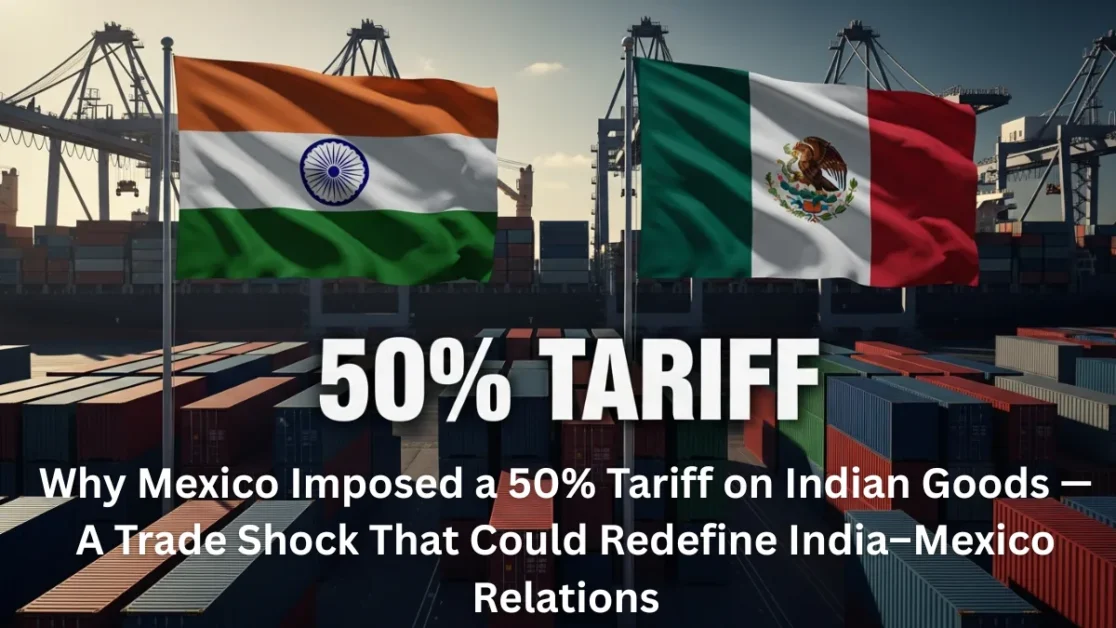
Why Mexico Imposed a 50% Tariff on Indian Goods
By Krishna Arya | Network Bharat
Website: https://networkbharat.com
Why Mexico Imposed a 50% Tariff on Indian Goods : Global trade often changes quietly — but sometimes, it sends shockwaves. Mexico’s decision to impose import tariffs of up to 50 percent on goods from India is one such moment. While not aimed at India alone, the move has stirred concern among exporters, policymakers, and trade analysts, raising tough questions about protectionism, diplomacy, and the future of India’s global trade strategy.
So, why did Mexico take this step, and what does it really mean for India? Let’s break it down clearly.
Mexico’s 50% Tariff on Indian Goods: Why It Happened, Who’s Hit & What India May Do Next
What Did Mexico Announce?
In December, Mexico’s Congress approved a major overhaul of its tariff structure, allowing the government to sharply increase duties on imports from countries without a Free Trade Agreement (FTA) with Mexico.
The Mexican Senate passed the bill on December 10, following approval by the lower house. The new tariff regime will come into force on January 1, 2026.
Since India does not have an FTA with Mexico, Indian exports now fall under this higher tariff framework.
Key Highlights
- 📌 Tariffs range from 5% to 50%
- 📌 1,463 tariff categories revised
- 📌 Over a dozen sectors impacted
- 📌 Most Indian goods may face ~35% duty
Why Did Mexico Impose Such High Tariffs?
Contrary to initial reactions, Mexico’s move is not an India-specific action. It reflects a broader shift in trade policy driven by domestic and global pressures.
1. Protecting Domestic Manufacturing
Mexico argues that rising imports have hurt local industries. Higher tariffs are meant to:
- Shield domestic producers
- Encourage local manufacturing
- Protect jobs within Mexico
2. Correcting Trade Imbalances
Mexico runs trade deficits with several non-FTA countries. The tariff hike is designed to slow import growth and rebalance trade.
3. Tightening Trade Controls
There is growing global scrutiny — especially from North America — over indirect routing of goods to bypass tariffs. Mexico’s new law aims to close these gaps.
4. No FTA = Higher Risk
Countries with FTAs — like the US, Canada, and EU members — remain protected. Nations like India, China, and Brazil, without such agreements, are directly affected.
🔍 Important Insight:
Mexico has clarified that the policy applies uniformly to all non-FTA partners, not just India.
Which Indian Sectors Will Be Hit the Hardest?
The impact on Indian exporters could be significant.
Most Affected Sectors
- 🚗 Auto parts and light vehicles
- 🧵 Textiles and garments
- 🧸 Toys
- 👟 Footwear
- 🪑 Furniture
- 🧴 Plastics
- 🧱 Aluminium and glass products
India’s automobile exports to Mexico alone are estimated at around $1 billion, making this sector particularly vulnerable to higher duties.
How Did India Respond to Mexico’s Tariff Hike?
New Delhi reacted with measured firmness.
India’s Official Position
The Indian government stated that:
- The tariff increase is not aligned with cooperative economic engagement
- Unilateral MFN tariff hikes lack transparency
- Prior consultation should have taken place
An official source emphasised that while India understands the move is not targeted, such decisions affect trust between trade partners.
Will India Take Countermeasures?
India has warned it may take “appropriate steps” to protect exporters, but it has also made clear that:
- Dialogue remains the priority
- Diplomatic engagement will continue
- Escalation is not India’s first choice
This signals strategic restraint rather than weakness.
Could This Lead to a Trade Agreement?
Ironically, the tariff shock may create an opportunity.
India and Mexico have long discussed:
- Expanding bilateral trade
- Reducing tariff barriers
- Exploring limited trade agreements
This development could accelerate talks on a structured trade framework, especially as India seeks deeper access to Latin American markets.
Why This Decision Matters Globally
Mexico’s tariff hike is part of a larger global trend:
- Rising protectionism
- Greater reliance on FTAs
- Reduced tolerance for MFN-based access
For India, it highlights the importance of:
- Diversifying export destinations
- Accelerating trade negotiations
- Strengthening competitiveness in global markets
What Happens Next?
📅 January 1, 2026 — tariffs take effect
📦 Product-wise duty details to follow
🤝 Diplomatic negotiations likely
📊 Exporters reassess pricing and supply chains
The next year will be crucial in determining whether this issue escalates or transforms into cooperation.
Conclusion: A Wake-Up Call, Not a Dead End
Mexico’s 50% tariff decision is a reminder that global trade rules are evolving fast. While Indian exporters face short-term uncertainty, the situation also underlines the need for stronger trade diplomacy and strategic foresight.
Whether this episode becomes a trade roadblock or a bridge to deeper cooperation will depend on how both nations engage in the months ahead.
#MexicoTariff #IndiaTrade #ExportNews #GlobalTrade #TradePolicy #IndianEconomy #Protectionism #BreakingNews #NetworkBharat