By Krishna Arya
Published on Network Bharat
500 Million Year Old Fossil
Imagine discovering a missing chapter from a book that tells the story of life on Earth.
That is exactly what scientists believe they have done after studying a remarkable fossil that remained hidden from the scientific spotlight for decades. The fossil, estimated to be around 500 million years old, is now helping researchers solve one of the biggest mysteries in evolutionary history—a puzzling gap in the fossil record that has confused experts for generations.
The discovery is not just another fossil find. Researchers say it could reshape our understanding of how life evolved during one of the most important periods in Earth’s history.
A Discovery That Changes the Story of Life
Earth’s history spans more than 4.5 billion years, but scientists rely on fossils to piece together the story of ancient life. While many chapters of this story are well documented, some periods remain surprisingly mysterious.
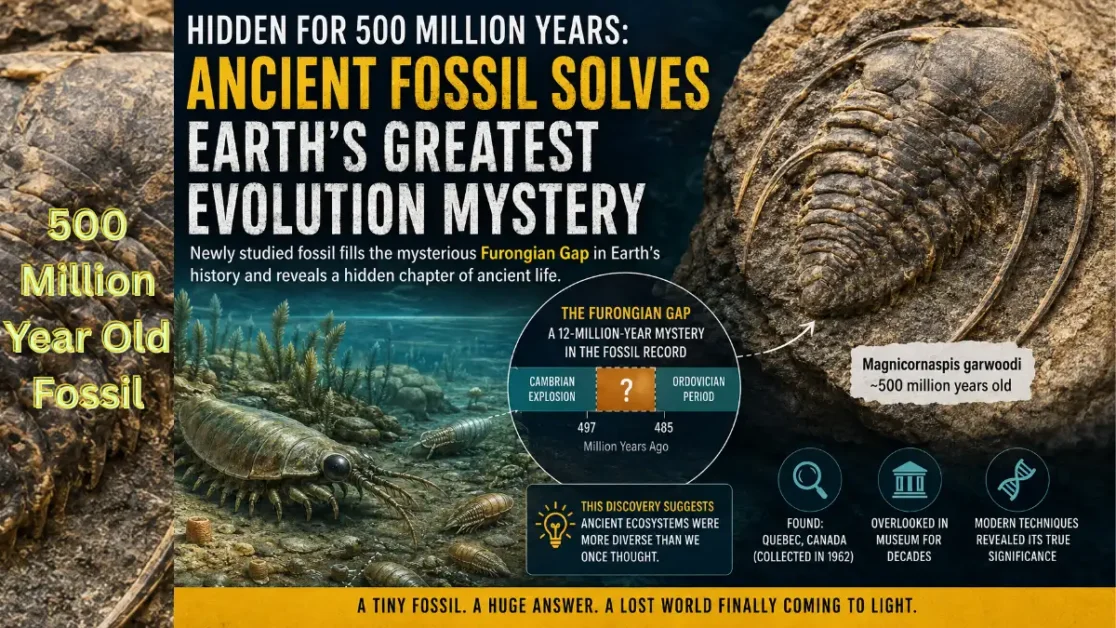
One of those mysteries is known as the Furongian Gap, a poorly understood interval during the late Cambrian Period when fossil evidence suddenly becomes scarce.
For years, scientists debated whether life experienced a major decline during this time or whether the lack of fossils was simply due to incomplete geological records.
Now, a newly analyzed fossil may finally provide the answer.
Researchers studying ancient rock formations discovered evidence that complex marine ecosystems were thriving during this period, suggesting that life was far more diverse than previously believed.
The Fossil That Waited Decades to Tell Its Story
What makes this discovery even more fascinating is that the fossil was not recently excavated.
The specimen had been collected decades ago and stored in a museum collection, where it remained largely unnoticed. Only after scientists applied modern research techniques did they realize its significance.
The fossil belongs to an ancient marine arthropod, a group of creatures that are distant relatives of modern insects, crabs, lobsters, and spiders.
Scientists named the species Magnicornaspis garwoodi, and they believe it lived in ancient oceans approximately 500 million years ago.
The discovery demonstrates how museum collections can still hold groundbreaking scientific secrets waiting to be revealed.
Understanding the Cambrian World
To appreciate the importance of this fossil, it helps to understand the world in which it lived.
Around 500 million years ago, Earth looked dramatically different from today. There were no forests, birds, mammals, or flowering plants. Life existed primarily in the oceans.
This period followed the famous Cambrian Explosion, a time when complex life forms rapidly diversified and many of the major animal groups first appeared.
Scientists have long considered the Cambrian Explosion one of the most significant events in biological history. However, what happened afterward remained less clear because of the limited fossil evidence from the Furongian period.
The newly studied fossil is helping fill that missing gap.
Solving Earth’s Missing Evolutionary Chapter
The fossil suggests that marine ecosystems continued evolving and diversifying during the Furongian period rather than experiencing a dramatic collapse.
This finding challenges some older theories and provides fresh evidence that the apparent lack of fossils may have more to do with geological preservation than a true decline in biodiversity.
In simple terms, life may not have disappeared from the record—it may simply have been hidden from scientists until now.
That distinction is important because it changes how researchers understand the evolutionary journey that eventually led to the modern world.
Why This Matters Beyond Science
At first glance, a fossil hundreds of millions of years old may seem disconnected from everyday life.
However, discoveries like this help scientists understand how ecosystems respond to environmental change over long periods of time.
By studying ancient organisms and extinction events, researchers gain valuable insights into biodiversity, climate shifts, and the resilience of life itself.
Every fossil acts as a time capsule, offering a glimpse into worlds that existed long before humans appeared.
This particular fossil provides evidence from a period that many scientists once viewed as a missing piece of Earth’s evolutionary puzzle.
Could More Hidden Discoveries Be Waiting?
Perhaps the most exciting aspect of this discovery is what it suggests for future research.
If one overlooked museum specimen can transform our understanding of an entire period in Earth’s history, countless other important discoveries may still be waiting in collections around the world.
Scientists are already hopeful that further investigations will uncover additional fossils from the Furongian period, helping to paint a clearer picture of life during this mysterious chapter.
Each new discovery brings researchers one step closer to understanding how life evolved from simple marine organisms into the incredible diversity of species that inhabit Earth today.
A Reminder That Earth’s Secrets Are Far From Exhausted
Despite centuries of scientific exploration, our planet continues to surprise us.
The discovery of a 500-million-year-old fossil that helps solve one of evolution’s greatest mysteries proves that some of the most important breakthroughs can come from unexpected places.
What was once considered a missing chapter in Earth’s story is slowly coming into focus, revealing a world filled with ancient creatures, thriving ecosystems, and evolutionary innovations that helped shape life as we know it.
For scientists and history enthusiasts alike, this fossil is more than a scientific specimen—it is a remarkable window into a forgotten world that existed half a billion years ago.
And as researchers continue their search, there is every reason to believe that even bigger discoveries may still lie hidden beneath the rocks of our ancient planet.
#FossilDiscovery #AncientLife #Evolution #Paleontology #ScienceNews #EarthHistory #CambrianPeriod #FossilRecord #AncientEarth #PrehistoricLife #Research #Discovery #Geology #Nature #HistoryOfLife