By Krishna Arya
For Network Bharat
Supreme Court UAPA Bail Verdict 2026
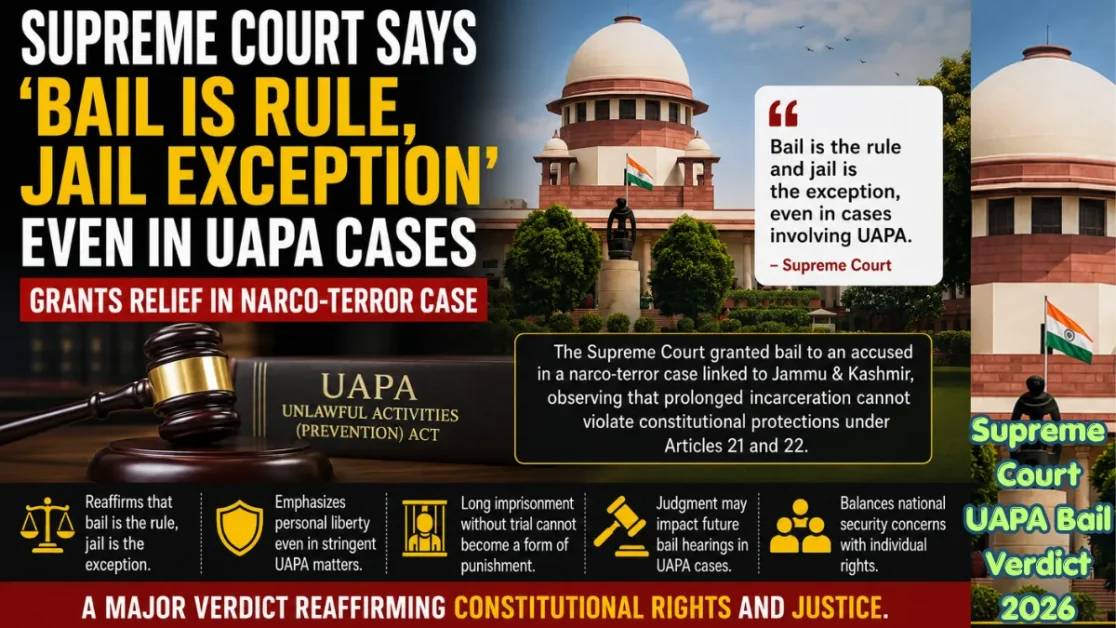
India’s Supreme Court has once again underlined one of the most important principles of democracy and criminal justice — “bail is the rule and jail is the exception.” In a significant development, the apex court granted bail to an accused in a narco-terror case registered under the stringent Unlawful Activities (Prevention) Act (UAPA), sending a strong message about personal liberty and constitutional rights.
The ruling has triggered a nationwide legal and political discussion because UAPA cases are generally considered extremely strict, with bail being difficult to secure. Legal experts believe the judgment could influence future terror-related cases where accused individuals spend years in prison before trial completion.
Supreme Court Highlights Importance of Personal Liberty
While hearing the matter, the Supreme Court reportedly observed that constitutional protections under Article 21 cannot be ignored, even in serious cases involving national security allegations. The bench emphasized that prolonged incarceration without the conclusion of trial cannot become a form of punishment.
The court reiterated that every accused person has fundamental rights, and courts must strike a balance between national security concerns and individual liberty. The observation is being seen as a reminder that the criminal justice system must remain fair, balanced, and constitutionally driven.
Why This Verdict Is Important
The UAPA is India’s primary anti-terror law and contains strict provisions regarding arrest and bail. In many cases, accused persons remain behind bars for several years while trials continue. Because of this, debates around misuse, delayed trials, and prolonged detention often dominate public discussions.
The latest Supreme Court ruling is important for several reasons:
- It reinforces the principle that liberty is a constitutional right.
- It stresses that lengthy imprisonment before conviction should not become routine.
- It highlights the judiciary’s role in protecting democratic values.
- It may impact future bail hearings in sensitive UAPA cases.
Legal analysts say the verdict could become a major reference point in upcoming cases involving terror allegations, organized crime, and national security investigations.
Narco-Terror Cases and Growing Concerns
Narco-terror cases involve allegations linked to drug trafficking networks being used to fund terror activities. Over the past few years, security agencies have intensified operations in Jammu & Kashmir and other sensitive regions to break such financial channels.
Investigating agencies argue that these networks pose a serious threat to national security. However, civil rights groups and legal experts have repeatedly raised concerns over delays in investigation and trial procedures under special laws.
The Supreme Court’s latest remarks appear to acknowledge the seriousness of both sides — protecting the nation while also ensuring that constitutional freedoms are not weakened.
Legal Experts React to the Verdict
Several legal experts welcomed the Supreme Court’s observations, calling them a reaffirmation of India’s constitutional framework. Senior advocates noted that courts have consistently maintained that punishment can only follow conviction, not merely accusation.
Some analysts also pointed out that the judgment may encourage faster trial processes in cases where accused individuals remain imprisoned for extended periods without a final verdict.
At the same time, security experts believe courts will continue to examine UAPA matters carefully because of their connection to terrorism and organized criminal activities.
A Larger Debate Around UAPA
The judgment has once again brought UAPA into the national spotlight. In recent years, opposition leaders, activists, journalists, and legal scholars have frequently debated the implementation of the law.
Supporters argue that strong anti-terror laws are essential to protect the country from internal and external threats. Critics, however, believe there should be stronger safeguards against prolonged detention and delays in trial completion.
The Supreme Court’s fresh observation may now add momentum to broader discussions around judicial reforms, speedy trials, and protection of civil liberties.
#SupremeCourt #UAPA #BreakingNews #IndianJudiciary #LegalNews #BailVerdict #NarcoTerrorCase #IndiaNews #Constitution #Article21 #NIA #CourtNews #JammuKashmir #JusticeSystem #TrendingNews #GoogleDiscover #LawNews #SupremeCourtIndia #IndiaPolitics #LatestNews
Conclusion
The Supreme Court’s statement that “bail is the rule and jail is the exception” even in UAPA cases is being viewed as a landmark reaffirmation of constitutional values. By granting relief in the narco-terror case, the apex court has once again highlighted the importance of balancing national security with personal liberty.
As debates over UAPA continue across the country, this ruling is likely to remain a major talking point in legal and political circles for weeks to come.
External Sources
Supreme Court Reiterates ‘Bail Is Rule, Jail Exception’ Even in UAPA CasesSupreme Court Highlights Personal Liberty in UAPA Bail Judgment
SC Says Long Incarceration Cannot Override Constitutional Rights in UAPA Cases
Supreme Court Grants Bail in Jammu & Kashmir Narco-Terror Case
‘Bail Is Rule, Jail Exception’: Supreme Court’s Key Observation on UAPA
Understanding UAPA and the Constitutional Right to Personal Liberty
Explained: How the Supreme Court Approaches Bail in UAPA Cases
What Is the Unlawful Activities (Prevention) Act (UAPA)?